Sample 10018
10018 Regolith Breccia 213 grams
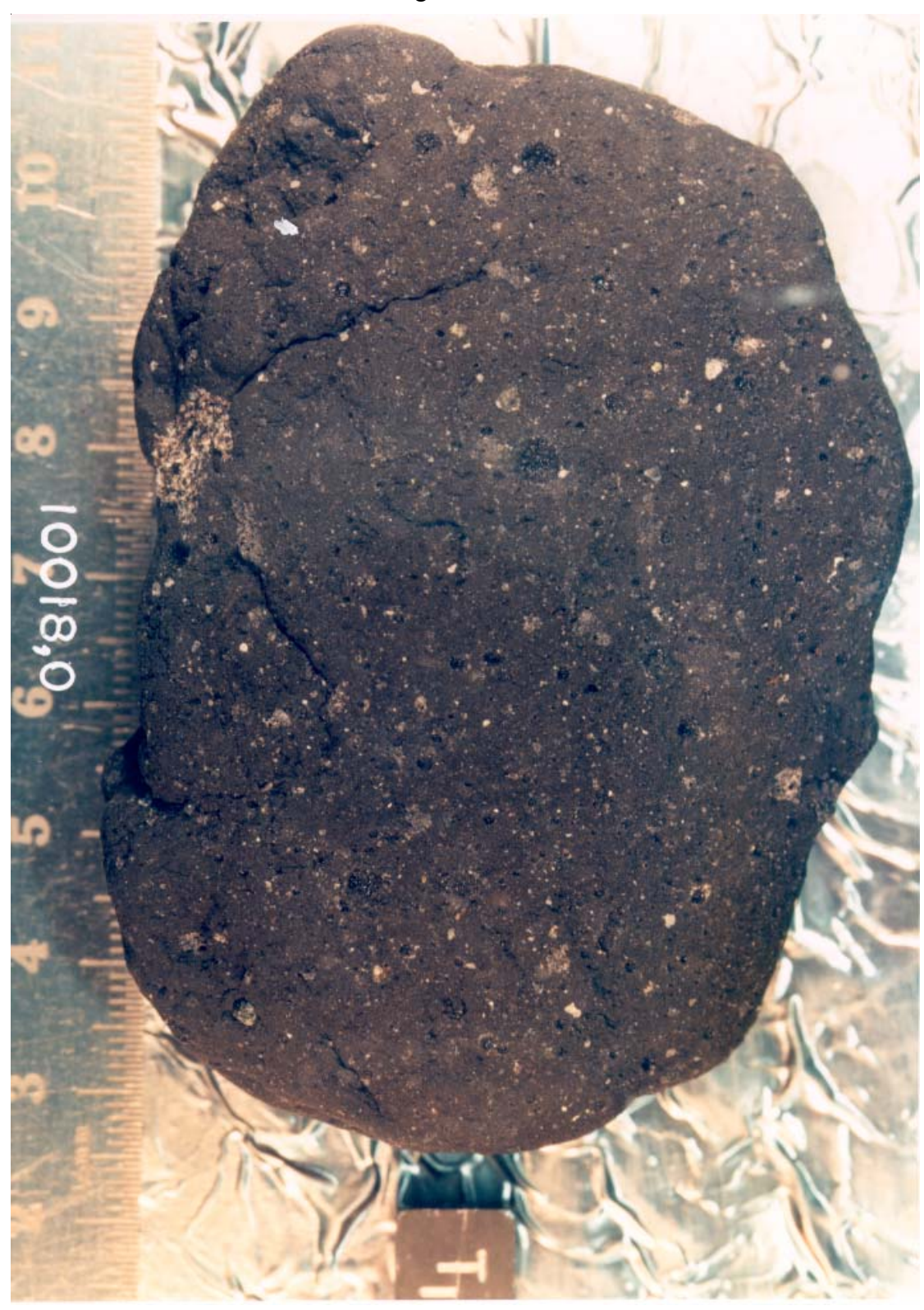
Figure 1: Photo of top surface of 10018. NASA S75-30226. Sample is 8 cm long. Cube is 1 cm.
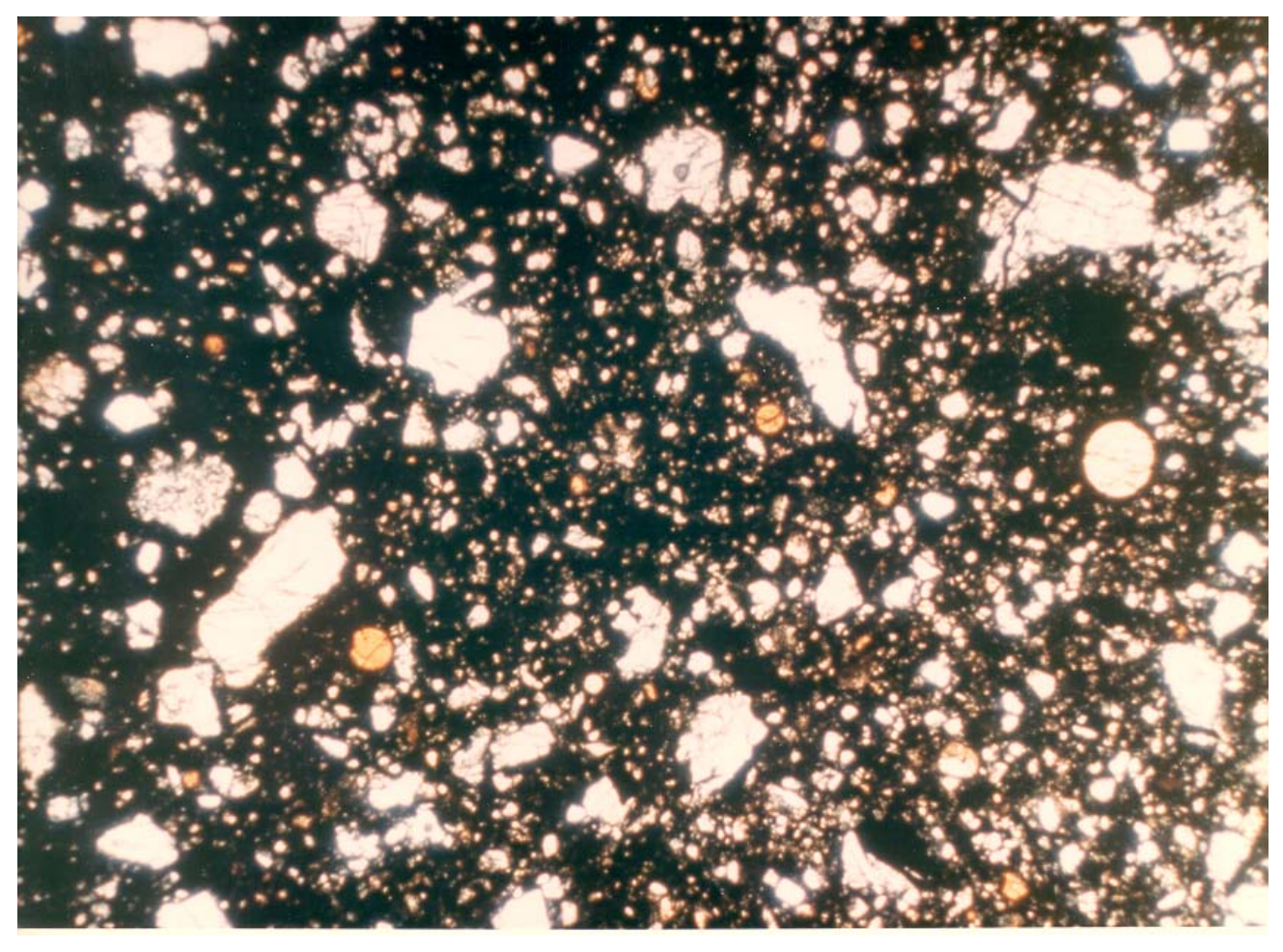
Figure 2: Photomicrograph of thin section of 10018. NASA #S70-49975 showing orange glass beads. Scale is 2.5 mm.
Introduction
Section titled “Introduction”10018 is a coherent, glass-matrix regolith breccia (figure 1). Fruland (1983) included 10018 in the Regolith Breccia Workbook, but Phinney et al. (1976) and Simon et al. (1984) did not include it in their otherwise comprehensive studies.
10018 has been reported to have high carbon content! This observation needs to be verified and explained.
Petrography
Section titled “Petrography”Chao et al. (1971) and Reid et al. (1970) compared breccia sample 10018 with soil 10084, finding them similar. It has a glass matrix, a seriate grain size distribution (figure 2) and numerous glass particles were recognized. Dence et al. (1970) and Reid et al. found a wide range of glass compositions. Chao et al. reported 13.5 % glass-welded aggregate (agglutinate), as well as a high percentage of mare basalt fragments.
Chemistry
Section titled “Chemistry”10018 appears to be Fe-rich compared with Apollo 11 soil (figure 3). Several labs reported high Ni (~200 300 ppm)(table 1). Wanke et al. (1972) reported 101 ppm fluorine.
Mineralogical Mode
Section titled “Mineralogical Mode”| Chao et al. 1971 | |
|---|---|
| Basaltic rock | 20.8 |
| Anorthositic rock | 0.8 |
| Mineral fragments | 5.6 |
| Glass-welded aggregate | 13.5 |
| Devitrified glass | 3 |
| Heterogeneous glass | 2.8 |
| Homogeneous glass | 1.9 |
| Basaltic microbreccia | tr |
| Anorthositec breccia | tr. |
| Shocked | 0.3 |
| Less than 25 microns | 30.9 |
| Pore space | 20.4 |
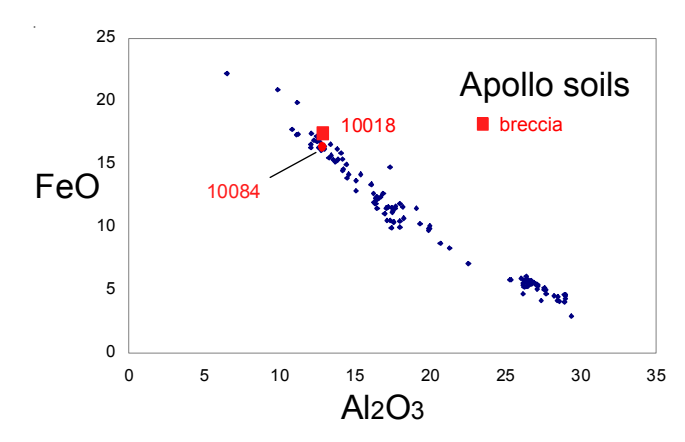
Figure 3: Composition of 10018 compared with Apollo soil samples.
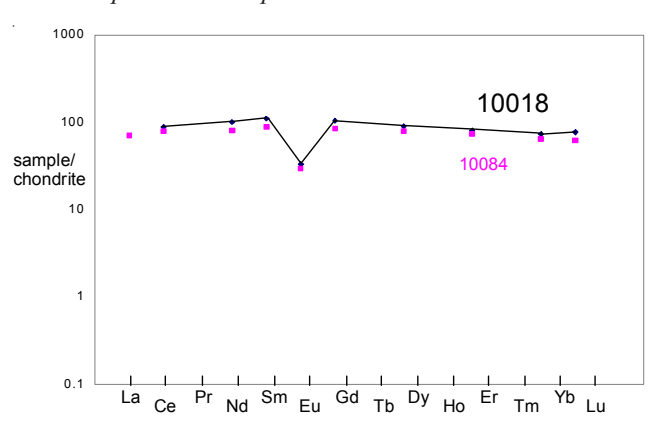
Figure 4: Normalized rare earth element diagram for breccia 10018 compared with soil 10084 (data from Philpotts et al. 1970).
Becker and Epstein (1981) reported a very large amount of carbon (up to 385 ppm) with low 13C in 10018. Thiemens and Clayton (1980) determined 105 ppm nitrogen (with a very negative delta 15N).
Schonfeld and Meyer (1972) calculated that 10018 was a mix of mare basalt with ~17 % gabboic anorthosite and ~3 % KREEP, while Rhodes and Blanchard (1981) found it was a mix of soil and high-K basalt. However, Simon et al. (1984) could not identify such a high percentage of highland component.
Cosmogenic isotopes and exposure ages
Section titled “Cosmogenic isotopes and exposure ages”The cosmic ray induced activity was reported by LSPET (1969) as 26Al = 100 dpm/kg., 22Na = 55 dpm/ kg., 46Sc = 13 dpm/kg., 54Mn = 28 dpm/kg. and 56Co = 33 dpm/kg.
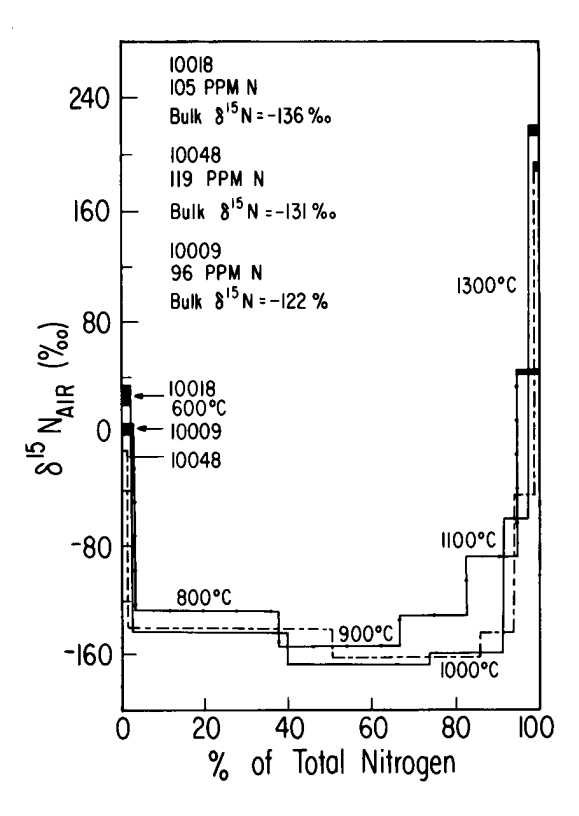
Figure 5: Isotopic composition of nitrogen as function of gas release (Thiemens and Clayton 1980).
Other Studies
Section titled “Other Studies”Funkhouser et al. (1970, 1971) and Bogard et al. (1971) reported the abundance and isotopic composition of rare gases from 10018 (figure 6).
Thiemens and Clayton found that the isotopic composition of nitrogen was extremely low (figure 5), perhaps giving the isotopic composition of the solar wind in the ancient past. They also speculated that the exposure age was long.
Processing
Section titled “Processing”10018 was one of the rocks in the F-201 at the time of the accidental glove rupture (exposure to Houston air). Apollo 11 samples were originally described and cataloged in 1969 and “re-cataloged” by Kramer et al. (1977). There are 9 thin sections.
List of Photo #s for 10018
Section titled “List of Photo #s for 10018”S75-30222 – 30228 S76-21352 – 21353
S75-30537 sawn surface S75-30943 TS
Table 1. Chemical composition of 10018.
| reference Compston70 | Wanke70 | Philpotts70 Goles70 | Annell70 | LSPET69 | O’Kelley 70 | ||||||||
|---|---|---|---|---|---|---|---|---|---|---|---|---|---|
| weight SiO2 % TiO2 Al2O3 FeO MnO MgO CaO Na2O K2O P2O5 S % sum | 41.81 7.99 12.34 16.46 0.22 7.79 12 0.46 0.17 0.15 0.15 | (a) (a) | (a) 41.9 (a) 9.2 (a) 11.5 (a) 17.7 (a) 0.13 (a) 8.3 (a) 11.6 (a) 0.53 (a) 0.16 | (b) (b) (b) (b) (b) (b) (b) (b) | 145 mg (b) 0.18 | (c ) | 43 8.2 13 16.8 0.205 8.4 12.3 0.5 | (b) | (b) 0.21 | (d) | 0.18 | 211 g (e) 0.17 | (e) |
| Sc ppm V Cr Co Ni Cu Zn Ga Ge ppb As | 51 1950 35 200 32 54 4 | 69 1900 33.8 370 | (b) (b) (b) (b) | 60.3 67 1880 32.7 | (b) 66 (b) 60 (b) 2340 (b) 32 197 12 23 4.4 | (d) (d) (d) (d) (d) (d) (d) (d) | |||||||
| Se Rb Sr Y Zr Nb Mo Ru Rh Pd ppb Ag ppb Cd ppb | 3.6 158.5 106 328 19 | 195 | 3.79 164 | (c ) (c ) | 340 | 3.6 110 97 (b) 429 25 | (d) (d) (d) (d) (d) | ||||||
| In ppb Sn ppb Sb ppb Te ppb | 360 | ||||||||||||
| Cs ppm Ba La Ce Pr Nd Sm Eu Gd Tb Dy Ho Er Tm Yb Lu Hf Ta W ppb Re ppb | 175 24 67 11 29 | 18 72 | 200 52.8 | (c ) 280 16.9 (c ) 61 | (b) | (b) 220 (b) 15 | (d) (d) | ||||||
| 60 13.5 1.68 4.1 | (b) 45.4 (b) 16.3 (b) 1.84 20.5 21.8 | (c ) (c ) (c ) | (c ) 14.6 (c ) 1.82 3.6 5.3 | (b) (b) (b) (b) | |||||||||
| 11.1 1.56 13.4 1.7 | (b) (b) | 12.8 (b) 11.8 (b) 1.87 | (c ) | (c ) 15.2 (c ) 2.14 12.9 1.4 | (b) (b) (b) (b) | ||||||||
| Os ppb Ir ppb Pt ppb Au ppb Th ppm U ppm | 2.4 technique: (a) XRF, (b) INAA and mixed, (c ) IDMS, (d) emission spec., (e) rad. Counting | 5 3.72 0.61 | (b) (b) (b) | 0.6 | (b) | 2.3 0.6 | (e) 2.3 (e) 0.6 | (e) (e) |
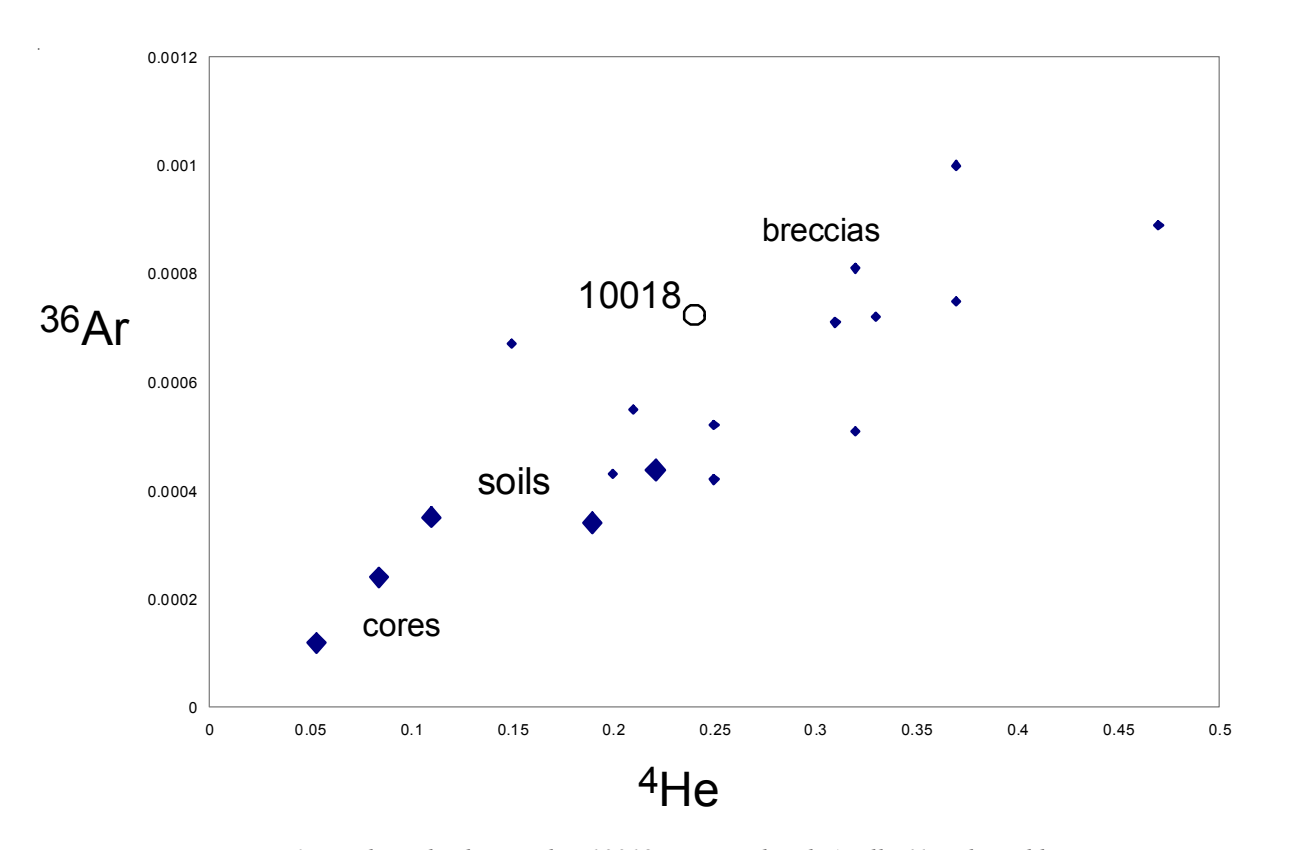
Figure 6: Implanted solar wind in 10018 compared with Apollo 11 soils and breccias (Funkhouser et al. 1070 and Hintenberger et al. 1976). Units STP cc/g.
References for 10018
Section titled “References for 10018”Annell C.S. and Helz A.W. (1970) Emission spectrographic determination of trace elements in lunar samples from Apollo 11. Proc. Apollo 11 Lunar Sci. Conf. 991-994.
Becker R.H. and Epstein S. (1981) Carbon isotopic ratios in some low-dl5N lunar breccias. Proc. 12th Lunar Planet. Sci. Conf. 289-293.
Chao E.C.T., James O.B., Minkin J.A., Boreman J.A., Jackson E.D. and Raleigh C.B. (1970) Petrology of unshocked crystalline rocks and evidence of impact metamorphism in Apollo 11 returned lunar samples. Proc. Apollo 11 Lunar Sci. Conf. 287-314.
Chao E.C.T., Boreman J.A., Minkin J.A. and James O.B. (1970) Lunar glasses of impact origin: Physical and chemical characteristics and geologic implications. J. Geophy. Res. 75, 7445-7479.
Chao E.C.T., Boreman J.A. and Desborough G.A. (1971) The petrology of unshocked and shocked Apollo 11 and Apollo 12 microbreccias. Proc. Second Lunar Sci. Conf. 791-816.
Compston W., Chappell B.W., Arriens P.A. and Vernon M.J. (1970b) The chemistry and age of Apollo 11 lunar material. Proc. Apollo 11 Lunar Sci. Conf. 1007-1027.
Dence M.R., Douglas J.A.V., Plant A.G. and Traill R.J. (1970) Petology, mineralogy and deformation of Apollo 11 samples. Proc. Apollo 11 Lunar Science Conf. 315-340.
Ehmann W.D. and Morgan J.W. (1970) Oxygen, silicon and aluminium in Apollo 11 rocks and fines by 14 MeV Neutron Activation. Proc. Apollo 11 Lunar Science Conf. 1071-1079.
Fruland Ruth M. (1983) Regolith Breccia Workbook. Curatorial Branch Publication # 66. JSC 19045.
Funkhauser J.G., Schaeffer O.A., Bogard D.D. and Zahringer J. (1970) Gas analysis of the lunar surface. Proc. Apollo 11 Lunar Sci. Conf. 1111-1116.
Funkhauser J.G., Jessberger E., Muller O. and Zahringer J. (1971) Active and inert gasses in Apollo 12 and 11 samples released by crushing at room temperature and heating at low temperature. Proc. 2nd Lunar Sci. Conf. 1381-1396.
Ganapathy R., Keays R.R., Laul J.C. and Anders E. (1970) Trace elements in Apollo 11 lunar rocks: Implications for meteorite influx and origin of moon. Proc. Apollo 11 Lunar Sci. Conf. 1117-1142.
Goles G., Randle K., Osawa M., Schmitt R.A., Wakita H., Ehmann W.D. and Morgan J.W. (1970) Elemental abundances by instrumental activation analyses in chips from 27 lunar rocks. Proc. Apollo 11 Lunar Sci. Conf. 1165-1176.
Lofgren G.E. (1971b) Devitrified glass fragments from Apollo 11 and Apollo 12 lunar samples. Proc. 2nd Lunar Sci. Conf. 949-955
LSPET (1969) Preliminary examination of lunar samples from Apollo 11. Science 165, 1211-1227.
O’Kelley G.D., Eldridge J.S., Schonfeld E. and Bell P.R (1970) Primordial radionuclide abundances, solar proton and cosmic ray effects and ages of Apollo 11 lunar samples by non-destructive gamma-ray spectrometry. Proc. Apollo 11 Lunar Sci. Conf. 1407-1424.
Philpotts J.A. and Schnetzler C.C. (1970b) Apollo 11 lunar samples: K, Rb, Sr, Ba and rare-earth concentrations in some rocks and separated phases. Proc. Apollo 11 Lunar Science Conf. 1471-1486.
Phinney W.C., McKay D.S., Simonds C.H. and Warner J.L. (1976a) Lithification of vitric- and clastic-matrix breccias: SEM photography. Proc. 7th Lunar Sci. Conf. 2469-2492.
Reid A.M., Frazer J.Z., Fujita H. and Everson J.E. (1970a) Apollo 11 samples: Major mineral chemistry. Proc. Apollo 11 Lunar Sci. Conf. 749-761.
Reid A.M., Frazer J.Z., Fujita H. and Everson J.E. (1970b) Chemical composition of the major phases in Apollo 11 lunar samples. SIO ref. 70-4 Univ. Calif. San Diego
Schmitt H.H., Lofgren G., Swann G.A. and Simmons G. (1970) The Apollo 11 samples: Introduction. Proc. Apollo 11 Lunar Science Conf. 1-54.
Sclar C.B. (1970) Shock metamorphism of lunar rocks and fines from tranquillity base. Proc. Apollo 11 Lunar Sci. Conf. 849-864.
Sclar C.B. (1971) Shock induced features of Apollo 12 microbreccias. Proc. Second Lunar Sci. Conf. 817-832.
Simon S.B., Papike J.J., Shearer C.K. and Laul J.C. (1983) Petrology of the Apollo 11 highland component. Proc. 14th Lunar Planet. Sci. Conf. in J. Geophys. Res. 88, B103-138.
Simon S.B., Papike J.J. and Shearer C.K. (1984) Petrology of Apollo 11 regolith breccias. Proc. 15th Lunar Planet. Sci. Conf. in J. Geophys. Res. 89, C109-132.
Thiemens M.H. and Clayton R.N. (1980) Ancient solar wind in lunar microbreccias. Earth Planet. Sci. Lett. 47, 34-42.
Wänke H., Rieder R., Baddenhausen H., Spettler B., Teschke F., Quijano-Rico M. and Balacescu A. (1970) Major and trace elements in lunar material. Proc. Apollo 11 Lunar Sci. Conf. 1719-1727.