Sample 12073
Regolith Breccia 407.7 grams
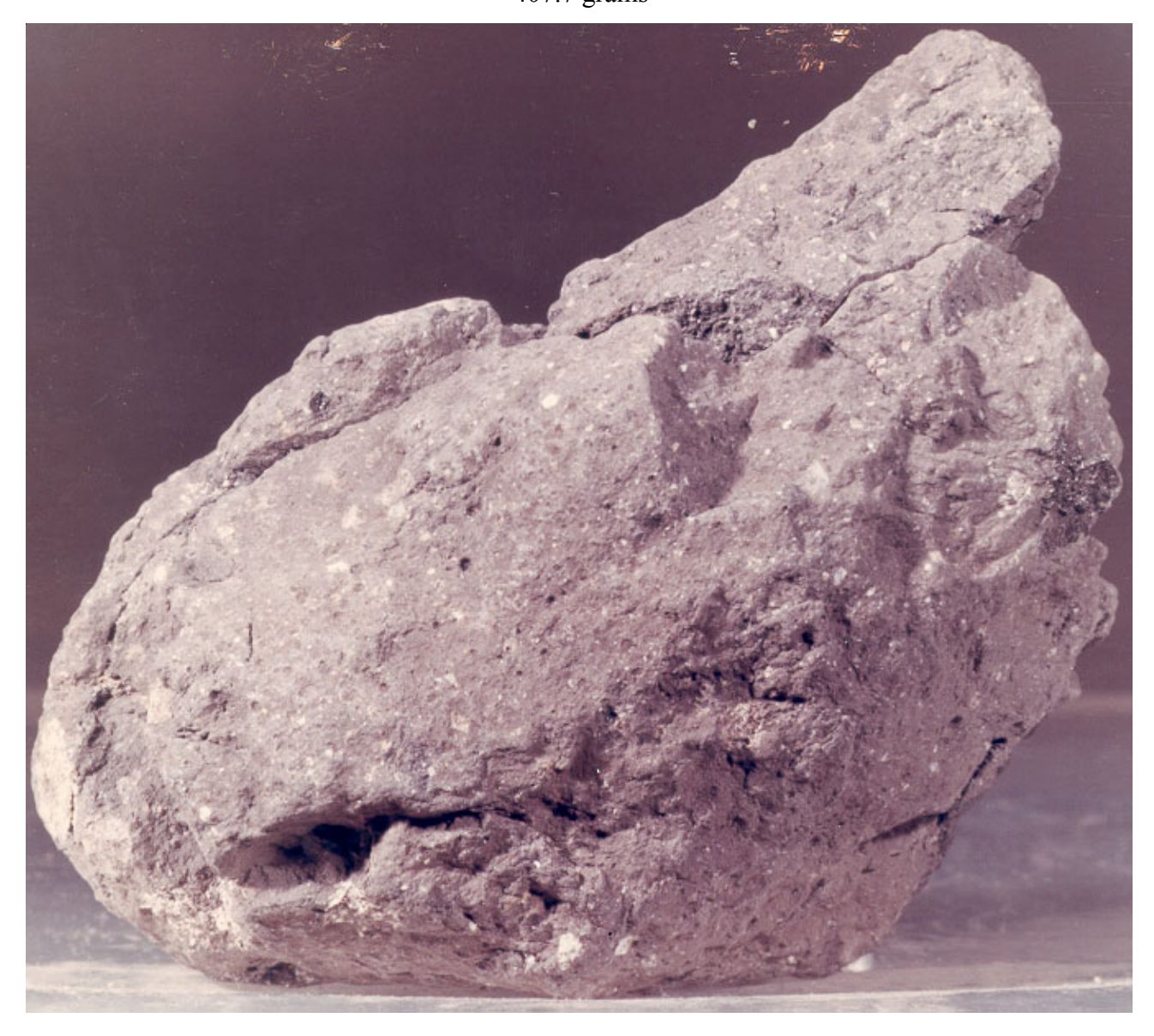
Figure 1: Photo of 12073,17. Scale unknown. NASA S70-44335
12073 was collected from the rim of a 6 meter crater a high content of solar wind rare gasses. near the LM, along with the contingency samples. It was possible to orient the sample based on photography Petrography taken from the LM and in the LRL (Schoemaker et al. Fruland (1983) and Simon et al. (1985) included 12073
Introduction fragments with various shapes and colors. It contains
1970). in their study of regolith breccias. It is coherent with porous matrix and has a chaotic fragmental texture and 12073 is a typical regolith breccia, with seriate seriate grain size distribution. The overall color is fragmental texture, high porosity and abundant glass brown and includes agglutinate glass. There is a wide
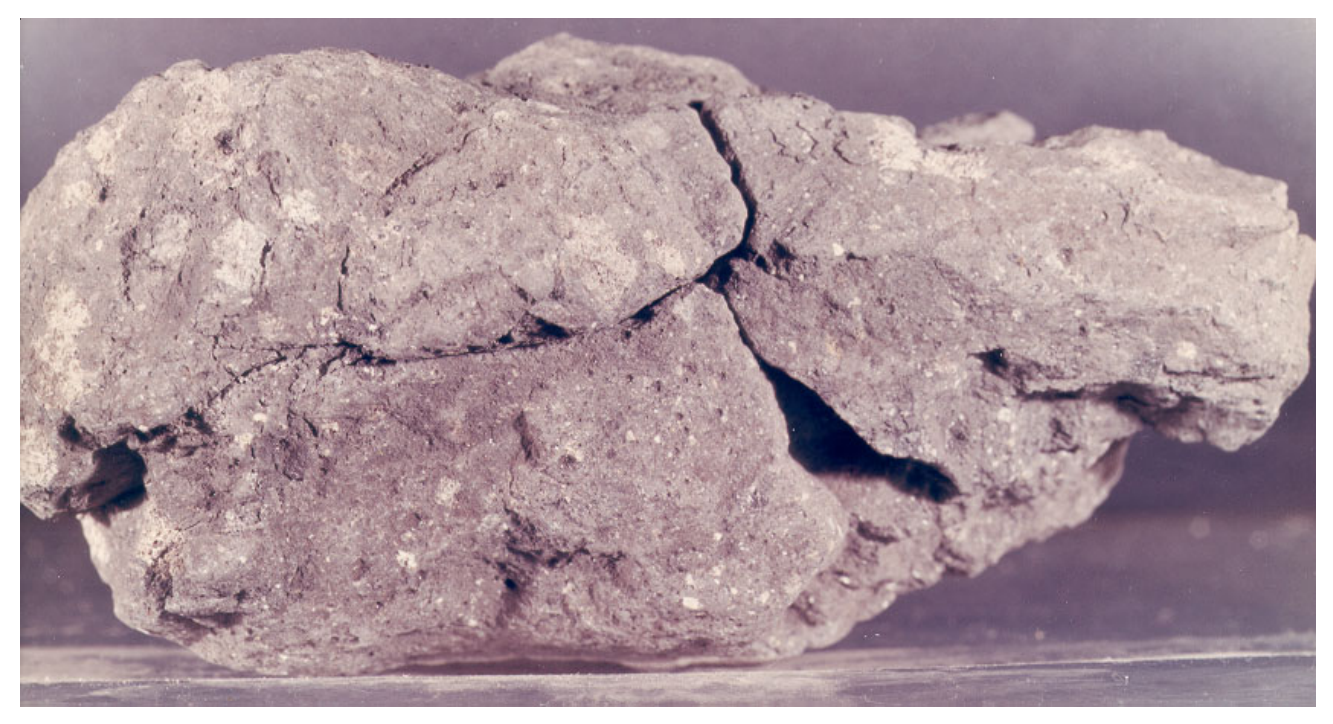
Figure 2: Photo of 12073,17 - about 4 inches long. NASA S70-44334.
| Mode for 12073 | Modal Petrology for 12073 | ||||||||
|---|---|---|---|---|---|---|---|---|---|
| Chao et al. 1971 | Simon et al. 1985 | ||||||||
| Basaltic rock | 6.4 | Mare Basalt | 2.4 | ||||||
| Anorthositic rock | 1 | ANT | |||||||
| Mineral fragments | 11.9 | CMB | |||||||
| Glass-welded aggregate | 16.4 | Poik. Bas. | 2.4 | ||||||
| Devitrified glass | 4.4 | Regolith bx. | 2.8 | ||||||
| Heterogeneous glass | 2.5 | Agglutinate | 0.1 | ||||||
| Homogeneous glass | 1.9 | Pyroxene | 4.3 | ||||||
| Basaltic microbreccia | 1.6 | Olivine | 1 | ||||||
| Anorthositic microbx. | 2.7 | Plag. | 1.2 | ||||||
| Shocked | 0.2 | Opaques | 0.1 | ||||||
| Less than 25 microns | 29.6 | Glass | 7.3 | ||||||
| Pore space | 21.3 | Matrix | 50.8 |
variety of glass, including spheres, ropy glass and shards. Much of the glass is brown, but also colorless, pale yellow and orange. Black glass has microcrystalline quench texture. Some ropy glass is clast-laden and displays flow texture. Chao et al. (1971) reported 21 % pore space. Waters et al. (1971) studied the fine detail of the matrix, reporting that there is an “abundance of minute particles of glass that are molded plastically against the clastic fragments of the rock, and also against each other until they fill almost every available space”. McKay et al. (1971) reported “accretionary lapilli similar to those found in Apollo 11 soil breccias”.
Dence et al. (1971) and Chao et al. (1971) describe and give analysis of various glass fragments found as inclusions in 12073. They note the high K and P in some of this glass. Anderson and Smith (1971) reported “grey mottled” basalts (impact breccias).
12073 had a high density of micrometeorite craters on the surface (Horz et al. 1971, Morrison et al. 1972)(figure 7).
Significant Clasts
Section titled “Significant Clasts”Alkali Anorthosite (,120)
Section titled “Alkali Anorthosite (,120)”Warren and Wasson (1980) and Warren et al. (1981) described and analyzed a white clast from 12073 (is it the same one illustrated in Fields et al. 1971?). It has an excessive amount of Eu (figure 5). Warren (1993) list it as possibly pristine (low siderophiles), and gives
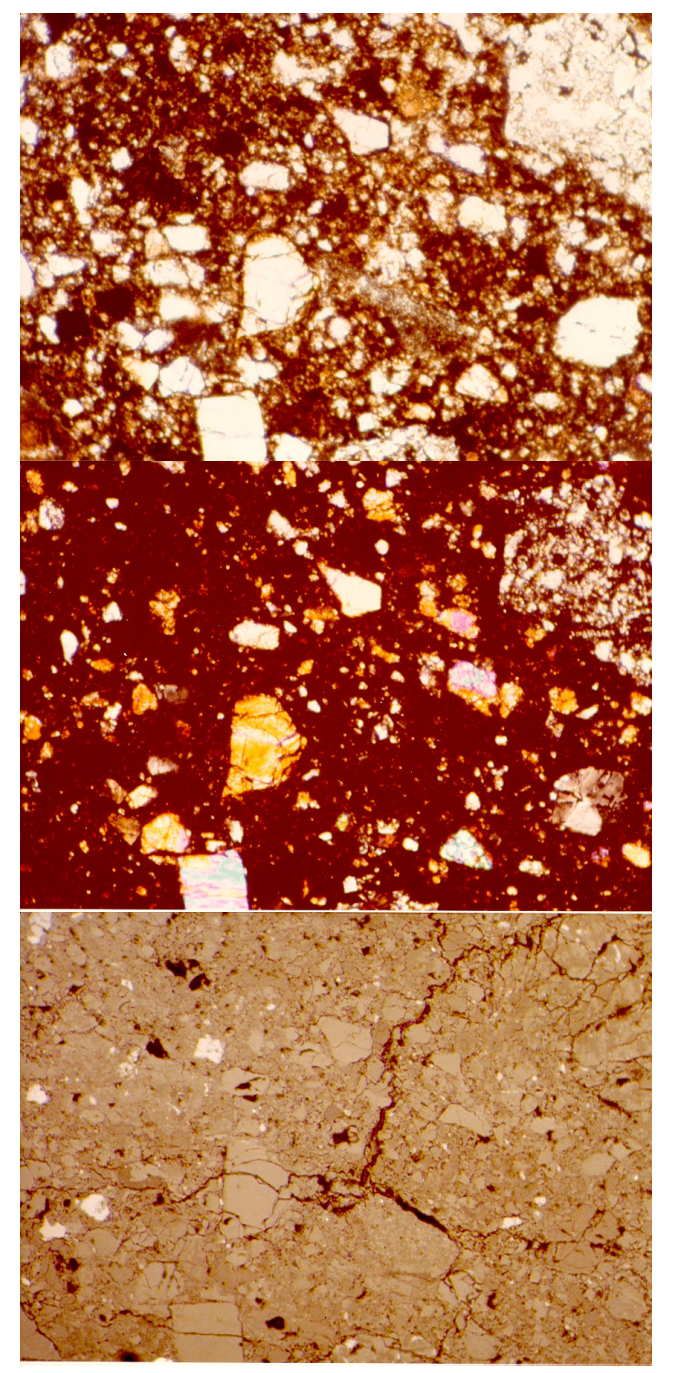
Figure 3: Photomicrographs of thin section 12073,5 - all of same area, all 1.3 mm across. a) transmitted light, NASA S79-27392, b) cross-polarized light, NASA S79-27393, c) reflected light, NASA S79- 27391.
the mineral analysis (99% feldspar, An78.6; pigeonite En41).
Basalt
Section titled “Basalt”Wiesmann and Hubbard (1975) analyzed a basalt clast (table, figure 5).
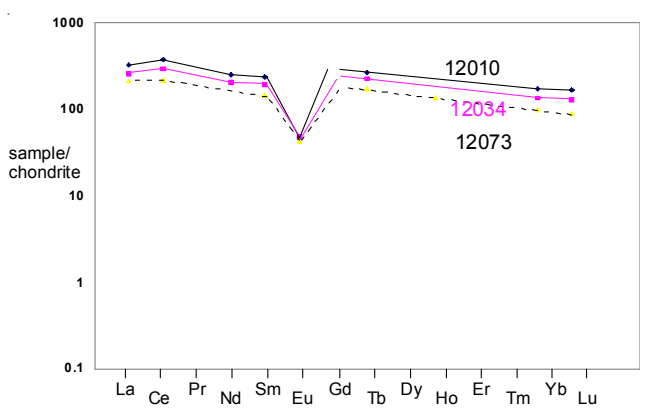
Figure 4: Comparison of REE for three regolith breccias from Apollo 12 (data from Goles et al. 1971 and Wanke et al. 1971).
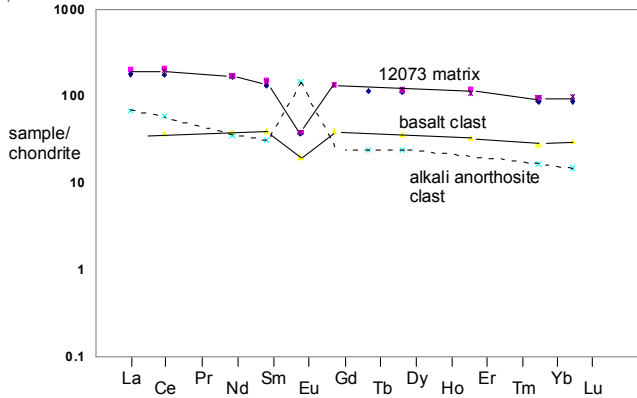
Figure 5: Normalized rare-earth-element diagram for matrix and two clasts in breccia sample 12073 (data for matrix from Hubbard et al. 1971, Schnetzler et al. 1971, Simons et al. 1985; data for basat clast from Wiesmann and Hubbard 1975; data for anorthosite from Warren et al. 1981).
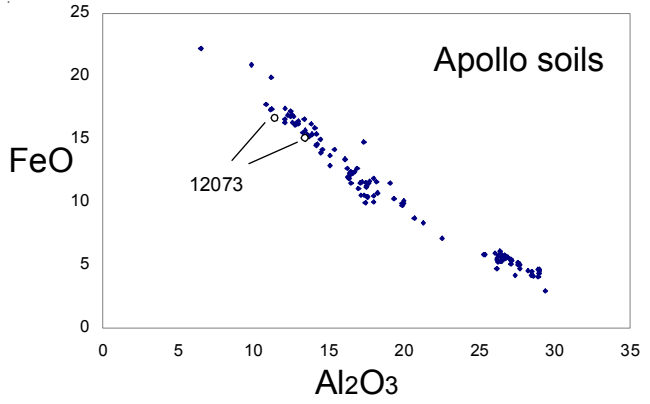
Figure 6: Composition of two portions of regolith breccia 12073 (see table).
Chemistry
Section titled “Chemistry”12073 has the chemical composition of an Apollo 12 soil (figure 4) and has been analyzed by numerous investigators (table 1). Wanke et al. (1971), Morrison et al. (1971), Schnetzler and Philpotts (1971) and Simon et al. (1985) all have analyses consistent with the K, U, Th of the whole rock (O’Kelley et al. 1971).
Using a least-squares chemical mixing model, Meyer et al. (1971) calculated that 12073 was made up of about 45 % local basalt, 6 % anorthosite, 43 % KREEP and 1% meteorite. Simon et al. (1985) calculate that 12073 is approximately 44 % basalt, 6 % anorthosite and 47 % KREEP. McKay et al. (1971) calculated 41 % KREEP. This is a higher KREEP content than most Apollo 12 soils.
Cosmogenic isotopes and exposure ages
Section titled “Cosmogenic isotopes and exposure ages”O’Kelly et al. (1971) determined the cosmic ray induced activity of 12073 as 22Na = 63 dpm/kg, 26Al = 110 dpm/kg, 46Sc = <10 dpm/kg, 54Mn = 28 dpm/kg and 56Co = 47 dpm/kg.
Other Studies
Section titled “Other Studies”Kirsten et al. (1971) and Heymann et al. (1971) reported rare gas contents and isotopic ratios and found high contents of (solar wind gases).
Processing
Section titled “Processing”12073 has several penetrating fractures and broke before it was received in Houston.
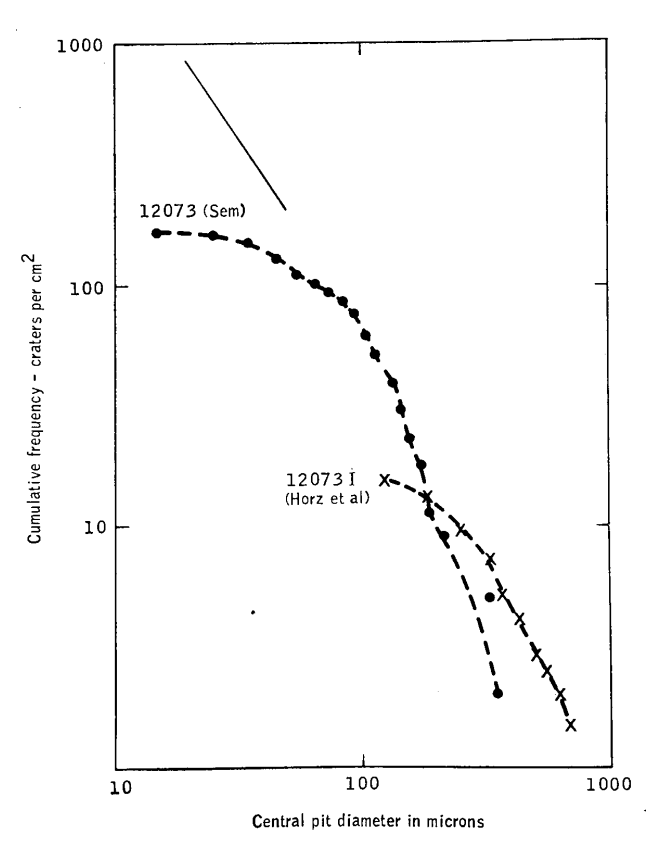
Figure 7: Micrometeorite count for surface of 12073 (Morrison et al. 1972).
Table 1. Chemical composition of 12073.
| weight SiO2 % TiO2 Al2O3 FeO MnO MgO CaO Na2O K2O P2O5 S % sum | reference Simon85 2.3 12.2 15.4 0.2 10.3 10.6 0.52 0.31 | 405 g 0.36 | O’Kelly71 Morrison71 Wiesmann75 2.17 13.2 14.4 0.23 7.63 10.6 0.65 (a) 0.38 | Hubbard71 126 mg 8 0.62 0.41 | basalt 0.52 | LSPET70 41 3.1 15 17 0.13 11 11.5 0.5 (b) 0.25 | 47.3 2.17 13.92 14.67 0.2 8.81 11.2 0.6 0.4 | Wanke71 Laul71 | Warren81 clast 48.35 0.13 32.32 1.11 0.02 0.35 15.8 2.14 0.25 | Schnetzler71 131 mg 0.38 | (b) | |||||||
|---|---|---|---|---|---|---|---|---|---|---|---|---|---|---|---|---|---|---|
| Sc ppm V | 37 100 | 28 83 | (d) (d) | 42 50 | (c ) | (c ) 36.2 | (d) | 1.97 | (d) | |||||||||
| Cr Co Ni Cu Zn Ga | 2326 36 140 | 2200 39 120 6.8 | (d) (d) (d) (d) (d) | 2800 30 350 | (c ) 2260 (c ) 38.2 (c ) 230 5.7 | (d) (d) (d) | (d) 35 6.5 (d) 4.5 | (f) | 98 (f) 7.1 71 | (d) (d) (d) | ||||||||
| 6.8 4.4 | 5.1 | (f) 1.16 | (d) | |||||||||||||||
| Ge ppb As | 30 | 110 26 | (d) (d) | 32 | (d) | |||||||||||||
| Se Rb Sr Y | 150 | 9.2 174 | (d) 9.26 163 | 1.89 105 | (b) 4.9 (b) 230 180 | (c ) | (c ) 11.3 (c ) 190 | (d) | 190 (d) 9.2 | (f) (f) | 10.2 164.8 | (b) (b) | ||||||
| Zr Nb Mo Ru Rh | 470 | 390 13 | (d) (d) | 1200 | (c ) | 310 | (d) | |||||||||||
| Pd ppb Ag ppb Cd ppb In ppb | 10.2 12.5 | (d) | 2.7 19 (d) 6.5 | (f) (f) (f) | ||||||||||||||
| Sn ppb Sb ppb Te ppb | 3 | (d) | 100 | (f) | ||||||||||||||
| Cs ppm Ba La Ce | 450 42.1 106 | 0.3 650 50 120 | (d) | (d) 571 (d) 48.4 (d) 127 | 83.1 22.4 | (b) (b) (b) | 0.5 390 49.8 131 | (d) (d) (d) | (d) 0.39 | (f) | 620 16.2 35 | (d) | (d) 565 (d) 120 | (b) (b) | ||||
| Pr Nd Sm Eu Gd | 74 19.3 2.1 | 86 25 2.4 31 | (d) 76.7 (d) 22.4 (d) 2.17 (d) 26.9 | 17.2 (b) 5.85 (b) 1.1 (b) 7.8 (b) | 21.4 2.44 | (d) (d) | 16 4.63 8.4 | (d) 76.8 (d) 21.6 (d) 2.19 26.8 | (b) (b) (b) (b) | |||||||||
| Tb Dy | 4.2 27 | 5.3 31 | (d) | (d) 28.6 | 8.7 | (b) | 6.2 31 | (d) (d) | 0.87 5.8 | (d) | (d) 28.9 | (b) | ||||||
| Ho Er | 6.3 | (d) | 18.9 | 5.29 | (b) | 7.58 | (d) | 17.4 | (b) | |||||||||
| Tm Yb Lu Hf Ta W ppb | 2.2 14.2 2.12 12.6 1.7 | 2 (d) 15 1.9 (d) 12 (d) 2.7 (d) | (d) 15.5 | 4.61 0.724 | (b) (b) | 16 2.17 21.7 2.1 1.21 | (d) (d) (d) (d) (d) | 2.7 0.37 1.4 0.18 | (d) (d) | (d) 16 (d) 2.43 | (b) (b) | |||||||
| Re ppb Os ppb | 0.86 | (d) | (d) | 37 | (d) | |||||||||||||
| Ir ppb Pt ppb | 8.8 | (d) 4.5 | (f) 0.11 | (d) | ||||||||||||||
| Au ppb Th ppm U ppm | 7.8 2 technique: (a) radiation counting, (b) IDMS, (c ) OES, (d) INAA, RNAA, (e) spark ms, (f) RNAA | 8.45 2.19 | (a) 10 (a) 2.2 | (d) (d) (d) | 8.2 2 | 2.7 (a) 8.17 (a) 2.32 | (d) 2 (d) (d) | (f) 1.71 1.2 0.9 | (d) (d) (d) |
References for 12073
Section titled “References for 12073”Anderson A.T. and Smith J.V. (1971) Nature occurance and exotic origin of “grey mottled” (Luny Rock) basalts in Apollo 12 soils and breccias. Proc. 2nd Lunar Sci. Conf. 431-438.
Chao E.C.T., Boreman J.A. and Desborough G.A. (1971) The petrology of unshocked and shocked Apollo 11 and Apollo 12 microbreccias. Proc. 2nd Lunar Sci. Conf. 797- 816.
Dence M.R., Douglas J.A.V., Plant A.G. and Trail R.J. (1971) Mineralogy and petrology of some Apollo 12 samples. Proc. 2nd Lunar Sci. Conf. 285-299.
Fields P.R., Diamond H., Metta D.N., Stevens C.M. and Rokop D.J. (1971) Isotopic abundance of actinide elements in Apollo 12 samples. Proc. 2nd Lunar Sci. Conf. 1571-1576.
Fruland R.M. (1983) Regolith Breccia Workbook. JSC 19045
Heyman D., Yaniv A. and Lakatos S. (1972) Inert gases from Apollo 12, 14 and 15 fines. Proc. 3rd Lunar Sci. Conf. 1857-1863.
Horz F., Hartung J.B. and Gault D.E. (1971) Micrometeorite craters on lunar rock surfaces. J. Geophys. Res. 76, 5770-5798.
Kirsten T., Steinbrunn F. and Zahringer J. (1971) Location and variation of trapped rare gases in Apollo 12 lunar samples. Proc. 2nd Lunar Sci. Conf. 1651-1669.
Laul J.C., Morgan J.W., Ganapathy R. and Anders E. (1971) Meteoritic materials in lunar samples: Characterization from trace elements. Proc. 2nd Lunar Sci. Conf. 1139-1158.
LSPET (1970) Preliminary Examination of Lunar Samples from Apollo 12. Science 167, 1325-1339.
McKay D.S., Morrison D.A., Clayton U.S., Ladle G.H. and Lindsay J.F. (1971) Apollo 12 soils and breccias. Proc. 2nd Lunar Sci. Conf. 755-773.
Meyer C., Brett R., Hubbard N.J., Morrison D.A., McKay D.S., Aitken F.K, Takeda H. and Schonfeld E. (1971) Mineralogy, chemistry and origin of the KREEP component in soil samples from the Ocean of Storms. Proc. 2nd Lunar Sci. Conf. 393-411.
Morrison D.A., McKay D.S., Heiken G.H. and Moore H.J (1971) Microcraters on lunar rocks. Proc. 3rd Lunar Sci. Conf. 2767-2791.
Morrison G.H., Gerard J.T., Potter N.M., Gangadharam E.V., Rothenberg A.M. and Burdo R.A. (1971) Elemental abundances of lunar soil and rocks from Apollo 12. Proc. 2nd Lunar Sci. Conf. 1169-1185.
O’Kelly, G.D., Eldridge J.S., Schonfeld E. and Bell P.R. (1971a) Abundances of the primordial radionuclides K, Th and U in Apollo 12 samples. Proc. 2nd Lunar Sci. Conf. 1159-1168.
O’Kelly, G.D., Eldridge J.S., Schonfeld E. and Bell P.R. (1971b) Cosmogenic radionuclide concentrations and exposure ages of lunar samples from Apollo 12 samples. Proc. 2nd Lunar Sci. Conf. 1747-1755.
Reed G.W., Jovanovic S. and Fuchs L.H. (1971) Fluorine and other trace-elements in lunar plagioclase separates. Earth Planet. Sci. Lett. 11, 354-358.
Schoemaker E.M., Batson R.M., Bean A.L., Conrad C., Dahlem D.H., Goddard E.N., Hait M.H., Larson K.B., Schaber G.C., Schleicher D.L., Sutton R.L., Swann G.A., and Waters A.C. (1970) 10. Preliminary Geologic Investigation of the Apollo 12 landing site. In Apollo 12: Preliminary Science Rpt. NASA SP-215. 113-156.
Schnetzler C.C. and Philpotts J.A. (1971) Alkali, alkaline earth, and rare earth element concentrations in some Apollo 12 soils, rocks, and separated phases. Proc. 2nd Lunar Sci. Conf. 1101-1122.
Simon S.B., Papike J.J. and Gosselin D.C. (1985) Petrology and chemistry of Apollo 12 regolith breccias. Proc. 16th Lunar Planet. Sci. Conf. D75-86.
Wanke H., Wlotzka F., Baddenhausen H., Balacescu A., Spettel B., Teschke F., Jagoutz E., Kruse H., Quijano-Rico M. and Rieder R. (1971) Apollo 12 samples: Chemical composition and its relation to sample locations and exposure ages, the two component origin of the various soil samples and studies on lunar metallic particles. Proc. 2nd Lunar Sci. Conf. 1187-1208.
Warner J. (1970) Apollo 12 Lunar-Sample Information. NASA TR R-353. JSC
Warren P.H. (1993) A concise compilation of petrologic information on possibly pristine nonmare Moon rocks. Am. Mineral. 78, 360-376.
Warren P.H. and Wasson J.T. (1980) Further foraging for pristine nonmare rocks: Correlations between geochemistry and longitude. Proc. 11th Lunar Planet. Sci. Conf. 431-470.
Warren P.H., Taylor G.J., Keil K., Marshall C. and Wasson J.T. (1981) Foraging westward for pristine nonmare
rocks: Complications for petrogenetic models. Proc. 12th Lunar Planet. Sci. Conf. 21-40.
Waters A.C., Fisher R.V., Garrison R.E. and Wax D. (1971) Matrix characteristics and origin of lunar breccia samples 12034 and 12073. Proc. 2nd Lunar Sci. Conf. 893-907.
Wiesmann H. and Hubbard N.J. (1975) A compilation of the Lunar Sample Data generated by the Gast, Nyquist, Hubbard Lunar Sample PI-ships. JSC unpublished