Sample 14076
Fragmental Breccia 2 grams
Section titled “Fragmental Breccia 2 grams”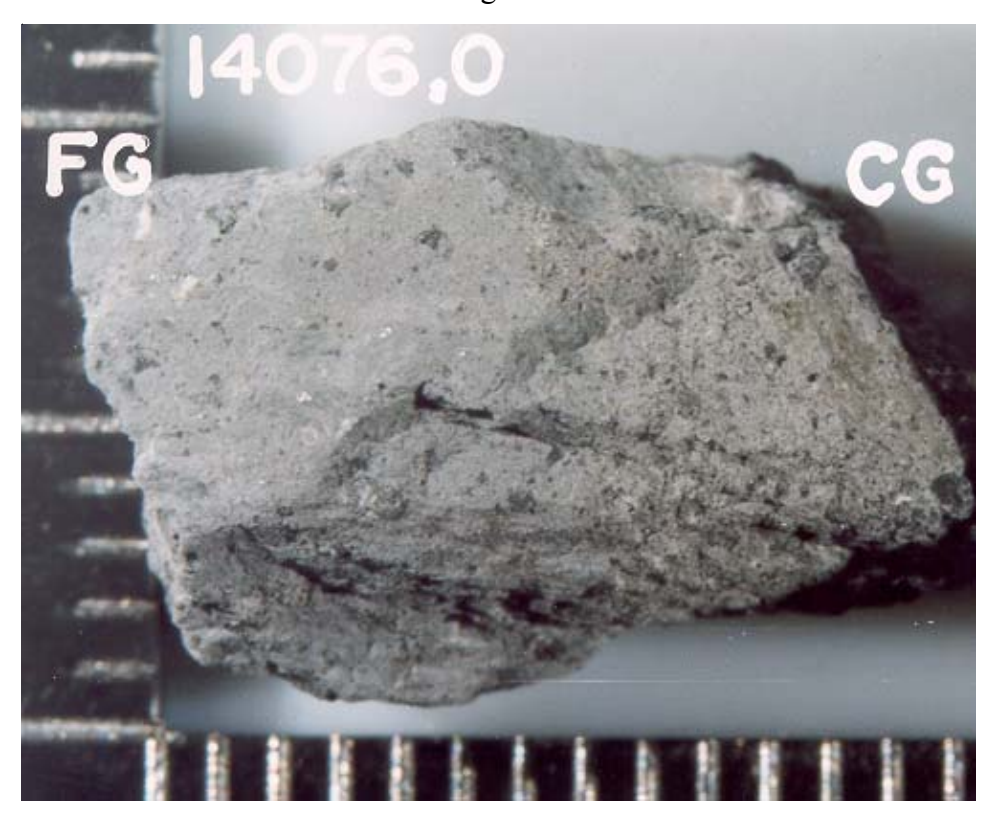
Figure 1: Photo of 14076. Scale is in mm. NASA S87-34960.
Introduction
Section titled “Introduction”14076 was one of 7 small rocks collected from the bottom of a 30 cm deep trench (see 14149) at station G, Apollo 14, located about 3 crater diameters from Cone Crater (Swann et al. 1977). It has two distinct lithologies with sharp contact; one is brownish like most other Apollo 14 soil breccias, and one is grayish and very aluminous. The aluminous lithology is thought to be an exotic highland regolith and is quite unusual when compared with other Apollo 14 breccias.
The aluminous part of 14076 is found to have large glass spheres and fragments of HASP (Vaniman 1990) and tiny glass spheroids of GASP (Warren 2008). A new lunar mineral, yoshiokaite, is also reported in this lithology.
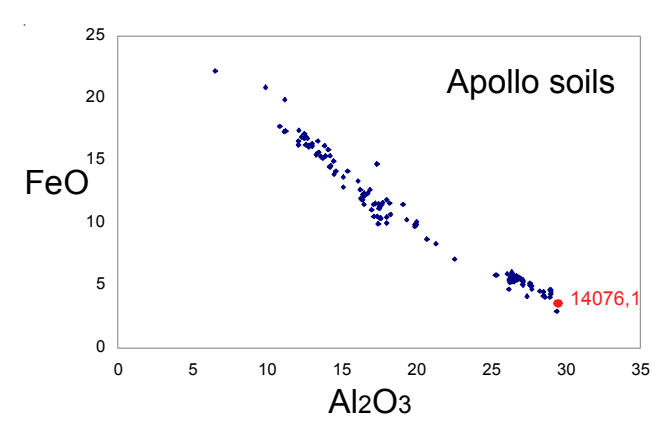
Figure 2: Chemical composition of light portion of 14076 compared with other lunar soils.
Petrography
Section titled “Petrography”The aluminous part of Apollo 14 regolith breccia 14076 has been found to contain a diverse suite of complementary silicate condensates (figures 4 and 5). A early description of this rock is reported in Jerde et al. (1990) “the finer-grained end - - - contains only 5-
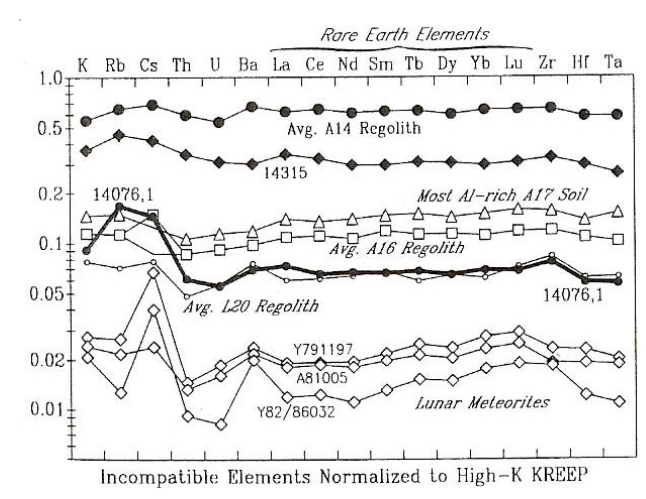
Figure 3: Spider diagram for trace element content of 14076,1 compared wtih 14315, Apollo 14 soils, Apollo 16 soil and some lunar meteorites (Jerde et al. 1990).
10% clasts > 0.5 mm across. In contrast, the coarsergrained end contains ~ 30% clasts. The matrices were also noted to be of different colors: “medium browngrey in one lithology and “light medium grey” in the other”.
Jerde et al. (1990) and Wentworth and McKay (1991) showed that the light-grey portion of 14076 was highly aluminous when compared with other Apollo 14 samples. The maturity index (Is/FeO) is low, perhaps due to growth of iron grains (Jerde et al. 1990).
The thin section of the light-grey lithology (14076,1) contains at least four large more-or-less intact spherules and many smaller object that appear to be broken spherules. The thin section lacks recognizable agglutinates, has only moderate porosity, and all of its glasses have been extensively devitrified (Jerde et al. 1990). Several unusual (devitrified) glass types are present: One common type is similar to HASP, seen before in some Apollo 16 samples. A new Ca, Al rich silicate mineral termed “Yoshiokaite” is has been found in this lithology. Most recently Warren et al. (2007) and Warren (2008) have reported tiny spheres and large masses of complementary Si- and Fe-rich glass, dubbed GASP (table 1, figure 5). These supposed condensates are not unlike the volatile-rich alumina poor glasses and coatings first observed by Keller and McKay (1992) in an Apollo 16 soil (61181).
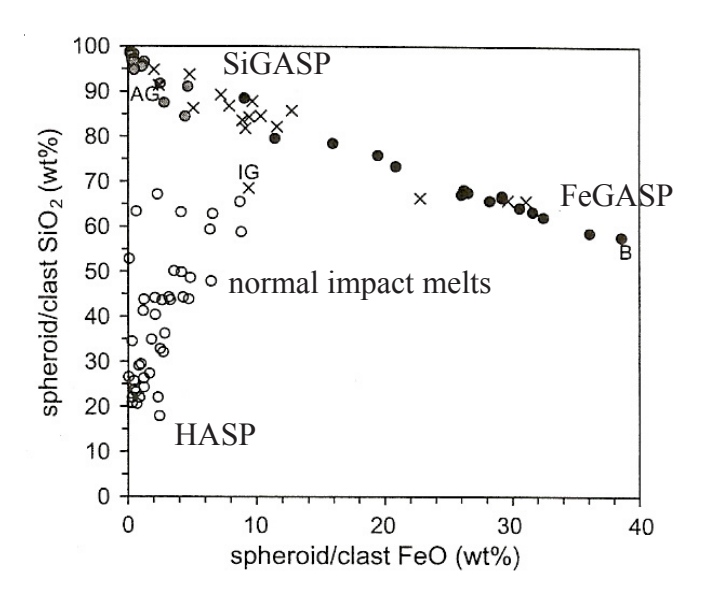
Figure 4: Fe and Si content of small glass spheres in 14076. X are non-sphere. Warren 2008.
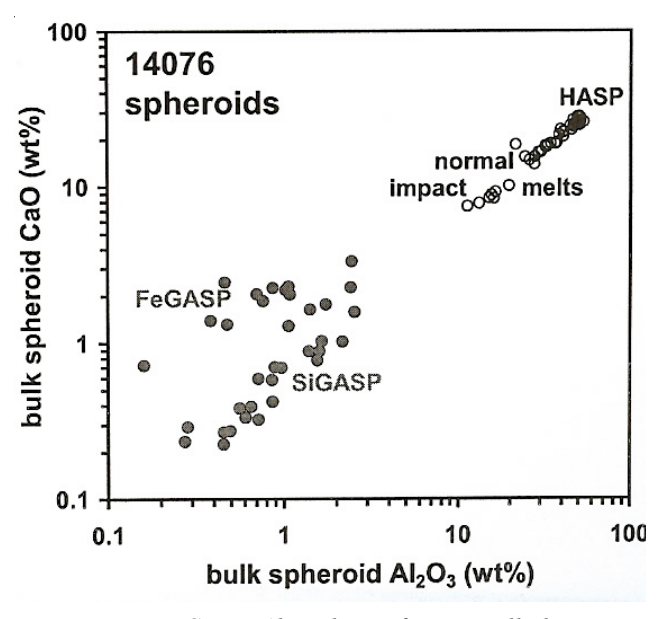
Figure 5: Ca vrs Al analysis of very small glass spheres in 14076 (Warren et al. 2007).
HASP: HASP stands for high-alumina, silica-poor glass and has been seen before (Nancy et al. 1976). It is, perhaps, the residue of high-temperature vaporization of lunar highland material.
GASP: GASP stands for gas-associated spheroidal precipitates (Warren et al. 2007).
VRAP: VRAP is an acronym that stands for volatilerich alumina poor condensates (Keller and McKay 1992).
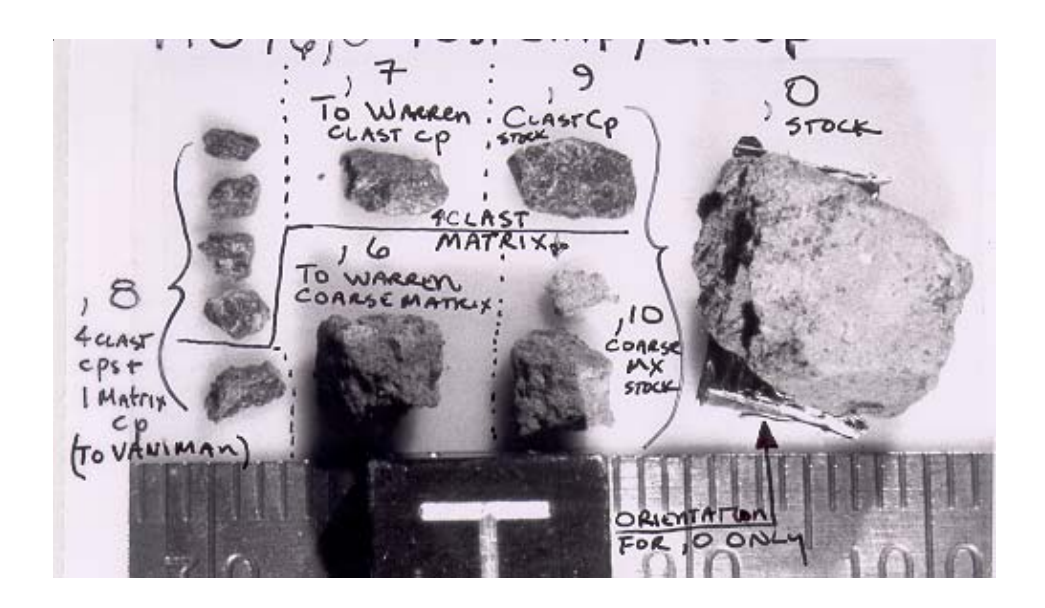
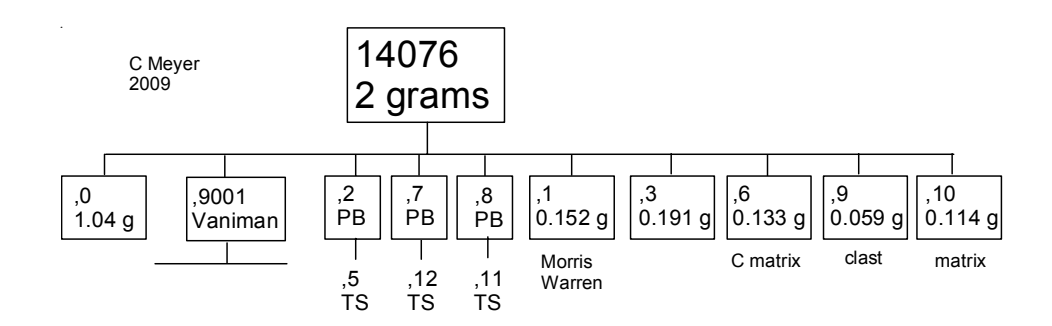
Figure 6: Photo from “data pack” for 14076.
Yoshiokaite: Vaniman and Bisch (1990) reported a new Ca, Al-silicate mineral in the aluminous part of 14076. It occurs as shocked crystal fragments an in devitrified highly-aluminous glasses. It has a hexagonal nepheline-like structure and is metastable. Analyses of yoshiokaite are given in table 1.
Chemistry
Section titled “Chemistry”There are three analyses of different parts of 14076 (Table 1). The brownish lithology has high trace element content and is very like other Apollo 14 regolith breccias.
However, the grayish, aluminous lithology of 14076,1 is low in trace element content. It has significant Ir and Au and is thought to be a sample of a highland regolith (Warren 2008). The grayish, aluminous lithology is found to be exotic to Apollo 14 and low in trace element content (figure 3). It is somewhat similar
to the Apollo 16 soils (except that they do not have abundant HASP).
The third analysis by Jerde et al. (1990) is of a small clast in 14076.
Processing
Section titled “Processing”14076, along with parent soil 14149, was returned in documented bag #20 in ALSREC 1006. Figure 6 shows how 14076 was divided. Documentation of the splits and their respective thin sections is found in the papers by Warren, Jerde etc.
Compilers note: It would seem that one should search all samples with HASP, for small spheroids of GASP and/or thin coatings of VRAP. One can only guess what the next acronym will be!
Table 1. Chemical composition of 14076.
| reference Jerde et al. 1990 | Warren2008Keller92Warren08Vaniman90 | ||||||||||||||
|---|---|---|---|---|---|---|---|---|---|---|---|---|---|---|---|
| weight SiO2 % | ,1 44 | ,6 47.7 | ,7 | ave GASP HASP VRAP (c ) 86.6 | 26 | 64 | Yoshiokaite 18.2 | 28 | 22.6 | 21.6 | 20.6 | 18.4 | 15.8 | (d) | |
| TiO2 | 0.33 | 1.6 | 0.88 | (c ) 0.03 | 0.7 | 0.08 | 0.07 | 0.02 | 0.08 | 0.14 | 0.14 | 0.12 | (d) | ||
| Al2O3 FeO | 30.4 3.78 | 18.3 9.5 | 24.2 6.2 | (c ) 0.38 (c ) 7.64 | 45 1.8 | 1 25 | 51.9 0.02 | 45.9 0.18 | 50 0.07 | 52.2 | 51.4 0.08 | 53.3 0.05 | 56.3 0.41 | (d) (d) | |
| MnO MgO | 0.058 3.33 | 0.13 10.3 | 5.3 | 0.075 (c ) 0.16 (c ) 4.5 | 5.5 | 0.5 1.9 | 0.41 | 0.98 | 0.27 | 0.09 | 0.3 | 0.02 | 0.4 | (d) (d) | |
| CaO | 16.8 | 11 | 14.4 | (c ) 0.55 | 21 | 1.3 | 28.8 | 25.5 | 27.7 | 26.5 | 28.3 | 27.8 | 27.8 | (d) | |
| Na2O K2O | 0.44 0.088 | 0.74 0.65 | 0.59 0.26 | (c ) 0.03 (c ) 0.02 | 1 2.9 | 0.02 0.01 | 0.02 | 0.02 0.01 | 0.09 0.01 | (d) (d) | |||||
| P2O5 S % | |||||||||||||||
| sum | |||||||||||||||
| Sc ppm | 7.8 | 20.3 | 12.7 | (a) | |||||||||||
| V Cr | 17 500 | 37 1250 | 34 880 | (a) (a) | |||||||||||
| Co | 15.8 | 36 | 20.1 | (a) | |||||||||||
| Ni Cu | 231 | 370 | 234 | (a) | |||||||||||
| Zn Ga | 6.9 10.8 | 6.7 | 33 3.1 | (a) (a) | |||||||||||
| Ge ppb | 260 | (b) | |||||||||||||
| As Se | |||||||||||||||
| Rb | 3.7 | 16 | 6.8 | (a) | |||||||||||
| Sr Y | 175 | 189 | 150 | (a) | |||||||||||
| Zr Nb | 108 | 1060 | 470 | (a) | |||||||||||
| Mo | |||||||||||||||
| Ru Rh | |||||||||||||||
| Pd ppb | |||||||||||||||
| Ag ppb Cd ppb | |||||||||||||||
| In ppb Sn ppb | |||||||||||||||
| Sb ppb | |||||||||||||||
| Te ppb Cs ppm | 0.146 | 1.8 | 0.25 | (a) | |||||||||||
| Ba | 90 | 850 | 350 | (a) | |||||||||||
| La Ce | 8 18.2 | 80 192 | 31 80 | (a) (a) | |||||||||||
| Pr Nd | 11.9 | 119 | 47 | (a) | |||||||||||
| Sm | 3.17 | 32.2 | 12.5 | (a) | |||||||||||
| Eu Gd | 1.09 | 2.7 | 1.47 | (a) | |||||||||||
| Tb Dy | 0.67 4.2 | 6.6 43 | 2.8 16.3 | (a) (a) | |||||||||||
| Ho | 0.73 | 3.5 | (a) | ||||||||||||
| Er Tm | |||||||||||||||
| Yb | 2.5 | 24 | 9.9 | (a) | |||||||||||
| Lu Hf | 0.34 2.22 | 1.37 26.4 | 3.5 9.9 | (a) (a) | |||||||||||
| Ta W ppb | 0.29 | 2.9 | 1.1 | (a) | |||||||||||
| Re ppb | 0.54 | (b) | |||||||||||||
| Os ppb Ir ppb | 7.3 8 | 12.6 | 11.3 | (b) (b) | |||||||||||
| Pt ppb | |||||||||||||||
| Au ppb Th ppm | 8.8 1.34 | 8 14.1 | 8 6.2 | (b) (a) | |||||||||||
| U ppm | 0.34 | 3.4 | 1.6 | (a) | technique: (a) INAA, (b) RNAA, (c ) e. probe, fused bead, (d) elec. Probe | ||||||||||
References for 14076
Section titled “References for 14076”Carlson I.C. and Walton W.J.A. (1978) Apollo 14 Rock Samples. Curators Office. JSC 14240
Chao E.C.T., Minkin J.A. and Best J.B. (1972) Apollo 14 breccias: General characteristics and classification. Proc. 3rd Lunar Sci. Conf. 645-659.
Jerde E.A., Morris R.V. and Warren P.H. (1990) In quest of lunar regolith breccias of exotic provenance: a uniquely anorthositic sample from the Fra Mauro (Apollo 14) highlands. Earth Planet. Sci. Lett. 98, 90-108.
Keller L.P. and McKay D.S. (1992) Micrometer-sized glass spheres in Apollo 16 soil 61181: Implications for impact volatilization and condensation. Proc. 22nd Lunar Planet. Sci. Conf. 137-141.
LSPET (1971) Preliminary examination of lunar samples from Apollo 14. Science 173, 681-693.
Naney M.T., Crowl D.M. and Papike J.J. (1976) The Apollo 16 drill core: Statistical analysis of glass chemistry and the characterization of a high alumina-silica poor HASP glass. Proc. 7th Lunar Sci. Conf. 155-184.
Simonds C.H., Phinney W.C., Warner J.L., McGee P.E., Geeslin J., Brown R.W. and Rhodes J.M. (1977) Apollo 14 revisited, or breccias aren’t so bad after all. Proc. 8th Lunar Sci. Conf. 1869-1893.
Sutton R.L., Hait M.H. and Swann G.A. (1972) Geology of the Apollo 14 landing site. Proc. 3rd Lunar Sci. Conf. 27- 38.
Swann G.A., Trask N.J., Hait M.H. and Sutton R.L. (1971a) Geologic setting of the Apollo 14 samples. Science 173, 716-719.
Swann G.A., Bailey N.G., Batson R.M., Eggleton R.E.., Hait M.H., Holt H.E., Larson K.B., Reed V.S., Schaber G.G., Sutton R.L., Trask N.J., Ulrich G.E. and Wilshire H.G. (1977) Geology of the Apollo 14 landing site in the Fra Mauro Highlands. U.S.G.S Prof. Paper 880.
Swann G.A., Bailey N.G., Batson R.M., Eggleton R.E.., Hait M.H., Holt H.E., Larson K.B., McEwen M.C., Mitchell E.D., Schaber G.G., Schafer J.P., Shepard A.B., Sutton R.L., Trask N.J., Ulrich G.E., Wilshire H.G. and Wolfe E.W. (1972) 3. Preliminary Geologic Investigation of the Apollo 14 landing site. In Apollo 14 Preliminary Science Rpt. NASA SP-272. pages 39-85.
Vaniman D.T. (1990) Glass variants and multiple HASP trends in Apollo 14 regolith breccias. Proc. 20th Lunar Planet. Sci. Conf. 209-217.
Vaniman D.T. and Bish D.L. (1990) Yoshiokaite, a new Ca, Al-silicate mineral from the Moon. Am. Mineral. 75, 676- 686.
Warner J.L. (1972) Metamophism of Apollo 14 breccias. Proc. 3rd Lunar Sci. Conf. 623-643.
Warren P.H. (2008) Lunar rain-rock: Diverse silicate impactvapor condensates in an Apollo-14 regolith breccia. Geochim. Cosmochim Acta 72, 3562-3585.
Warren P.H., Tonui E., Young E.D. and Newman W.L. (2007) Lunar Rock-rain: Diverse silicate impact-vapor condensation in an Apollo 14 regolith breccia (abs#2406). Lunar Planet. Sci. XXXVIII Lunar Planetary Institute, Houston.
Wentworth S.J. and McKay D.S. (1991) Apollo 14 glasses and the origin of lunar soils. Proc. 21st Lunar Planet. Sci. Conf. 185-192. Lunar Planetary Institute, Houston.
Williams R.J. (1972) The lithification of metamorphism of lunar breccias. Earth Planet. Sci. Lett. 16, 250-256.
Wilshire H.G. and Jackson E.D. (1972) Petrology and stratigraphy of the Fra Mauro Formation at the Apollo 14 site. U.S. Geol. Survey Prof. Paper 785.