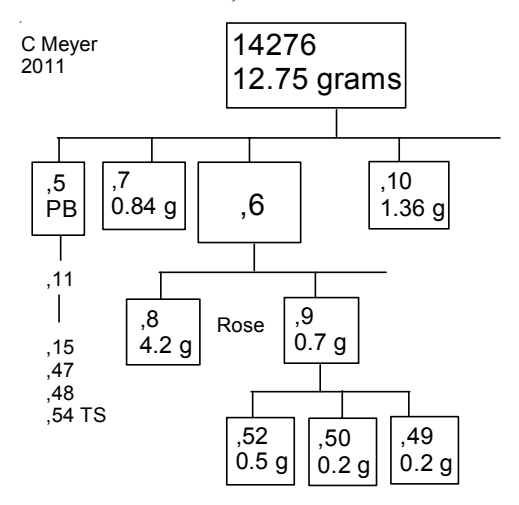
Sample 14276
KREEP Basalt
Section titled “KREEP Basalt”12.75 grams
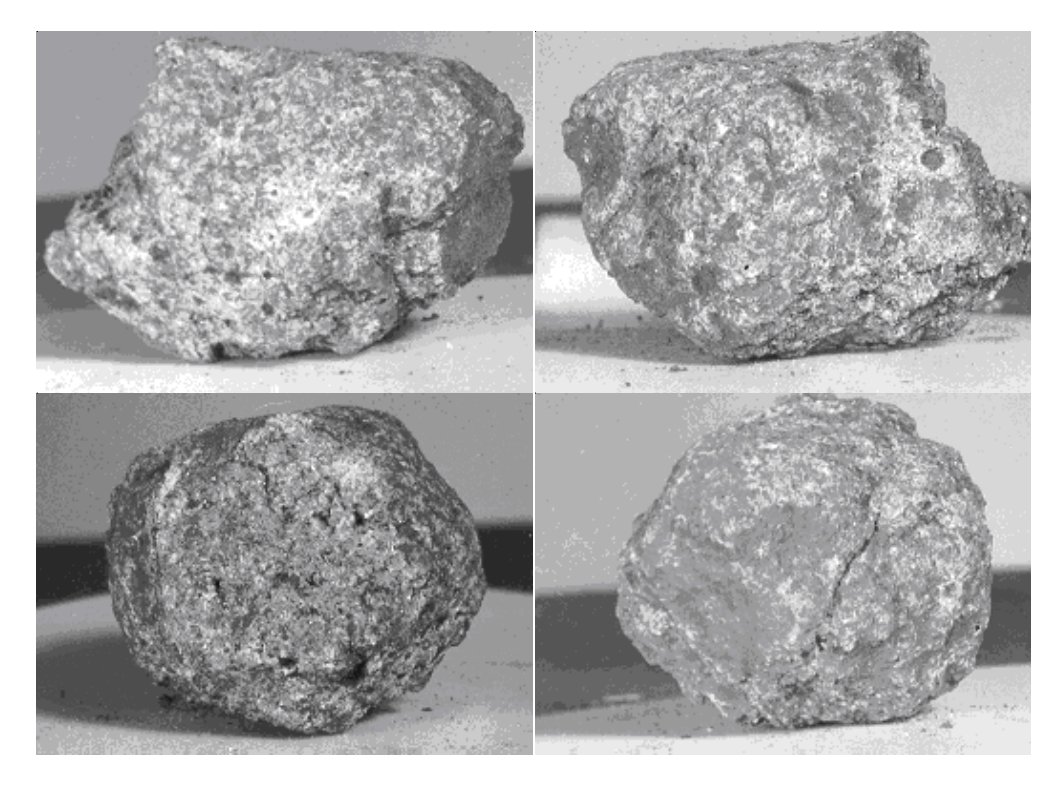
Figure 1: Photos of all sides of 14276. Sample is 2 cm across. NASA S71-26626 - 9.
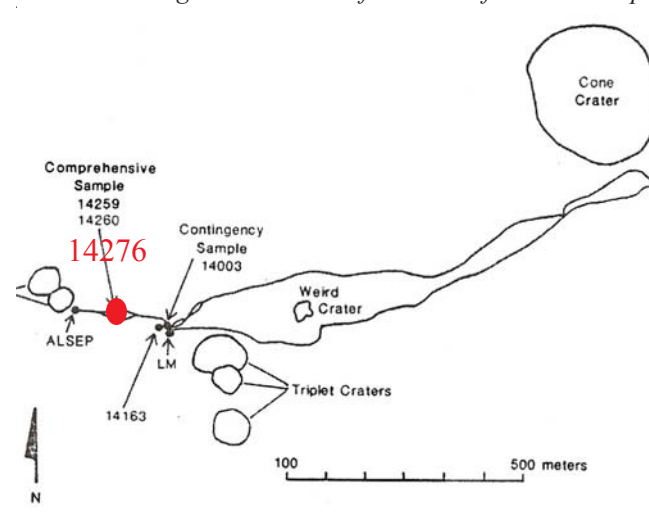
Figure 2: Map of Apollo 14 traverse showing location of comprehensive sample.
Mineralogical Mode for 14276
Section titled “Mineralogical Mode for 14276”Gancarz et al. 1972
Olivine - Pyroxene 33 % Plagioclase 65 Ilmenite 2 mesostasis
Introduction
Section titled “Introduction”14276 is from the “comprehensive sample” taken near ALSEP station (see section on 14259). It is rounded on all sides by micrometeorite bombardment (figure 1). It is a feldspathic basalt that is about 3.9 b.y. old.
According to Clayton et al. (1972) and Brunfeldt et al. (1972), “lunar sample 14276 was part of a consortium sample with Professor G.J.Wasserburg as consortium leader”.
Petrography
Section titled “Petrography”Bence and Papike (1972) and Gancarz et al. (1972) found the texture and mineralogy of 14276 to be identical to 14310. It is a fine-grained subophitic basalt with fine laths of plagioclase interlocking with and penetrating pyroxene grains (figures 3 and 4). Pyroxene cores are low-Ca orthopyroxene, surrounded by progressively higher Ca pyroxene (figure 5).
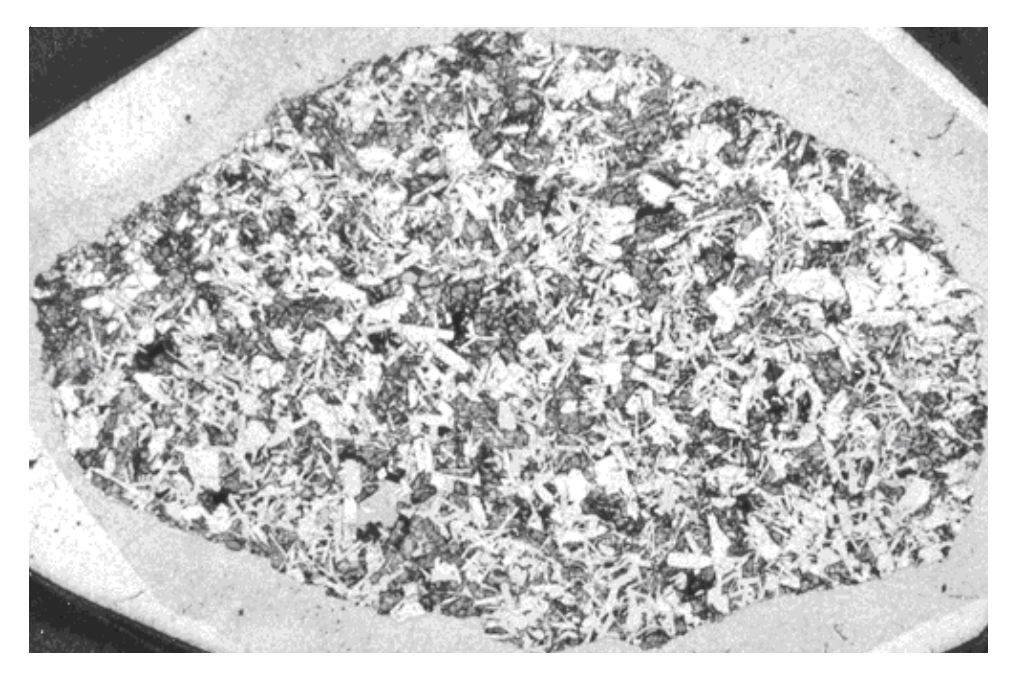
Figure 3: Photomicrograph of thin section of 14276,11. Scale 1.2 cm. NASA S71-43141.
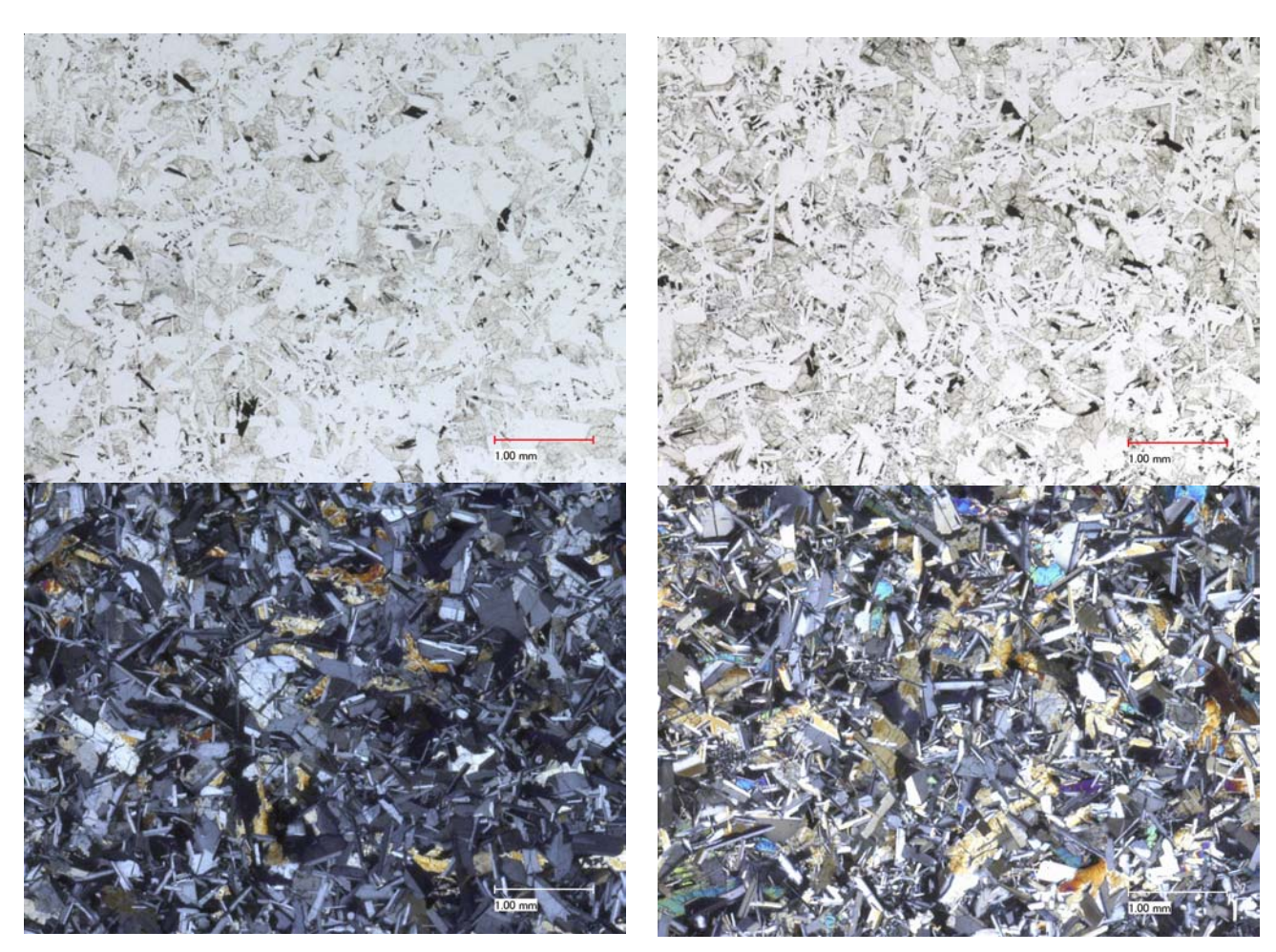
Meyer @50x. Meyer @50x.
Figure 4a: Photomicrographs of 14276,14 by C Figure 4b: Photomicrographs of 14276,48 by C
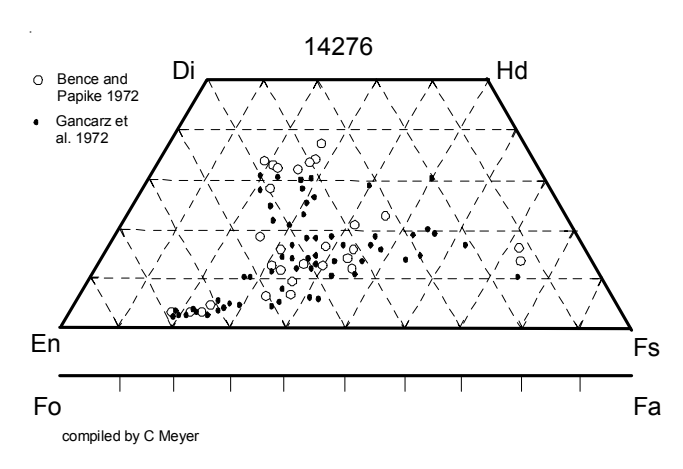
Figure 5: Pyroxene composition of 14276.
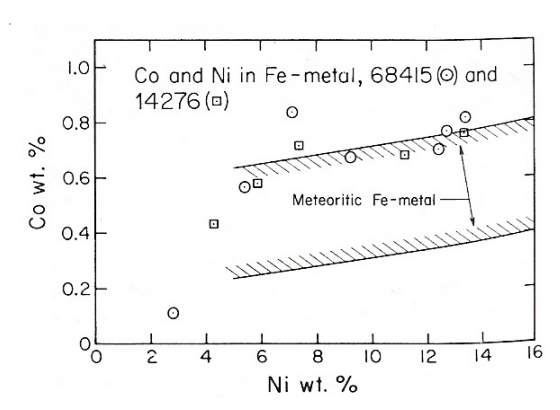
Figure 6: Ni and Co in 14276 and 68415 show that these melts were made by meteorite impact (Gancarz et al. 1973).
Meyer (1977) and McKay et al. (1979) review the petrology of KREEP basalt. Phinney et al. (1975) discussed the statistics of the samples collected as the “comprehensive” suite. Vaniman and Papike (1980) included it in their suite of highland melt rocks.
Chemistry
Section titled “Chemistry”Rose et al. (1972), Brunfeldt (1972) and Ebihara et al. (1992) analyzed 14076, finding that it is an aluminous basalt with intermediate levels of trace elements and meteoritic siderophiles. The trace element content (figure 8) has the characteristic slope of KREEP. There remains the possibility that Apollo 14 KREEP basalts are recrystallized impact melt rocks and as such are a mixture of components.
Radiogenic age dating
Section titled “Radiogenic age dating”Papanastassiou and Wasserburg (1971) determined the age of 14276 (figure 7), later revised by Wasserburg and Papanastassiou (1971).
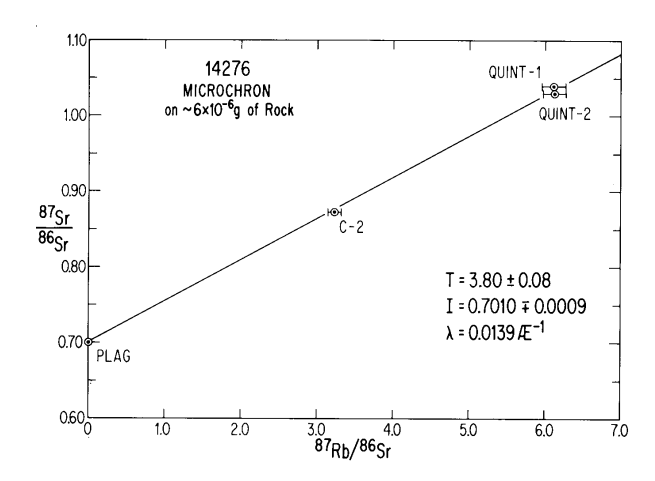
Figure 7: Rb/Sr “Microchron” (by Papanastassiou and Wasserburg 1981).
Summary of Age Data for 14276
Section titled “Summary of Age Data for 14276”Rb/Sr Wasserburg 1971 3.88 ± 0.01 b.y.
Processing
Section titled “Processing”This is one of the samples collected as part of the “comprehensive suite”.
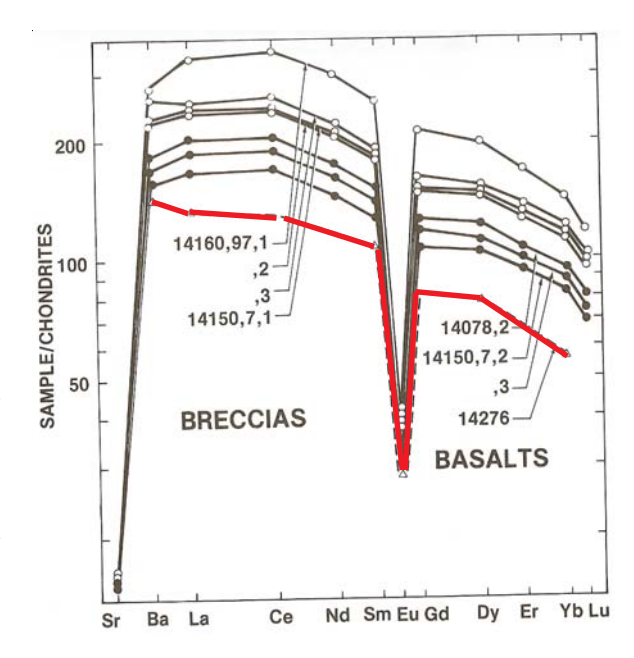
Figure 8: Normalized rare-earth-element diagram for KREEP basalts and breccia (McKay et al. 1979).
Table 1. Chemical composition of 14276.
| reference | Ebihara 92 | Rose72 | Brunfeldt72 | |||
|---|---|---|---|---|---|---|
| weight SiO2 % TiO2 Al2O3 FeO MnO MgO CaO Na2O K2O P2O5 S % sum | 47.6 1.2 21.34 7.94 0.12 7.1 13.18 0.72 0.48 0.4 | (c ) (c ) | (c ) 1.1 (c ) 22.1 (c ) 7.77 (c ) 0.1 (c ) 8.62 (c ) 13.3 (c ) 0.7 (c ) 0.43 | (b) (b) (b) (b) (b) (b) (b) (b) | ||
| Sc ppm V Cr Co Ni Cu Zn Ga | 106 1.17 | (a) 4 | 20 37 1779 9 (a) 113 42 4.2 | (c ) | (c ) 18.2 (c ) 25 (c ) 1450 (c ) 13 (c ) 38 (c ) 1.7 (c ) 3.8 | (b) (b) (b) (b) (b) (b) (b) |
| Ge ppb | 24.9 | (a) | ||||
| As Se Rb Sr Y Zr Nb Mo Ru | 114 12.5 | (a) | (a) 13 165 200 620 33 | (c ) (c ) (c ) | 0.16 (c ) 14 (c ) 170 | (b) (b) (b) |
| Rh Pd ppb Ag ppb Cd ppb In ppb Sn ppb Sb ppb Te ppb Cs ppm Ba La Ce Pr Nd | 5.62 0.75 7.4 33.6 0.078 0.73 3.65 0.534 103 69.9 | (a) (a) (a) (a) (a) (a) (a) (a) (a) (a) | 700 59 | 0.02 56 0.024 0.57 (c ) 540 (c ) 43 | (b) (b) (b) (b) (b) (b) | |
| Sm Eu | 1.87 | (a) | 20 1.9 | (b) (b) | ||
| Gd Tb Dy Ho Er | 4.31 | (a) | 4.8 23 7.3 | (b) (b) (b) | ||
| Tm Yb Lu Hf Ta W ppb | 13.6 2.02 | (a) | (a) 16 | (c ) 11.7 16 2.1 2.5 | (b) (b) (b) (b) | |
| Re ppb Os ppb Ir ppb Pt ppb | 0.66 5.02 3.53 | (a) (a) (a) | ||||
| Au ppb Th ppm | 0.941 | (a) | 0.3 8 | (b) (b) | ||
| U ppm | 2.51 | (a) | 2.5 | (b) technique: (a) RNAA, (b) INAA, RNAA, (c ) “microchemical” |
References for 14276
Section titled “References for 14276”Bence A.E. and Papike J.J. (1972) Pyroxenes as recorders of lunar basalt petrogenesis: Chemical trends due to crystalliquid interaction. Proc. 3rd Lunar Sci. Conf. 431-469.
Brunfeldt A.O., Heier K.S., Nilssen B., Sundvoll B. and Steinnes E. (1972) Distribution of elements between different phases of Apollo 14 rocks and soils. Proc. 3rd Lunar Sci. Conf. 1133-1147.
Carlson I.C. and Walton W.J.A. (1978) Apollo 14 Rock Samples. Curators Office. JSC 14240
Clayton R.N., Hurd J.M. and Mayeda T.K. (1972) Oxygen isotopic compositions and oxygen concentrations of Apollo 14 and Apollo 15 rocks and soils. Proc. 3rd Lunar Sci. Conf. 1455-1463.
Ebihara M., Wolf R., Warren P.H. and Anders E. (1992) Trace elements in 59 mostly highland moon rocks. Proc. Lunar Planet. Sci. 22, 417-426.
von Engelhardt W. (1979) Ilmenite in the crystallization sequence of lunar rocks. Proc. 10th Lunar Sci. Conf. 677 694.
Gancarz A.J., Albee A.L. and Chodos A.A. (1972) Comparative petrology of Apollo 16 sample 68415 and Apollo 14 samples 14276 and 14310. Earth Planet. Sci. Lett. 16, 307-330.
Hubbard N.J., Gast P.W., Rhodes J.M., Bansal B.M., Wiesmann H. and Church S.E. (1972) Nonmare basalts: Part II. Proc. 3rd Lunar Sci. Conf. 1161-1179.
LSPET (1971) Preliminary examination of lunar samples from Apollo 14. Science 173, 681-693.
McKay G.A., Wiesmann H., Bansal B.M. and Shih C.-Y. (1979a) Petrology, chemistry, and chronology of Apollo 14 KREEP basalts. Proc. 10th Lunar Planet. Sci. Conf. 181 205.
Papanastassiou D.A. and Wasserburg G.J. (1981) Microchrons: The 87Rb-87Sr dating of microscopic samples. Proc. 12th Lunar Planet. Sci. Conf. 1027-1038.
Phinney W.C., Simonds C.H. and Warner J. (1975) Description, Classification and Inventory of the Comprehensive sample from Apollo 14. Curator’s Catalog, pp. 46.
Reimold W.U., Nyquist L.E., Bansal B.M., Wooden J.L., Shih C.-Y., Wiesmann H. and Mackinnnon I.D.R. (1985) Isotope analysis of crystalline impact-melt rocks from Apollo 16 stations 11 and 13. North Ray Crater. Proc. 15th Lunar Planet. Sci. Conf. in J. Geophys. Res. 90, C597-C612.
Rose H.J., Cuttitta F., Annell C.S., Carron M.K., Christian R.P., Dwornik E.J., Greenland L.P. and Ligon D.T. (1972) Compositional data for twenty-one Fra Mauro lunar materials. Proc. 3rd Lunar Sci. Conf. 1215-1229.
Sutton R.L., Hait M.H. and Swann G.A. (1972) Geology of the Apollo 14 landing site. Proc. 3rd Lunar Sci. Conf. 27 38.
Swann G.A., Trask N.J., Hait M.H. and Sutton R.L. (1971a) Geologic setting of the Apollo 14 samples. Science 173, 716-719.
Swann G.A., Bailey N.G., Batson R.M., Eggleton R.E.., Hait M.H., Holt H.E., Larson K.B., Reed V.S., Schaber G.G., Sutton R.L., Trask N.J., Ulrich G.E. and Wilshire H.G. (1977) Geology of the Apollo 14 landing site in the Fra Mauro Highlands. U.S.G.S. Prof. Paper 880.
Swann G.A., Bailey N.G., Batson R.M., Eggleton R.E.., Hait M.H., Holt H.E., Larson K.B., McEwen M.C., Mitchell E.D., Schaber G.G., Schafer J.P., Shepard A.B., Sutton R.L., Trask N.J., Ulrich G.E., Wilshire H.G. and Wolfe E.W. (1972) 3. Preliminary Geologic Investigation of the Apollo 14 landing site. In Apollo 14 Preliminary Science Rpt. NASA SP-272. pages 39-85.
Vaniman D.T. and Papike J.J. (1978) The lunar highland melt-rock suite. Geophys. Res. Lett. 5, 429-432.
Vaniman D.T. and Papike J.J. (1980) Lunar highland melt rocks: Chemistry, petrology and silicate mineralogy. In Proc. Conf. Lunar Highlands Crust (Papike J.J. and Merrill R.B., eds.) 271-337. Pergamon. Lunar Planetary Institute, Houston.
Wasserburg G.J. and Papanastassiou D.A. (1971) Age of an Apollo 15 mare basalt: lunar crust and mantle evolution. Earth Planet. Sci. Lett. 13, 97-104.