Sample 15286
Regolith Breccia 34.6 grams
Section titled “Regolith Breccia 34.6 grams”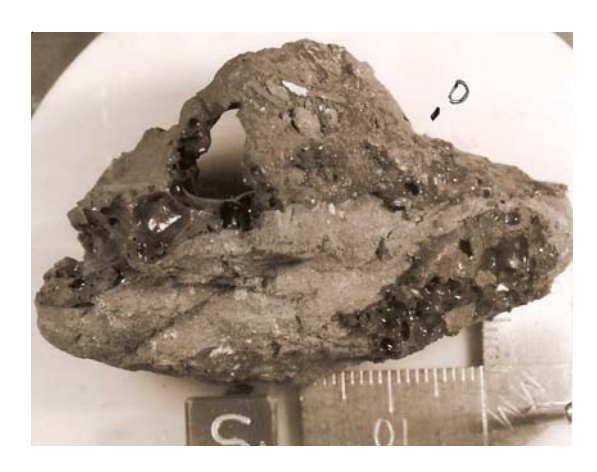
Figure 1: Processing photo of 15286 showing glass wrapped around regolith breccia. Cube is 1 cm.
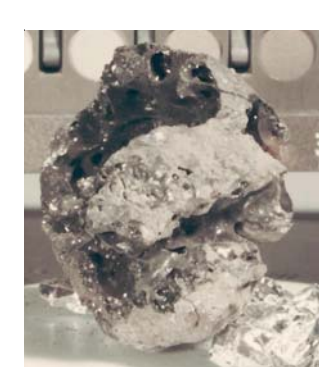
Figure 2: End view of 15286. Sample is about 1 inch. S71-44953
Introduction
Section titled “Introduction”15286 was collected from the rim of a small crater at station 6, on the Apennine Front. It is a coherent glassmatrix soil breccia, similar to other samples collected at same time. Ryder (1985) even suggests that 15286 may be spalled from 15265-15267, but that seems impossible because glass wraps around the particle (figures 1 and 2).
Petrography
Section titled “Petrography”Thin sections show that the interior of 15286 is a typical soil breccias (figure 3). The maturity index Is /FeO = 13 for 15286 indicates that it is a submature soil (breccia).
The shiny black glass attached to 15286 was studied in detail by Wosinski et al. (1973), Winzar et al. (1978), Handwerker et al. (1977) and Uhlmann et al. (1979, 1981). Mehta et al. (1979) reported on the tiny metallic iron particles included in the glass.
Chemistry
Section titled “Chemistry”McKay et al. (1989) determined the chemical composition of 15286 (figure 4). The high Ni, Ir and Au indicate that it is a soil breccia.
Other Studies
Section titled “Other Studies”McKay et al. (1989) reported the rare gas content and isotopic ratios of 15286.
Brownlee et al. (1973 and 1975) studied the size distribution of micrometeorite craters (figure 5).
Processing
Section titled “Processing”There are 7 thin sections of 15286.
References for 15286
Section titled “References for 15286”Brownlee D.E., Horz F., Vedder J.F., Gault D.E. and Hartung J.B. (1973) Some physical parameters of micrometeorides. Proc. 4th Lunar Sci. Conf. 3197-3212.
Brownlee D.E., Horz F., Hartung J.B. and Gault D.E. (1975) Density, chemistry and size distribution of interplanetary dust. Proc. 6th Lunar Sci. Conf. 3409-3416.
Butler P. (1971) Lunar Sample Catalog, Apollo 15. Curators’ Office, MSC 03209
Handwerker C.A., Klein L.C., Onorato P.I.K. and Uhlmann D.R. (1977) Matrix glass vs. intruded glass in lunar breccias 15286. Proc. 8th Lunar Planet. Sci. Conf. 2581-2592.