Sample 66035
66035 – 211.4 grams
66036 – 4.4 grams
66037 – 3.7 grams
Ancient Regolith Breccia
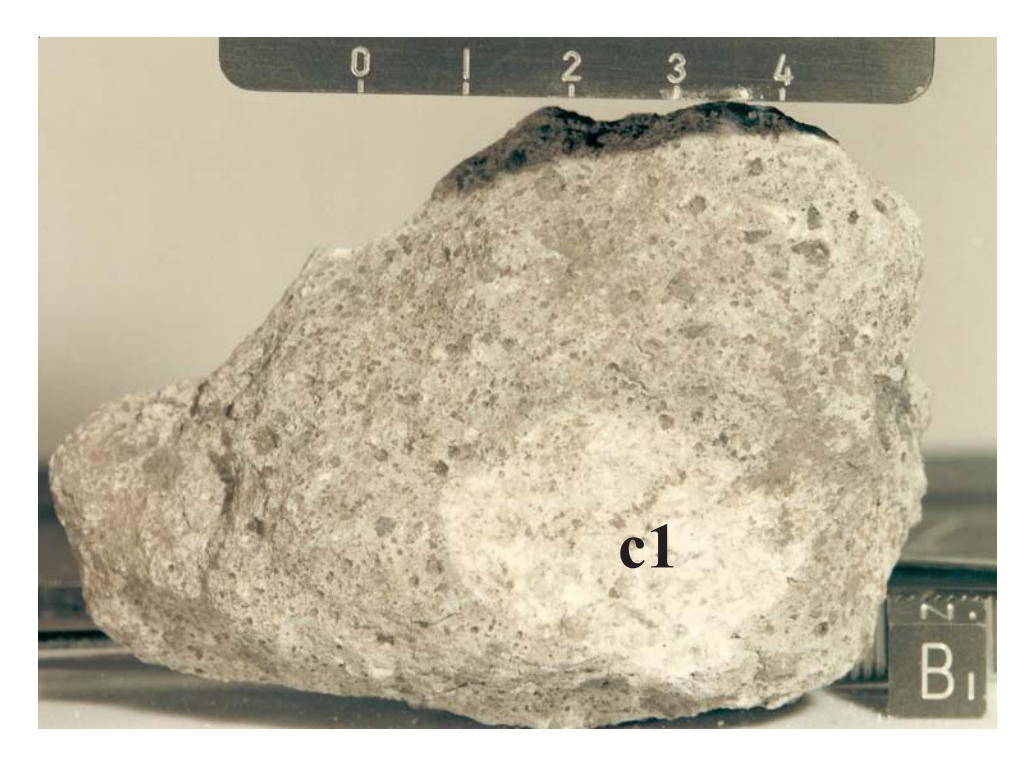
Figure 1: Photo of 66035 showing large cataclastic anorthosite clast (c1). Cube and scale are in cm. S72-39662.
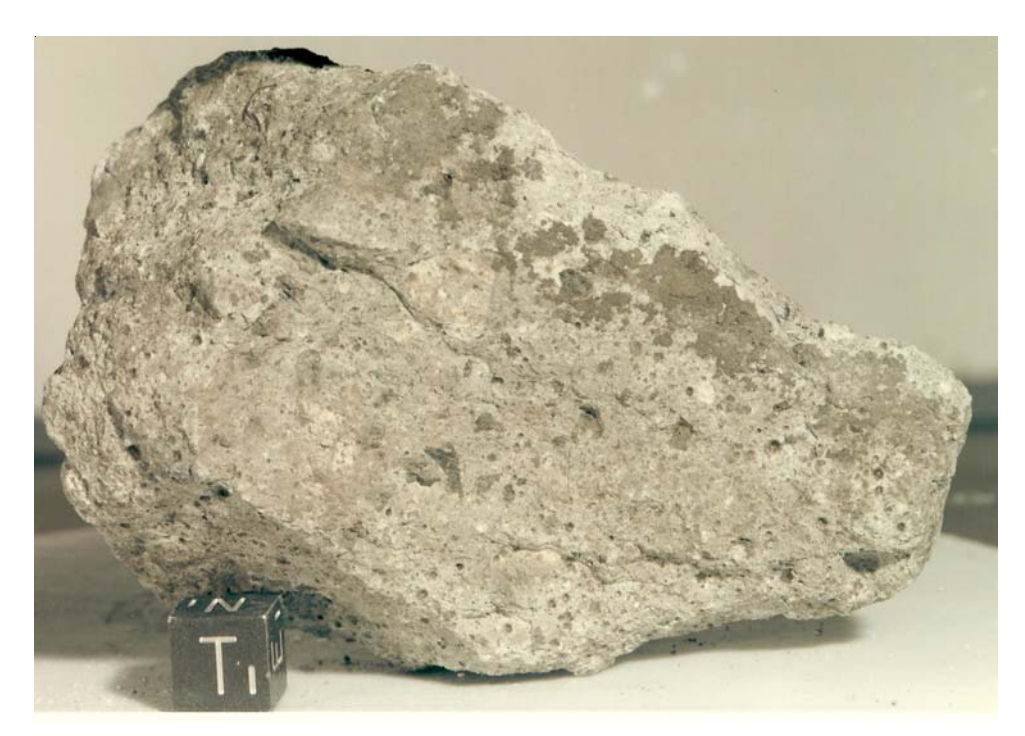
Figure 2: Photo of 66035. Cube is 1 cm. S72-39665.
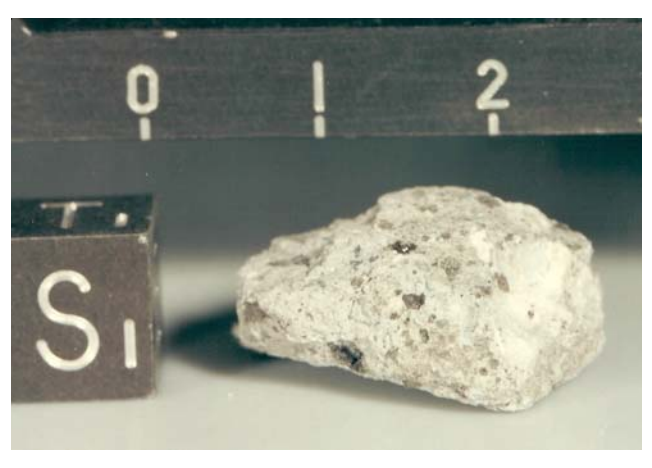
Figure 4: Photo of 66037. Scale in cm. S72-40392 Figure 3: Photo of 66036. Cube is 1 cm. S72-40389
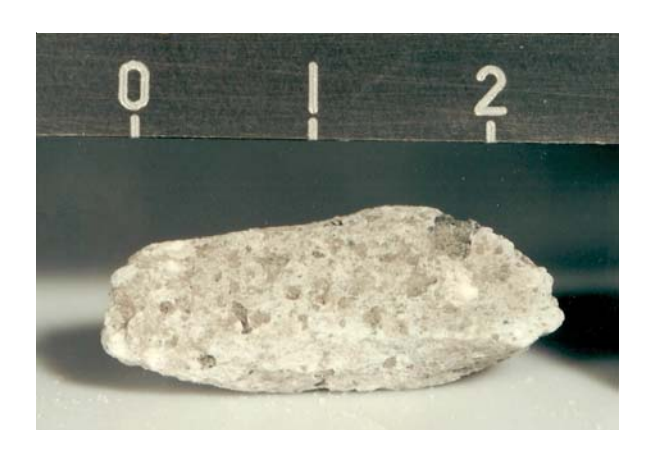
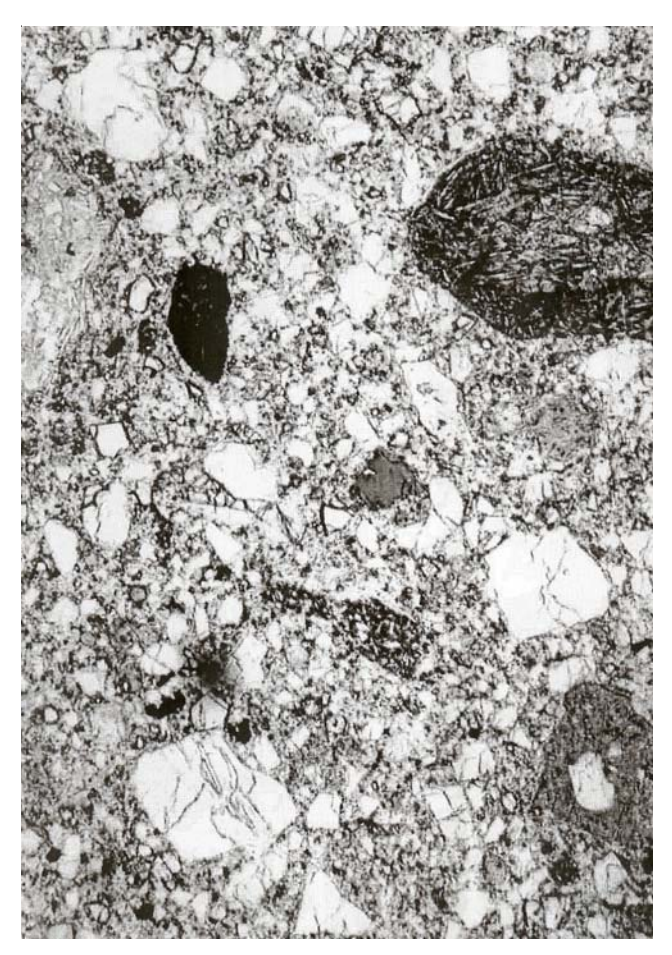
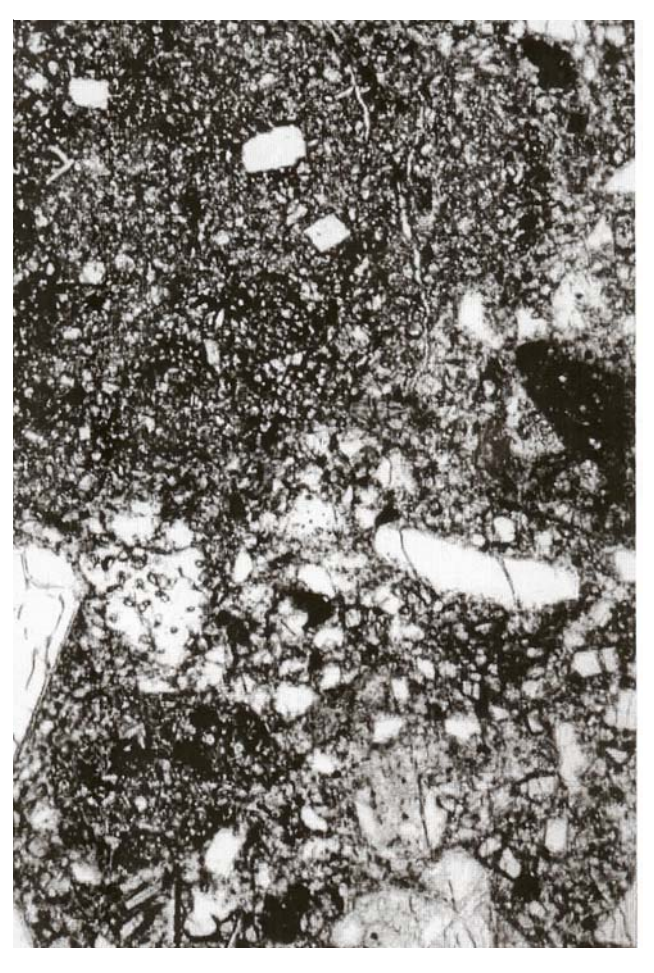
Figure 5: Photomicrograph of thin section of 66036 Figure 6: Photomicrograph of thin section 66037 from from Ryder and Norman 1980. Field of view 2 mm. Ryder and Norman 1980. Field of view 2 mm.
Introduction
Section titled “Introduction”66035 – 66037 are from the base of Stone Mountain, 66035 has zap pits on all surfaces (figures 1, 2, 15 and Apollo 16. They were collected together with 66030 16), so it must have “rolled or jumped” on the regolith. near the rim of a 10 m crater, and near 66055 (figures 7 - 9). These samples are regolith breccias, but they have excess 40Ar and have been termed “ancient regolith breccia”.
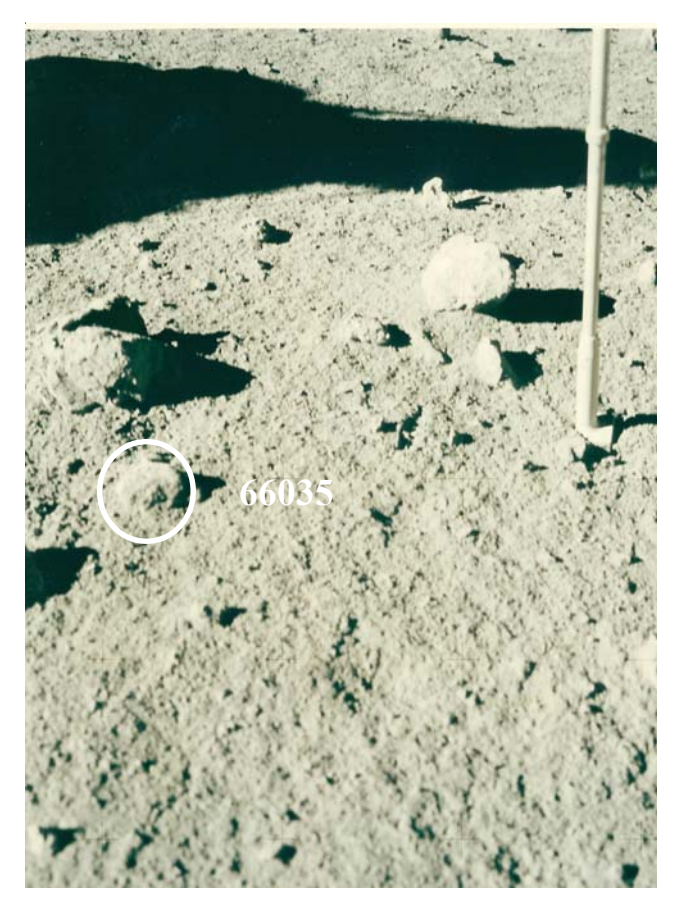
Figure 7: Surface photo of 66035. AS16-107-17513.
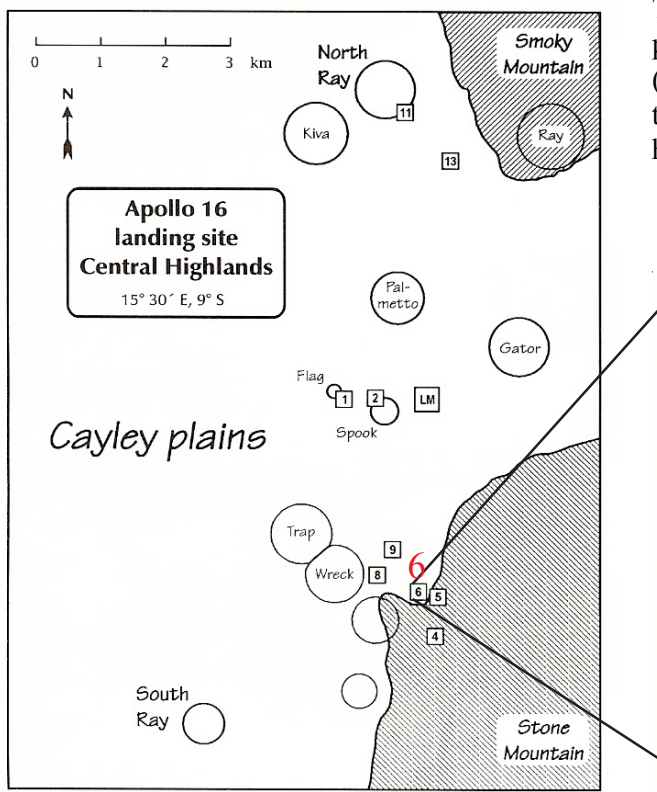
Figure 8: Map of Apollo 16 site with station 6.
Petrography
Section titled “Petrography”Grieve et al. (1974) recognized a suite of impact melt products in the matrix of 66035, ranging from glasses to crystalline poikilitic and subophitic rocks (figure 14).
James (1981) and Fruland (1983) identified 66035 as a regolith breccia. Consequently, McKay et al (1986), Simon et al. (1988) and Joy et al. (2011) included 66035 and 66036 in their study of regolith breccias. The maturity index ( $I_s$ /FeO) is low, but the rare gas content is high.
Quick et al. (1978) describe 66075, which is presumably a companion rock to 66035.
Significant clasts
Section titled “Significant clasts”c1 Large Cataclastic Anorthosite ,12 ,13TS
Section titled “c1 Large Cataclastic Anorthosite ,12 ,13TS”This is the large (3.5 cm) clast seen in figure 1. However, it was only “skin deep” and there is not a lot of mass. It is ~95% plagioclase ( $An_{94-95}$ ), 5% pyroxene ( $Wo_{2-6}En_{66-68}Fs$ ), but it is not pristine. According to Warren and Wasson (1978) it has a “granulitic” texture, but Ryder and Norman (1980) termed it “granoblastic noritic anorthosite”. The REE are shown in figure 17 and the pyroxene composition is shown in figure 12.
c2 Coarse-grained Norite ,18,22TS
Section titled “c2 Coarse-grained Norite ,18,22TS”This clast was seen by PET who described the abundant pyroxene as honey-brown. It is $\sim$ 58% plagioclase (An97), pyroxene (En57) (figure 13) and plots within the field of “ferroan anorthosite”. However, it also has significant Ir and Au (contamination?)(table).
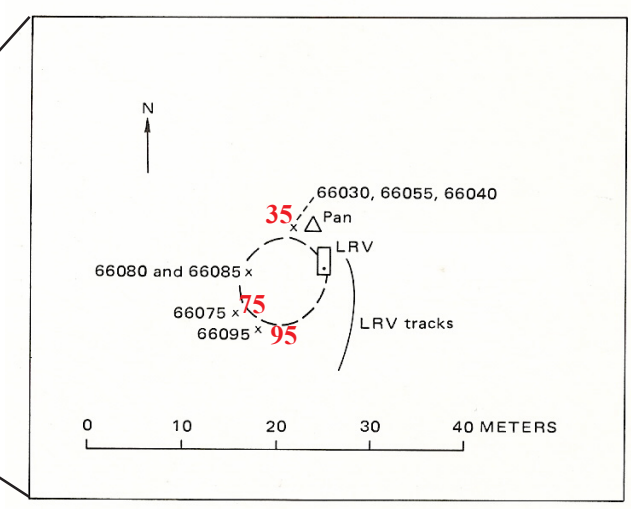
Figure 9: Map of station 6 with 66035, 66075 and 66095.
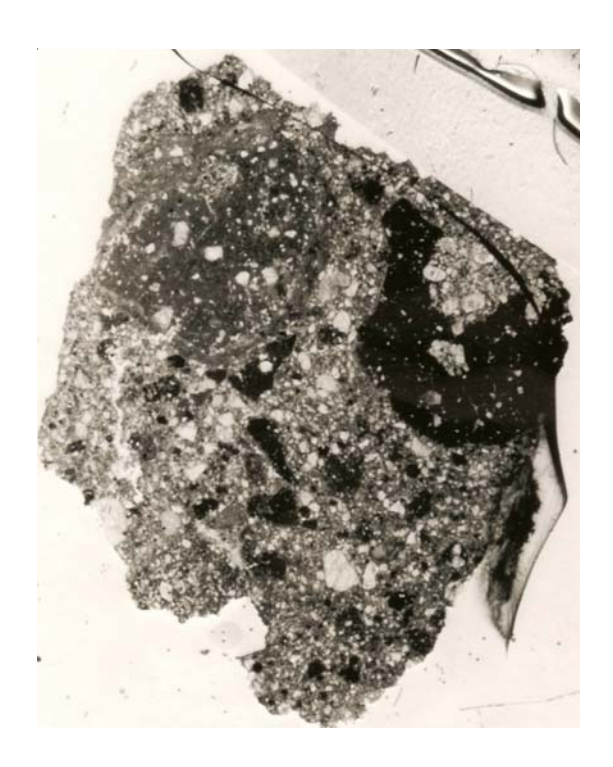
Figure 10: Photo of thin section of 66035,5. S72-43566. About 1 cm across.
Porous Olivine: Fo97 with 1.2% Ca2SiO4 of meteoritic origin (Warren and Wasson 1979, Joy et al. 2012).
Granitic Glass: Grieve et al. (1974) reported several clasts of granitic glass (table 3) – significant, because the same thing is found in 66055.
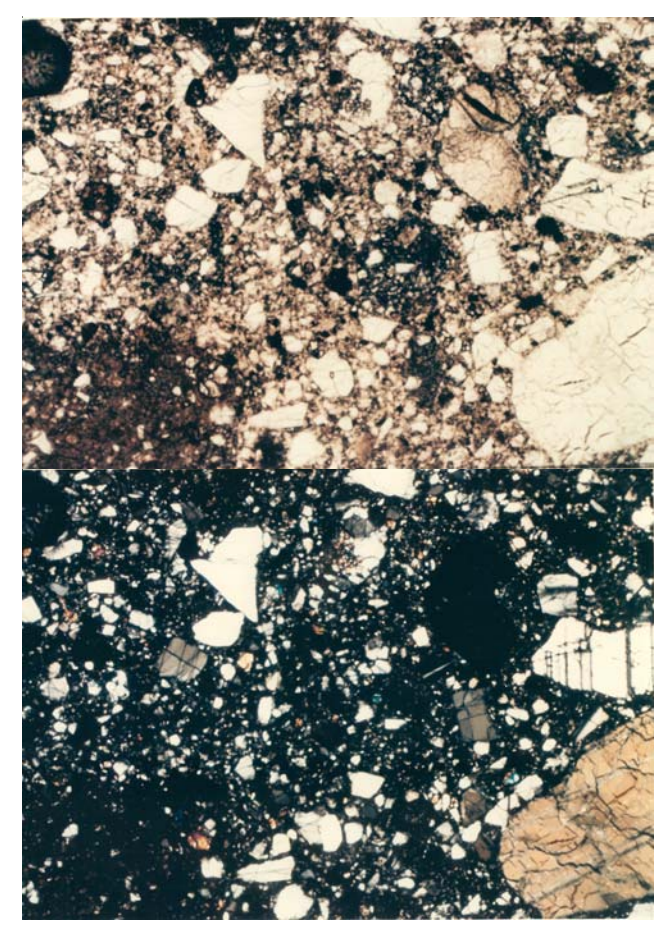
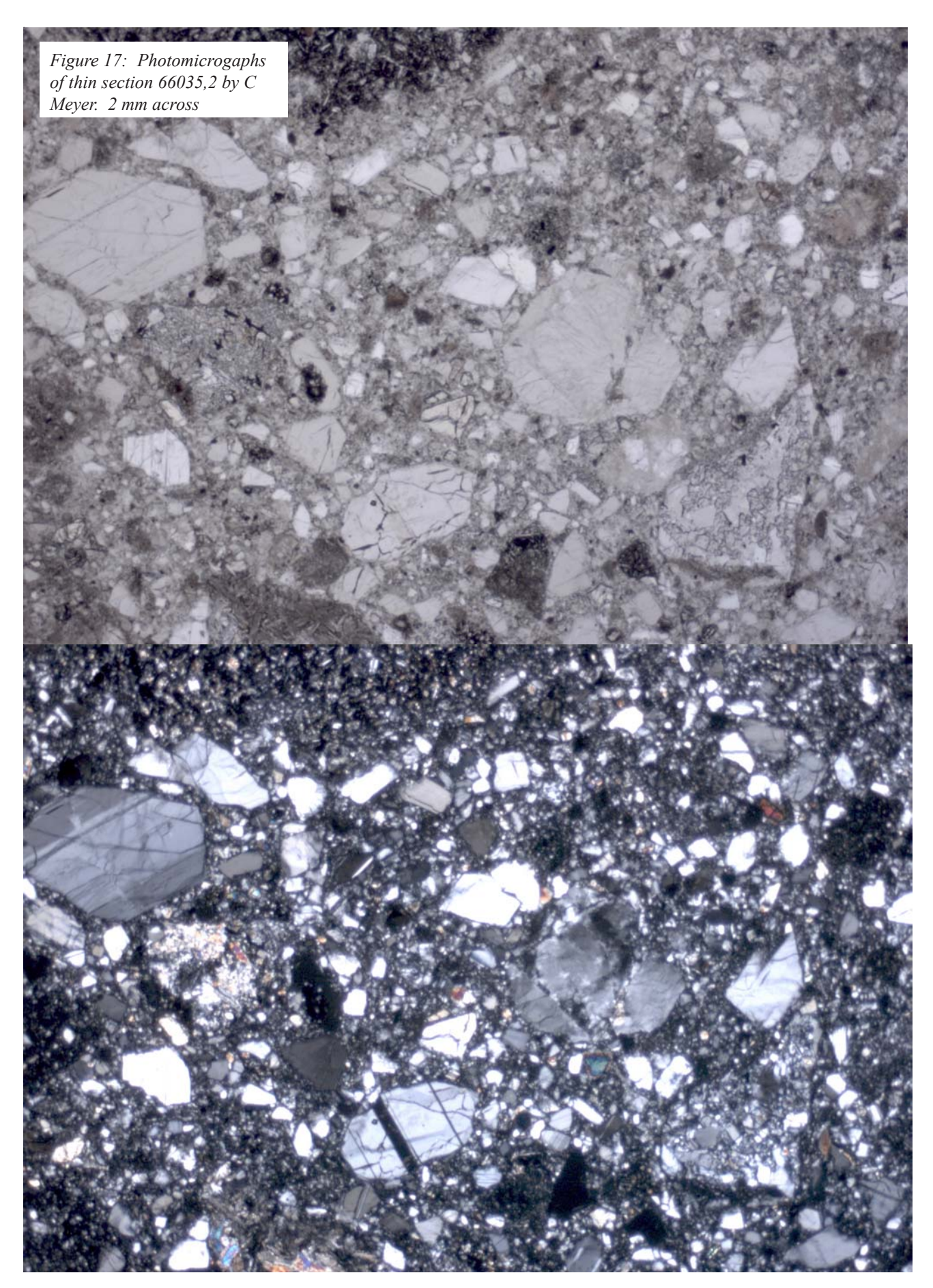
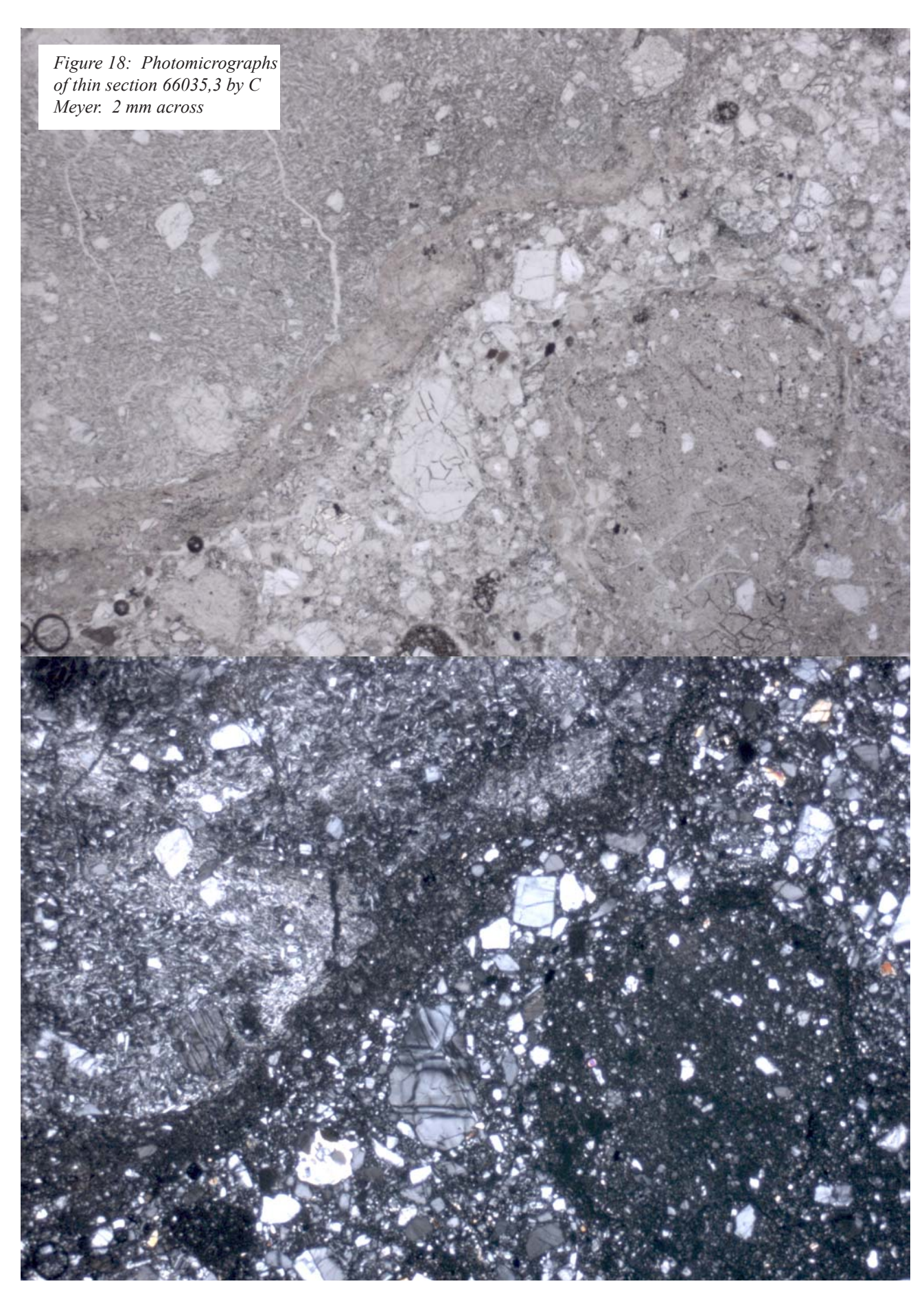
Figure 11: Photomicrographs of thin section of matrix of 66035 showing abundant glass: a) top is plane polarized light S72-42258, b) bottom is crossedpolarized light S72-42259. Scale is about 2 mm across.
Summary of Age Data for 66035
Section titled “Summary of Age Data for 66035”Cohen et al. 2007 3956 +/-579 m.y.
Mineralogical Mode for 66035
Section titled “Mineralogical Mode for 66035”(from McKay et al. 1986) (“Optical”)
| (Holli McKay et al. 1986) (Optical) | ||||||||||
|---|---|---|---|---|---|---|---|---|---|---|
| >500 micron | 20-500 micron | |||||||||
| Mare basalt | 0 | 0 | ||||||||
| KREEP basalt | 1.2 | 3.2 | ||||||||
| Plutonic rock frag | . 94 | 8.1 | ||||||||
| Other lithic | 0 | 7.5 | ||||||||
| Granulite | 0 | 0 | ||||||||
| Poik. Rocks | 1.8 | 8.8 | ||||||||
| Subophitic | 0.9 | 7.5 | ||||||||
| Intergranular | 0 | 3 | ||||||||
| Intersertal | 0 | 0.3 | ||||||||
| Vitric breccia | 0 | 1 | ||||||||
| Frag. Breccia | 0 | 0 | ||||||||
| Plagioclase | 0 | 41.4 | ||||||||
| Olivine | 0 | 8.5 | ||||||||
| Pyroxene | 0 | 2.7 | ||||||||
| Opaques | 0 | 0 | ||||||||
| Glass | 0.9 | 13.9 | ||||||||
| Agglutinate | 0 | 1.1 |
Mineralogical Mode for 66035
Section titled “Mineralogical Mode for 66035”(from Simon et al. 1988)
| · · | 20-90 micron | 90-1000 micron |
|---|---|---|
| Matrix < 20 micron | 34.9 % | |
| Mare basalt | 0 | 0 |
| KREEP basalt | 0 | 0 |
| Feldspathic basalt | 0 | 0 |
| Plutonic rock frag. | 0 | 0.4 % |
| Granulite | 0 | 0.2 |
| Poik. rocks | 0.2 | 4.7 |
| Impact melts | 0.7 | 6 |
| Regolith brec. | 0 | 1 |
| Agglutinate | 0.3 | 1.6 |
| Plagioclase | 14.6 | 17.3 |
| Olivine | 1.3 | 0.1 |
| Pyroxene | 1.7 | 0.3 |
| Opaques | 0.1 | 0 |
| Glass | 2.2 | 4 |
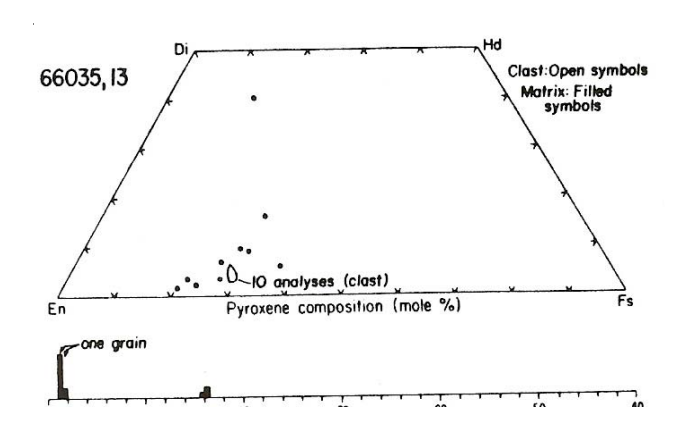
Figure 12: Pyroxene composition of c1 (Warren and Wasson 1979).
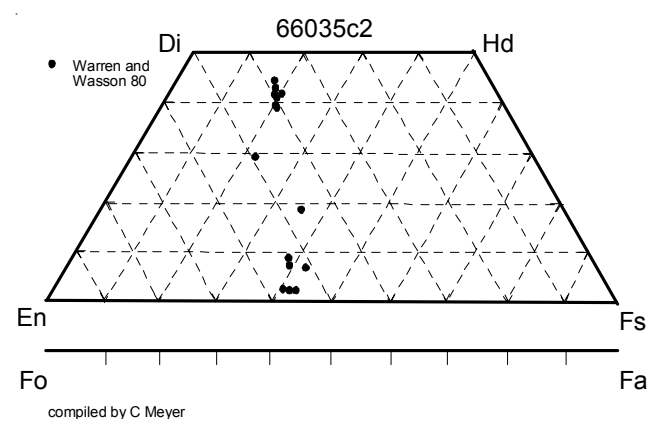
Figure 13: Pyroxene composition.of c2 (Warren and Wasson 1980).
Chemistry
Section titled “Chemistry”The composition of the matrix of 66035 has been reported by Korotev (1990), McKay et al. (1986) and Simon et al. (1988). Eldridge et al. (1973) obtained a measure of K, U and Th, for the bulk rock, in agreement with the data for the matrix. Warren and Wasson reported data for the clasts.
Radiogenic age dating
Section titled “Radiogenic age dating”Cohen et al. (2007) dated a clast by Ar/Ar (with poor precision).
Cosmogenic isotopes and exposure ages
Section titled “Cosmogenic isotopes and exposure ages”Eldridge et al. (1973) reported the cosmic ray induced activity of 26Al = 136 dpm/kg and 22Na = 42 dpm/kg.
Other Studies
Section titled “Other Studies”The rare gas content and isotopic ratios are given in McKay et al. (1986) and Joy et al. (2011).
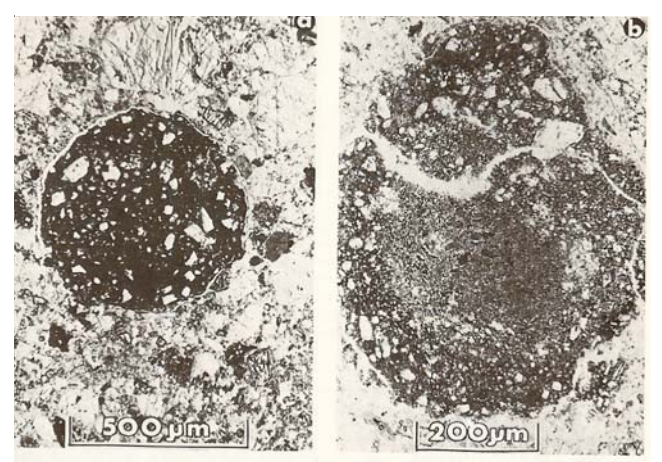
Figure 14: Photo of clasts in 66035 (from Grieve et al. 1974).
Processing
Section titled “Processing”66035, 66036 and 66037 were returned in a bag with soil 66030 – see section on 66031.
66035 had not been sawn (as of 2009). The clasts were sampled by chipping. There are 17 thin sections of 66035, 2 each of 66036 and 66037.
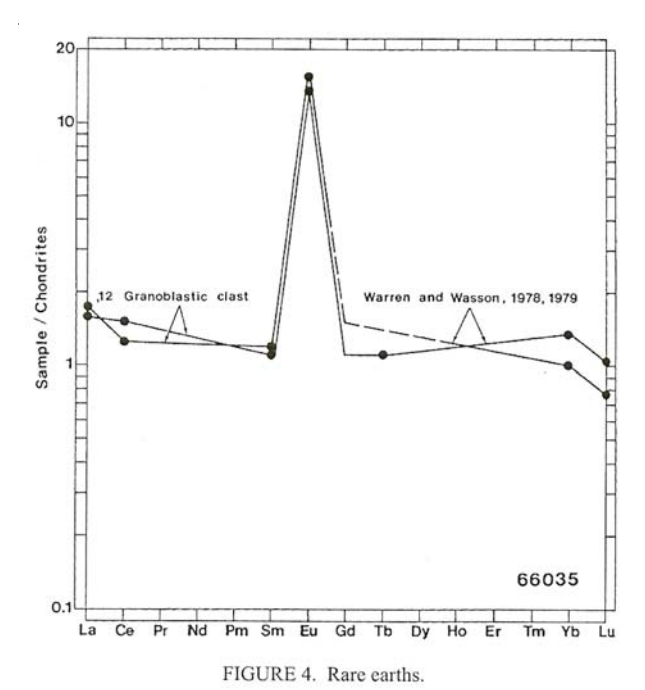
Figure 17: Compsosition of clast “c1”.
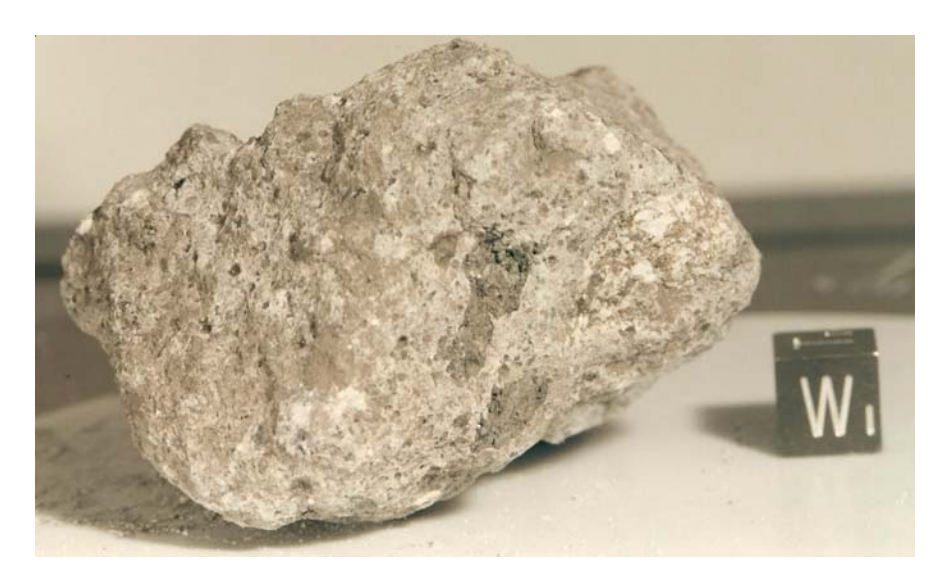
Figure 15: Photo of 66035 showing clasts. Cube is 1 cm. S72-39664.
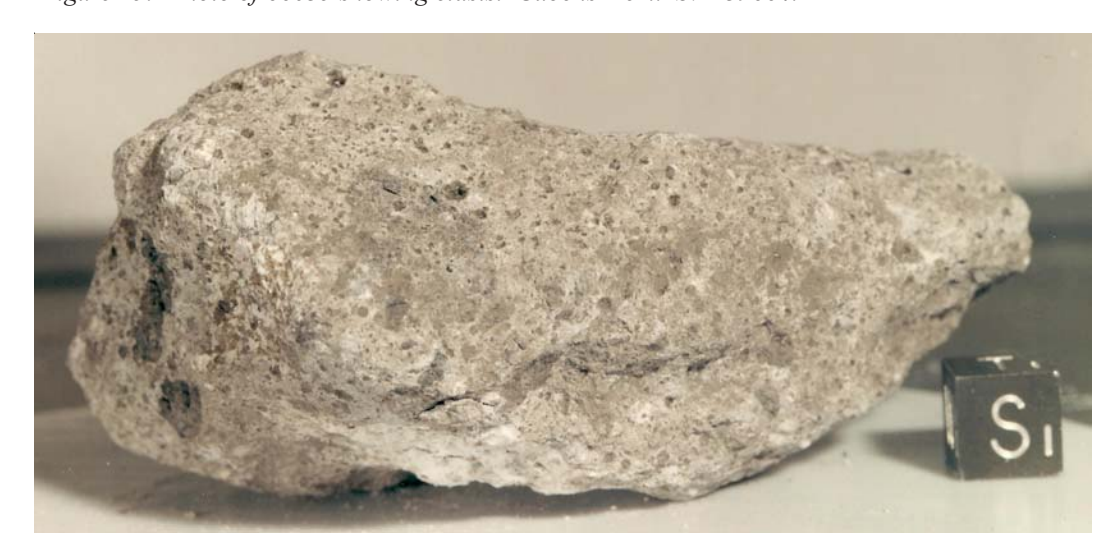
Figure 16: Photo of 66035 showing clast. Cube is 1 cm. S72-39663.
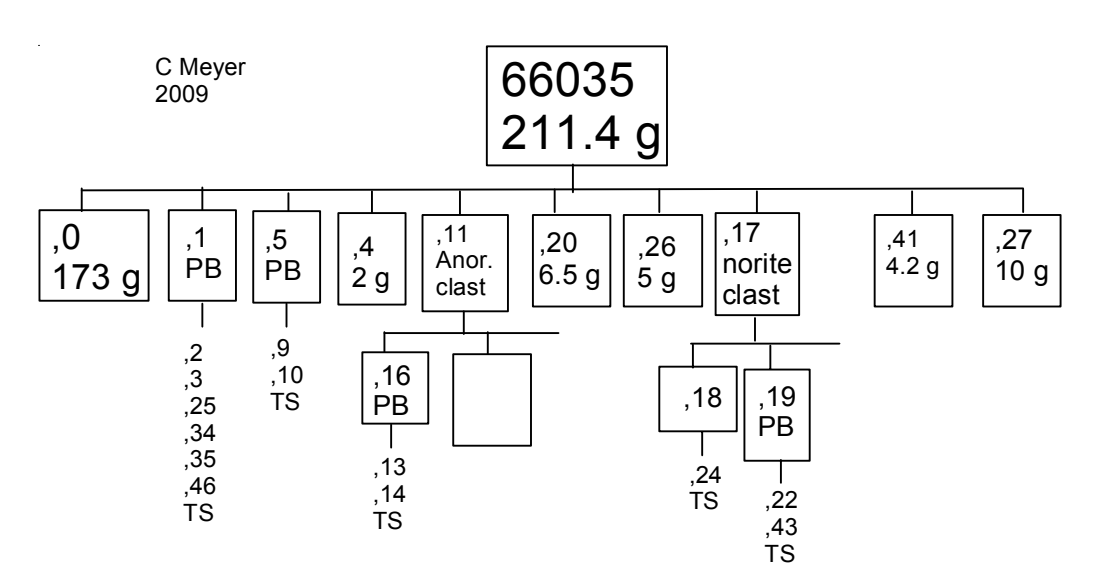
Table 1. Chemical composition of 66035.
| SiO2 % TiO2 FeO | weight | reference McKay86 Korotev96 Simon88 | Warren80 Warren 79 clast c2 | clast c1 | Warren 78 ,12 clast 44.3 (a) | Eldridge73 | ||||||
|---|---|---|---|---|---|---|---|---|---|---|---|---|
| Al2O3 | 0.43 28.5 4.85 | 4.69 | 0.66 30 4.15 | 47.1 (a) 0.27 (a) 19.6 (a) 10.9 | 44.3 0.84 29.8 3.21 | 44.3 0.67 31 2.83 | 29.8 3.22 | (a) (a) | ||||
| MnO MgO CaO Na2O | 5.25 16 0.442 | 15.6 0.474 | 0.053 4.6 15.2 0.5 | (a) 0.16 (a) 8.8 (a) 12.6 (a) 0.22 | 0.04 4.64 16.8 0.41 | 0.033 3.81 17.2 0.43 | 0.04 4.64 16.8 0.41 | (a) (a) (a) (a) | ||||
| K2O P2O5 S % sum | 0.096 | (a) 0.02 | 0.016 | 0.01 | 0.016 | (a) 0.092 | (b) | |||||
| Sc ppm V | 9.26 20 | 7.25 | 6.5 14 | (a) | (a) 23.1 | 2.3 | 3.1 | 2.32 | (a) | |||
| Cr Co Ni | 700 18.6 214 | 673 25 354 | 501 25.7 370 | (a) 1400 (a) 19.5 (a) 52 | 250 7.8 20.4 | 240 7.1 6 | 25.2 7.8 20.4 | (a) (a) (a) | ||||
| Cu Zn | 3.2 | 1.03 | 0.82 | 1.03 | (a) | |||||||
| Ga Ge ppb As | 195 | 4.1 72 | 4.5 48 | 4.1 72.4 | (a) (a) | |||||||
| Se Rb Sr | 187 | 183 | 1.6 110 | (a) (a) | ||||||||
| Y Zr | 150 | 214 | 140 | (a) 220 | ||||||||
| Nb Mo Ru | ||||||||||||
| Rh Pd ppb | ||||||||||||
| Ag ppb Cd ppb | 19 | 21 | 19 | (a) | ||||||||
| In ppb Sn ppb | 4.3 | 1.3 | 4.3 | (a) | ||||||||
| Sb ppb Te ppb | ||||||||||||
| Cs ppm Ba | 0.1 101 | 150 | 0.14 120 | (a) | (a) 113 | 21 | 17 | 21 | (a) | |||
| La Ce | 9.08 24.5 | 15.6 40.1 | 11.3 29.5 | (a) 1.88 (a) 4.6 | 0.58 1.1 | 0.54 1.3 | 0.58 1.1 | (a) (a) | ||||
| Pr Nd | 14 | 18.5 | (a) 6 | |||||||||
| Sm Eu | 4.23 1.095 | 6.93 1.23 | 5.09 1.24 | (a) 0.89 (a) 0.68 | 0.22 1.09 | 0.2 0.95 | 0.22 1.09 | (a) (a) | ||||
| Gd Tb Dy | 0.81 | 1.41 | 6.3 1.04 7.6 | (a) (a) | (a) 0.24 | 0.054 | (a) | |||||
| Ho Er | 1.4 | (a) | ||||||||||
| Tm Yb | 2.97 | 4.92 | 3.5 | (a) 1.11 | 0.2 | 0.27 | 0.2 | (a) | ||||
| Lu | 0.424 | 0.669 | 0.47 | (a) 0.18 | 0.026 | 0.036 | 0.026 | (a) | ||||
| Hf Ta | 3.26 0.39 | 5.27 0.57 | 3.6 0.41 | (a) 0.53 (a) 0.14 | 0.15 | |||||||
| W ppb Re ppb | 0.099 | 0.06 | 0.11 | 0.06 | (a) | |||||||
| Os ppb Ir ppb | 4.4 | 8.3 | 5.5 | (a) 1.04 | 0.3 | 0.9 | 0.3 | (a) | ||||
| Pt ppb Au ppb Th ppm | 4.5 1.77 | 7.8 2.5 | 1.4 1.52 | (a) 0.8 (a) 0.17 | 0.132 | 0.14 | 0.132 | (a) | 1.87 | (b) | ||
| U ppm | 0.38 | 0.67 | 0.51 | (a) 0.6 | 0.49 | (b) | ||||||
| technique: (a) INAA, (b) radiation counting |
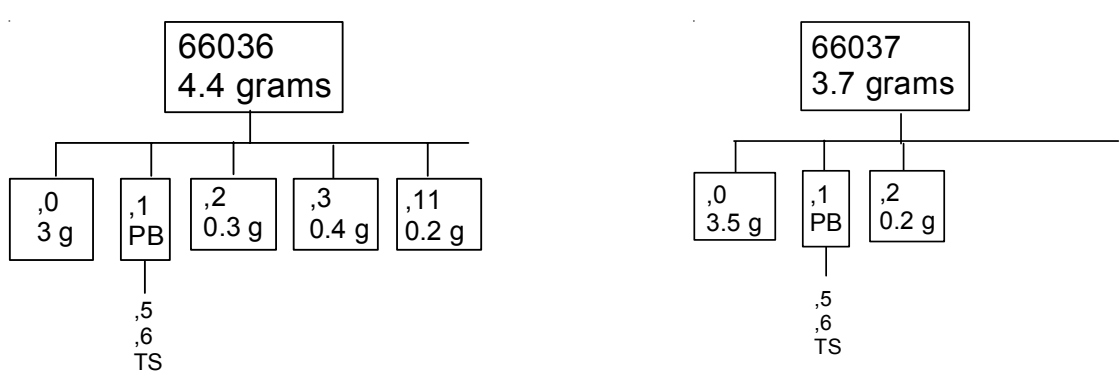
Table 2: Glass compositions in 66035.
| Grieve et al.1974 | Shearer 1990 | |||||||||||||||
|---|---|---|---|---|---|---|---|---|---|---|---|---|---|---|---|---|
| 1 | 2 | 3 | 4 | 5 | 6 | 10 | 11 | 12 | 13 | 14 | 15 | 16 | Wentworth 1988 | |||
| SiO2 | 71.25 | 56.69 | 63.94 | 57.68 | 44.89 | 43.38 49.77 | 43.55 44.94 | 44.1 | 44.17 | 47.48 | 47.31 | 48.5 | 48.9 | (a) | ||
| TiO2 | 0.58 | 1.18 | 2.83 | 0.98 | 0.01 | 0.03 | 1.13 | 2.99 | 2.62 | 1.74 | 2.49 | 0.92 | 1.27 | 0.7 | 1.56 | (a) |
| Al2O3 12.35 | 6.76 | 11.52 | 17.05 | 35.62 | 33.36 20.84 | 22.43 17.87 | 14.77 14.77 | 22.74 | 19.79 | 23.46 | 18.8 | (a) | ||||
| FeO | 5.67 | 30.23 | 10.4 | 7.77 | 0.14 | 0.88 | 2.28 | 4.04 | 6.27 | 5.07 | 7.77 | 6.73 | 8.42 | 2.1 | 0.52 | (a) |
| MnO | 0.11 | 0.4 | 0.14 | 0.11 | 0.01 | 0.02 | 0.27 | 0.04 | 0.1 | 0.05 | 0.11 | 0.1 | 0.11 | 0.9 | 0.17 | (a) |
| MgO | 0 | 0.57 | 1.73 | 4.12 | 0 | 1.33 | 8.44 | 12.96 16.05 | 17.4 | 20.65 | 7.79 | 9.22 | 10.44 | 10.58 | (a) | |
| CaO | 1.99 | 1.44 | 5.81 | 8.4 | 18.74 | 18.71 12.54 | 13.2 | 10.52 | 11.34 8.29 | 13.66 | 12.03 | 14.83 | 16.72 | (a) | ||
| Na2O | 2.43 | 0.05 | 0.11 | 1.12 | 0.28 | 0.77 | 1.2 | 0.05 | 0 | 0.06 | 1.26 | 0.16 | 0.67 | 0.24 | 1.26 | (a) |
| K2O | 5.39 | 2.65 | 4.49 | 2.25 | 0.01 | 0.01 | 2.14 | 0.07 | 0 | 0.01 | 0.27 | 0 | 0.35 | 0.05 | 0.5 | (a) |
| P2O5 | 0.01 | 0 | (a) | |||||||||||||
| Zr | 256 | 768 | (b) | |||||||||||||
| Ba | 128 | 986 | (b) | |||||||||||||
| La | 16 | 68 | (b) |
Lunar Sample Compendium C Meyer 2012
Lunar Sample Compendium C Meyer 2012
References for 66035, 36 and 37
Section titled “References for 66035, 36 and 37”Bersch M.G., Taylor G.J., Keil K. and Norman M.D. (1991) Mineral compositions in pristine lunar highland rocks and the diversity of highland magmatism. Geophys. Res. Letters 18, 2085-2088.
Butler P. (1972) Lunar Sample Information Catalog Apollo 16. Lunar Receiving Laboratory. MSC 03210 Curator’s Catalog. pp. 370.
Cohen B.A., Symes S.J. and Swindle T.D. (2006) Petrography and chemistry of impact-melt clasts in Apollo 16 breccias (abs#1379). Lunar Planet. Sci. XXXVII, Lunar Planetary Institute, Houston.
Cohen B.A., Symes S.J., Swindle T.D., Weirich J. and Isachsen C. (2007) Ages of Impact-melt clasts in Apollo 16 breccias (abs#1006). Lunar Planet. Sci. XXXVIII, Lunar Planetary Institute, Houston.
Eldridge J.S., O’Kelley G.D. and Northcutt K.J. (1973) Radionuclide concentrations in Apollo 16 lunar samples determined by nondestructive gamma-ray spectrometry. Proc. 4th Lunar Sci. Conf. 2115-2122.
Fruland Ruth M. (1983) Regolith Breccia Workbook. Curatorial Branch Publication # 66. JSC 19045.
Grieve R.A.F., Plant A.G. and Dence M.R. (1974) Lunar impact melts and terrestrial analogs: Their characteristics, formation and implications for crustal evolution. Proc. 5th Lunar Sci. Conf. 261-273.
Hunter R.H. and Taylor L.A. (1981) Rust and schreibersite in Apollo 16 highland rocks: Manifestations of volatileelement mobility. Proc. 12th Lunar Planet. Sci. Conf. 253- 259.
James O.B. (1981) Tentative classification of the Apollo 16 breccias (abs). Lunar Planet. Sci. XII, 506-508.
Joy K.H., Kring D.A., Bogard D.D., McKay D.S. and Zolensky M.E. (2012) Re-examination of the formation ages of the Apollo 16 regolith breccias. Geochem. Cosmochim. Acta 75, 7208-7225.
Joy K.H., Zolensky M.E., Ross D.K., McKay D.S. and Kring D.A. (2012) Direct detection of projectile relicts on the Moon (abs#4035). Early Solar System Impact Bombardment II. Lunar Planet. Sci. Institute, Houston.
Korotev R.L. (1996c) On the relationship between the Apollo 16 ancient regolith breccias and feldspathic fragmental breccias, and the composition of the prebasin crust in the Central Highlands of the Moon. Meteor. & Planet. Sci. 31, 403-412.
McKay D.S., Bogard D.D., Morris R.V., Korotev R.L., Johnson P. and Wentworth S.J. (1986) Apollo 16 regolith breccias: Characterization and evidence for early formation in the megaregolith. Proc. 16th Lunar Planet. Sci. Conf. in J. Geophys. Res. 91, D277-D303.
Quick J.E., Brock B.S. and Albee A.L. (1978) Petrology of Apollo 16 breccia 66075. Proc. 9th Lunar Planet. Sci. Conf. 921-939.
Ryder G. and Norman M.D. (1980) Catalog of Apollo 16 rocks (3 vol.). Curator’s Office pub. #52, JSC #16904
Shearer C.K., Papike J.J., Galbreath K.C., Wentworth S.J. and Shimizu N. (1990b) A SIMS study of lunar “komatiitic glasses”. Trace element characteristics and possible origin. Geochim. Cosmochim. Acta 54, 1851-1857.
Simon S.B., Papike J.J., Laul J.C., Hughes S.S. and Schmitt R.A. (1988) Apollo 16 regolith breccias and soils: Recorders of exotic component addition to the Descartes region of the moon. Earth Planet. Sci. Lett. 89, 147-162.
Warner J.L., Simonds C.H. and Phinney W.C. (1973) Apollo 16 rocks: Classification and petrogenetic model. Proc. 4th Lunar Sci. Conf. 481-504.
Warren P.H. and Wasson J.T. (1978) Compositionalpetrographic investigation of pristine nonmare rocks. Proc. 9th Lunar Planet. Sci. Conf. 185-217.
Warren P.H. and Wasson J.T. (1979a) The compositionalpetrographic search for pristine nonmare rocks: Third foray. Proc. 10th Lunar Planet. Sci. Conf. 583-610.
Warren P.H. and Wasson J.T. (1980a) Further foraging of pristine nonmare rocks: Correlations between geochemistry and longitude. Proc. 11th Lunar Planet. Sci. Conf. 431- 470.
Warren P.H. and Kallemeyn G.W. (1984) Pristine rocks (8th foray): Plagiophile element ratios, crustal genesis, and the bulk composition of the Moon. Proc. 15th Lunar Planet. Sci. Conf. in J. Geophys. Res. 89, C16-C24.
Warren P.H. (1993) A concise compilation of petrologic information on possibly pristine nonmare Moon rocks. Am. Mineral. 78, 360-376.
Wentworth S.J. and McKay D.S. (1988) Glasses in ancient and young Apollo 16 regolith breccias: Populations and ultra-Mg glass. Proc. 18th Lunar Planet. Sci. Conf. 67-77. Lunar Planetary Institute, Houston.