Sample 67601
67601 – 186 grams 67610 – 67 grams Soil and rake residue
Section titled “67601 – 186 grams 67610 – 67 grams Soil and rake residue”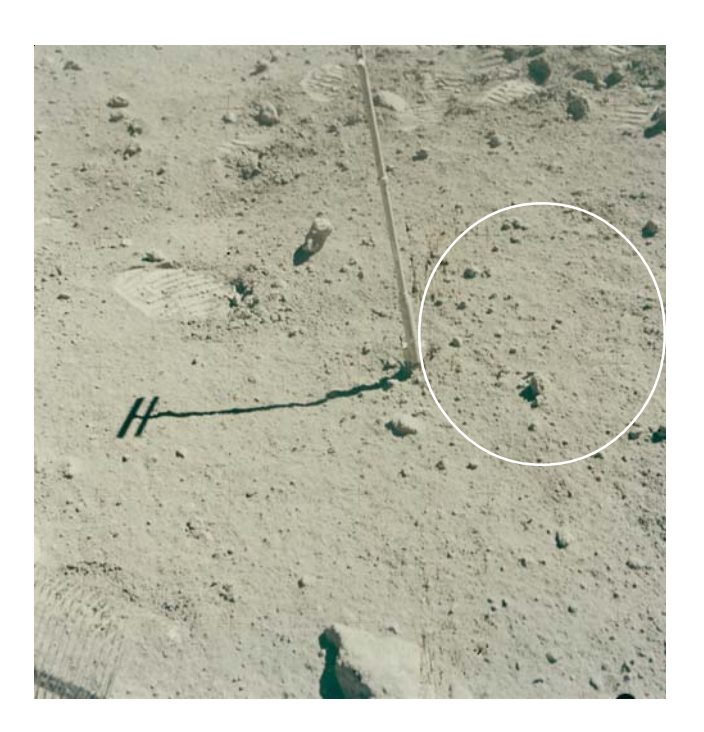
Figure 1: Photo of area where 67600 and 67610 were collected. AS16-116-18642
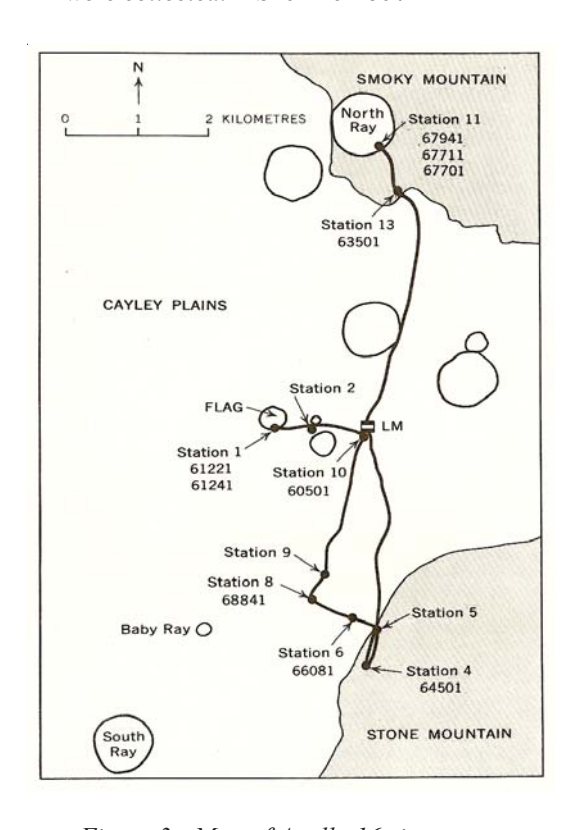
Figure 3: Map of Apollo 16 site.
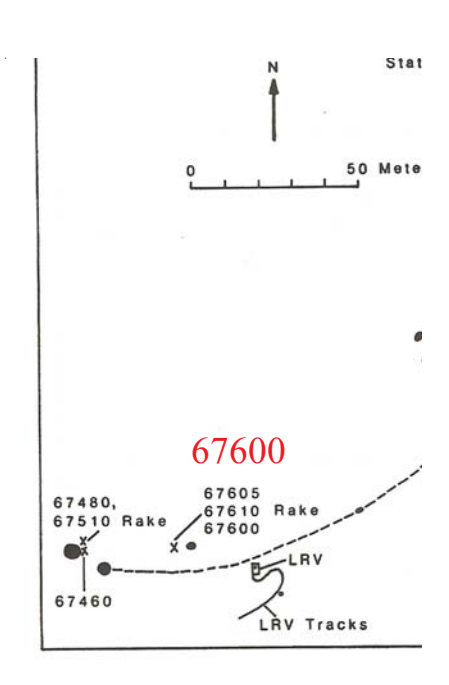
Figure 2: Map showing location of samples 67600 and 67610 inside of rim of North Ray Crater.
Introduction
Section titled “Introduction”Soil sample 67600 and rake sample 67610 were collected on the “bench” just inside the rim of North Ray Crater (figures 1 - 3).
The soil samples from North Ray Crater have noticeably coarser grain size and are apparently less mature compared with other lunar soils probably due to the fact that NRC is only 50 m.y. old (Arvidson et al. 1975). It is thought that NRC was deep enough to penetrate through the Cayley Formation to sample the Descartes Formation, and indeed the change in chemical composition indicates this may be the case. According to cratering theory, the rock samples on the crater rim are mostly likely to be from the greatest depth (Ulrich et al. 1981).
Petrography
Section titled “Petrography”The maturity index for 67601 is $I_s/FeO = 45$ and the agglutinate content is 36 %. The average grain size is 113 microns (figure 6). The mode for 67601 is given in Heiken et al. (1973) and Houck (1982).
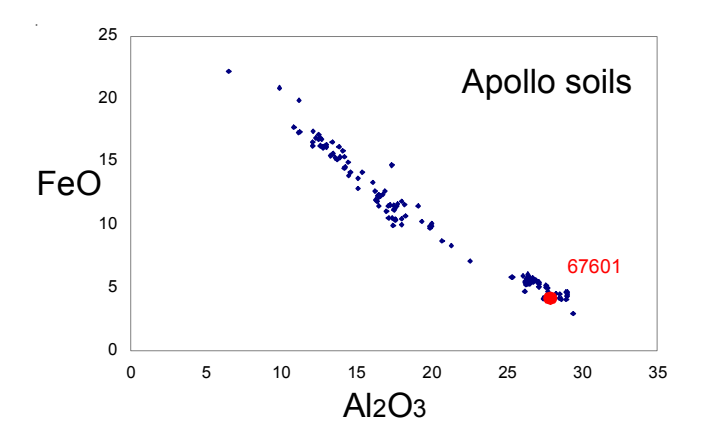
Figure 4: Composition of 67601 compared with that of other Apollo soil samples.
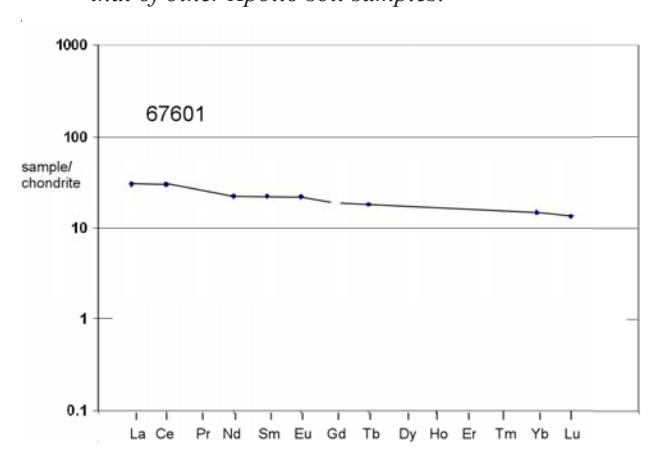
Figure 5: Normalized rare-earth-element diagram.
Marvin (1972) cataloged the coarse-fine particles, while Delano et al. (1973) and Taylor et al. (1973) studied their mineralogy. Smith and Steele (1972) cataloged the rake samples from 67610.
Chemistry
Section titled “Chemistry”The chemical composition of station 11 soils (NRC) is noticeably different from that of other Apollo 16 soils. The Al content is higher, and the Fe and REE content is lower.
Muller (1973) determined 209 ppm nitrogen in the less than 24 micron size fraction of 67601, while Kerridge et al. (1975) and Becker and Clayton (1977) reported only 39 ppm and 44 ppm nitrogen, respectively, for bulk 67601.
Cirlin and Housley (1981) determined 25 ppb Cd and 7.1 ppm Zn.
Mineralogical Mode for 67601
Section titled “Mineralogical Mode for 67601”| Heiken et | Houck | |
|---|---|---|
| al. 1973 | 1982 | |
| Agglutinate | 36 % | 27.2 |
| Breccia | 40.2 | 48.2 |
| Anorthosite | 3.6 | 0.7 |
| Olivine | 0.7 | |
| Pyroxene | 2.9 | 3 |
| Plagioclase | 14 | 18.7 |
| Opaques | ||
| Glass | 1.6 | 1.7 |
| Basalt | 0.6 |
Cosmogenic isotopes and exposure ages
Section titled “Cosmogenic isotopes and exposure ages”Clark and Keith (1973) determined the cosmic-rayinduced activity of 26Al = 96 dpm/kg, 22Na = 33 dpm/ kg, 54Mn = 6 dpm/kg, and 46Sc = <4 dpm/kg. Kirsten et al. (1973) reported a 21Ne exposure age of 55 m.y.
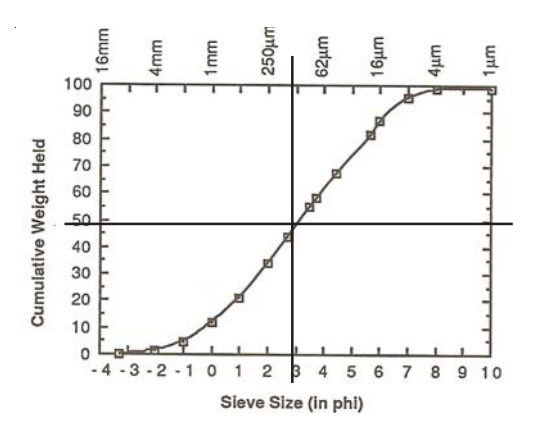
average grain size = 113 microns
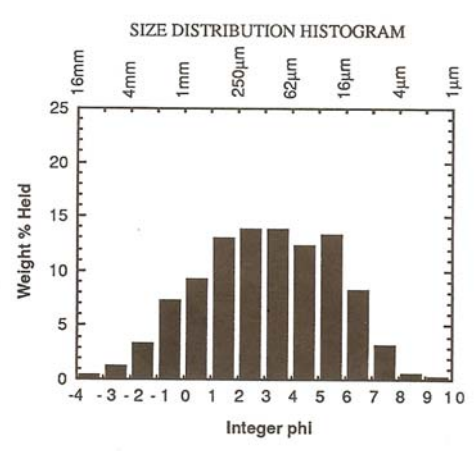
Figure 6: Grain size distribution for 67601 (Graf 1993, from data by Heiken et al.)
Table 1. Chemical composition of 67601.
| reference LSPET72 Clark73 | Korotev91 Krahenbuhl73 | Haskin73 | Boynton75 | ave. st. 11 Korotev81 | |||||||||
|---|---|---|---|---|---|---|---|---|---|---|---|---|---|
| weight SiO2 % TiO2 Al2O3 FeO MnO MgO CaO Na2O K2O P2O5 S % sum | 45.3 0.42 28.9 4.09 0.06 4.75 16.4 0.44 0.07 0.06 0.04 | (a) (a) (a) (a) (a) (a) (a) (a) (a) (a) | (a) 0.072 | (b) | 4.23 16.1 0.509 (c ) | (c ) (c ) | 45.3 0.5 27.4 4.02 4.53 16 0.53 0.071 (c ) | (c ) (c ) (c ) (c ) | (c ) 4.24 0.054 (c ) 0.062 (c ) 18 (c ) 0.593 | (c ) (c ) (c ) (c ) | 45.1 0.41 28.9 4.2 0.056 4.3 16.5 0.48 0.065 | ||
| Sc ppm V | 7.01 | (c ) | 6.6 | (c ) 7.2 | (c ) | 7.3 18 | |||||||
| Cr Co Ni | 540 111 | (a) (a) | 568 27.9 363 | (c ) (c ) | (c ) 175 | 543 14.4 (d) 180 | (c ) | (c ) 500 (c ) 18 | (c ) (c ) | 515 14.5 140 | |||
| Cu Zn | 6.9 | (d) 10 | (c ) | ||||||||||
| Ga Ge ppb As | 245 | (d) | 4.4 | (c ) | |||||||||
| Se Rb Sr Y | 1.3 194 22 | (a) (a) (a) | 193 | (c ) | 1.3 | (d) | 1.65 180 20 | ||||||
| Zr Nb Mo Ru Rh | 89 5.4 | (a) (a) | 79 | (c ) | 83 | ||||||||
| Pd ppb Ag ppb Cd ppb In ppb | 4.5 21 | (d) | |||||||||||
| Sn ppb Sb ppb Te ppb | 0.73 8.5 | (d) (d) | |||||||||||
| Cs ppm Ba La Ce Pr | 0.07 84 6.99 17.9 | (c ) (c ) (c ) | (c ) 0.054 | (d) 0.064 (c ) 6.7 16.5 | 70 (c ) 5.6 (c ) 16 | (c ) (c ) (c ) | 71 5.9 | ||||||
| Nd Sm Eu | 10 3.28 1.23 | (c ) (c ) (c ) | 11.1 3.1 1.29 | (c ) (c ) | (c ) 1.26 | (c ) | 2.8 1.13 | ||||||
| Gd Tb Dy Ho Er | 0.66 | (c ) | 4.1 0.62 4.3 0.86 | (c ) (c ) | (c ) 0.65 (c ) 5.3 | (c ) (c ) | 0.56 | ||||||
| Tm Yb Lu Hf Ta | 2.39 0.329 (c ) 2.29 0.3 | (c ) (c ) (c ) | 2.28 0.33 1.99 | (c ) 2.3 (c ) 0.39 (c ) 2.2 0.3 | (c ) (c ) (c ) (c ) | 2.05 0.29 1.85 0.3 | |||||||
| W ppb Re ppb | 0.527 | (d) | |||||||||||
| Os ppb Ir ppb Pt ppb | 7.4 | (c ) 5.01 | (d) | ||||||||||
| Au ppb Th ppm U ppm | 1.6 | (a) 1.04 0.28 | 5 (b) 1.15 (b) 0.31 | (c ) | (c ) 2.47 (c ) 0.295 technique: (a) XRF, (b) radiation count. (c ) INAA, (d) RNAA | (d) (d) | 1 | (c ) | 1 0.27 |
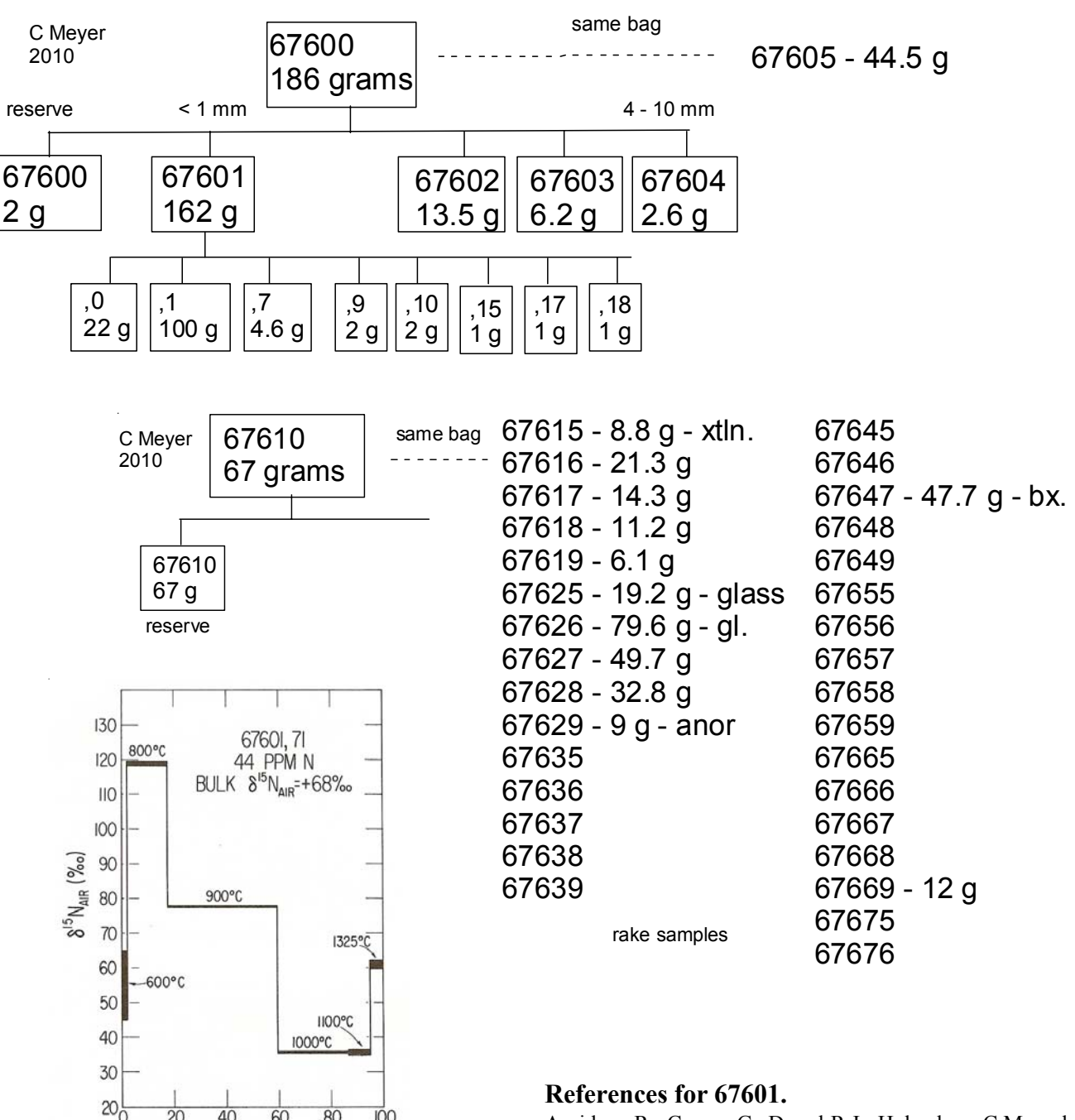
Figure 7: Nitrogen isotopes as function of release temperature (Becker and Clayton 1977).
Becker and Clayton (1977) determined the isotopic composition of nitrogen (figure 7). Boynton W.V., Baedecker P.A., Chou C.-L., Robinson K.L.
Nunes (19750 reported studies of the Pb isotopes.
Arvidson R., Crozaz G., Drozd R.J., Hohenberg C.M. and Morgan C.J. (1975) Cosmic ray exposure ages of features and events at the Apollo landing sites. The Moon 13, 259 276.
Becker R.H. and Clayton R.N. (1977) Nitrogen isotopes in lunar soils as a measure of cosmic-ray exposure and regolith Other Studies history. Proc. 8th Lunar Sci. Conf. 3685-3704.
and Wasson J.T. (1975a) Mixing and transport of lunar Kirsten et al. (1973) determined the rare gas content surface materials: Evidence obtained by the determination of lithophile, siderophile, and volatile elements. Proc. 6th and isotopic ratios for 67601. Lunar Sci. Conf. 2241-2259.
Butler P. (1972) Lunar Sample Information Catalog Apollo 16. Lunar Receiving Laboratory. MSC 03210 Curator’s Catalog. pp. 370.
Cirlin E.H. and Housley R.M. (1981) Distribution and evolution of Zn, Cd, and Pb in Apollo 16 regolith samples and the average U-Pb ages of the parent rocks. Proc. 12th Lunar Planet. Sci. Conf. 529-540.
Clark R.S. and Keith J.E. (1973) Determination of natural and cosmic ray induced radionuclides in Apollo 16 lunar samples. Proc. 4th Lunar Sci. Conf. 2105-2113.
Delano J.W., Bence A.E., Papike J.J. and Cameron K.L. (1973) Petrology of the 2 -4 mm soil fractions from the Descartes region of the moon and stratigraphic implications. Proc. 4th Lunar Sci. Conf. 537-551.
Graf J.C. (1993) Lunar Soils Grain Size Catalog. NASA Pub. 1265
Haskin L.A., Helmke P.A., Blanchard D.P., Jacobs J.W. and Telunder K. (1973) Major and trace element abundances in samples from the lunar highlands. Proc. 4th Lunar Sci. Conf. 1275-1296.
Heiken G.H., McKay D.S. and Fruland R.M. (1973b) Apollo 16 soils – grain size analysis and petrography. Proc. 4th Lunar Sci. Conf. 251-266.
Houck K.J. (1982a) Petrologic variations in Apollo 16 surface soils. Proc. 13th Lunar Planet. Sci. Conf. J. Geophys. Res. 87, A197-A209.
Kirsten T., Horn P. and Kiko J. (1973a) 39Ar/40Ar dating and rare gas analysis of Apollo 16 rocks and soils. Proc. 4th Lunar Sci. Conf. 1757-1784.
Korotev R.L. (1991) Geochemical stratigraphy of two regolith cores from the Central Highlands of the Moon. Proc. 21st Lunar Planet. Sci. Conf. 229-289. Lunar Planetary Institute, Houston
Korotev R.L. and Morris R.V. (1993) Composition of Apollo 16 regolith core 60013/14. Geochim. Cosmochim. Acta 57, 4813-4826.
Krahenbuhl U., Ganapathy R., Morgan J.W. and Anders E. (1973b) Volatile elements in Apollo 16 samples: Implications for highland volcanism and accretion history of the moon. Proc. 4th Lunar Sci. Conf. 1325-1348.
LSPET (1973) The Apollo 16 lunar samples: Petrographic and chemical description. Science 179, 23-34.
LSPET (1972) Preliminary examination of lunar samples. Apollo 16 Preliminary Science Report. NASA SP-315, 7 1—7-58.
Marvin U.B. (1972) Apollo 16 coarse fines (4-10 mm): Sample classification, description and inventory. JSC Catalog.
Moore C.B., Lewis C.F. and Gibson E.K. (1973) Total carbon contents of Apollo 15 and 16 lunar samples. Proc. 4th Lunar Sci. Conf. 1613-1923.
Moore C.B. and Lewis C.F. (1975) Total nitrogen contents of Apollo 15, 16 and 17 lunar fines samples. Lunar Sci. VI, 569-571.
Morris R.V., Score R., Dardano C. and Heiken G. (1983) Handbook of Lunar Soils. Two Parts. JSC 19069. Curator’s Office, Houston
Morris R.V. (1978) The surface exposure (maturity) of lunar soils: Some concepts and Is/FeO compilation. Proc. 9th Lunar Sci. Conf. 2287-2297.
Müller O. (1973) Chemically bound nitrogen contents of Apollo 16 and Apollo 15 lunar fines. Proc. 4th Lunar Sci. Conf. 1625-1634.
Nunes P.D. (1975) Pb loss from Apollo 17 glassy samples and Apollo 16 revisited. Proc. 6th Lunar Sci. Conf. 1491 1499.
Papike J.J., Simon S.B. and Laul J.C. (1982) The lunar regolith. Rev. Geophys. Space Phys. 20, 761-826.
Smith J.V. and Steele I.M. (1972) Apollo 16 rake samples 67515 to 68537: Sample classification, description and inventory. Curator’s Catalog. JSC
Sutton R.L. (1981) Documentation of Apollo 16 samples. In Geology of the Apollo 16 area, central lunar highlands. (Ulrich et al. ) U.S.G.S. Prof. Paper 1048.
Taylor G.J., Drake M.J., Hallam M.E., Marvin U.B. and Wood J.A. (1973b) Apollo 16 stratigraphy: The ANT hills, the Cayley Plains and a pre-Imbrian regolith. Proc. 4th Lunar Sci. Conf. 553-568.