Sample 69955
Cataclastic Anorthosite 75.9 grams
Section titled “Cataclastic Anorthosite 75.9 grams”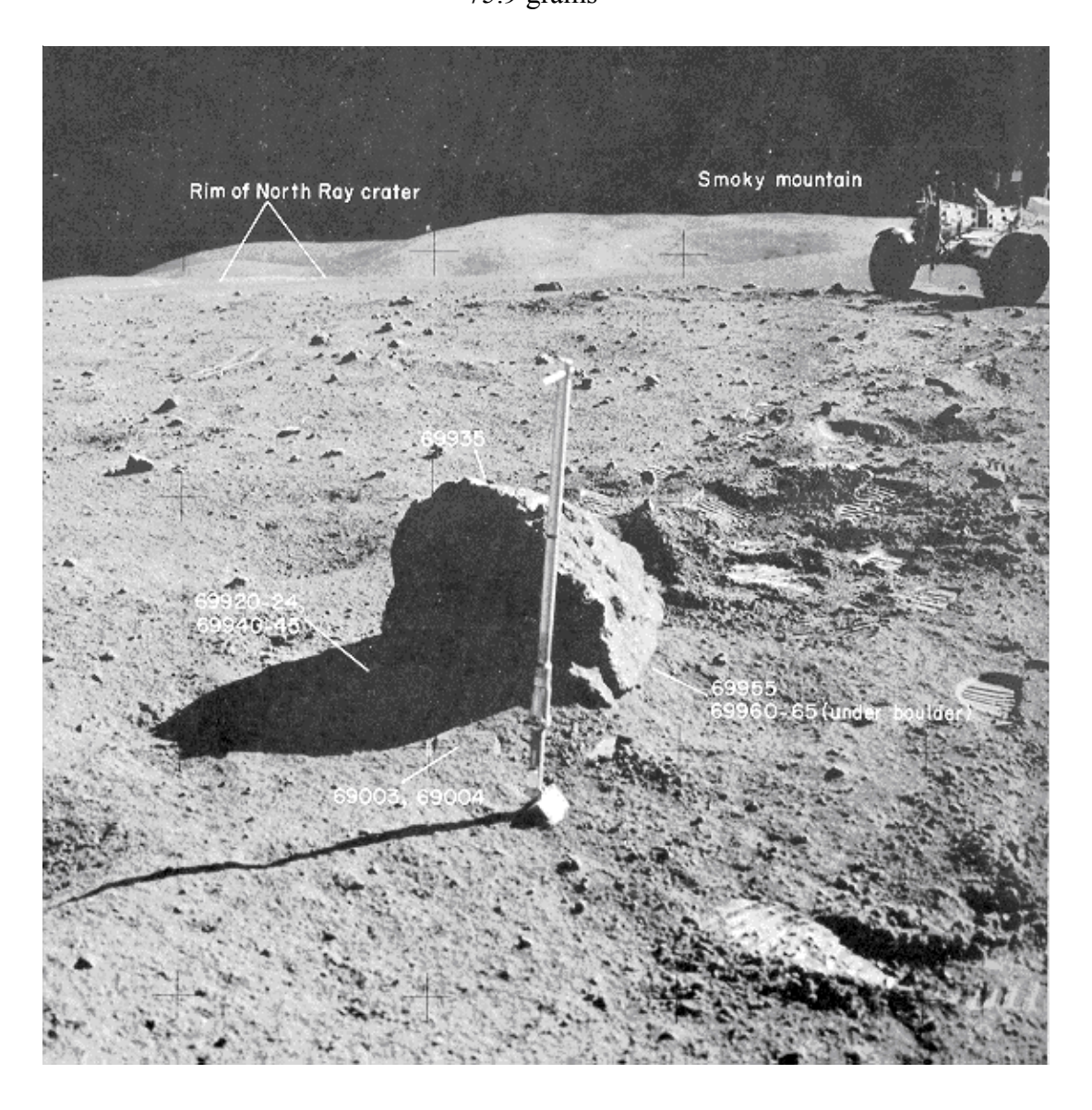
Figure 1: Boulder at station 9, Apollo 16 showing postion of samples 69935 (breccia, top) and 69955 (anorthosite, bottom). This boulder is thought to be from South Ray Crater (Sutton 1981), because it is perched, without a fillet, on the regolith. Boulder is about 0.5 meter in size.
Introduction
Section titled “Introduction”Lunar sample 69955 was chipped from the bottom of a 0.5 meter-sized boulder found perched on the lunar regolith (Sutton 1981). Hence, 69955 was a clast in a breccia (represented by 69935). This boulder (figure 1) may have been derived from South Ray Crater (Sutton 1981) or secondary craters from the SRC event (Drozd et al. 1974) at about ~ 2 m.y. See transcript in section on 69935.
Petrography
Section titled “Petrography”Petrographic descriptions of 69955 are found in the catalogs by Butler (1972) and Ryder and Norman (1980). The sample is almost entirely made of plagioclase (figures 2 and 3). It was noted that the plagioclase had a greasy luster in hand specimen.
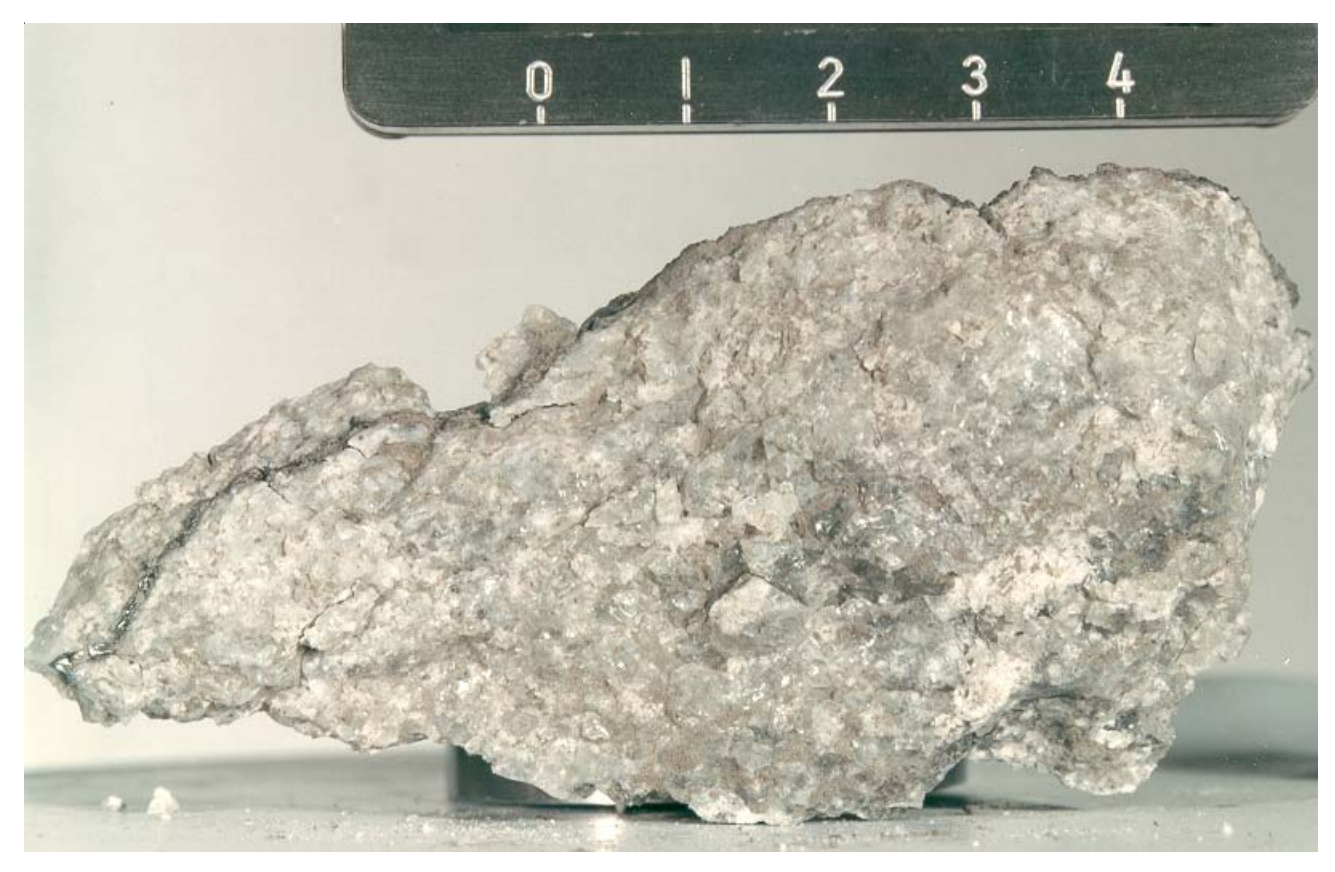
Figure 2: Photo of 69955. NASA S72-40124. Scale at top is in cm.
McGee (1993) described a portion as: “a rock that is relatively coarse-grained, shocked cataclastic anorthosite. Most of the plagioclase has been converted to maskelynite. Less shocked (still birefringent) patches of plagioclase within the maskelynite are as much as 3 mm across. Pyroxene grains are 0.1-0.08 mm across and have no visible exsolution lamellae. Some relict intergranular texture is preserved in lithic clasts. Plagioclase compositions have a relatively large range. Low-Ca pyroxene compositions are heterogeneous and have a trimodal distribution. High-Ca pyroxene compositions have a fairly narrow range. Rare olivine (Fo61) with included chromite, is present.”
Photos show a thin (2 mm) flat black glass vein running the length of the sample.
Mineralogy
Section titled “Mineralogy”Olivine: not analyzed
Pyroxene: McGee (1993) analyzed pyroxene in 69955 (figure 5). Note the very low Ca orthopyroxene.
Plagioclase: Ryder and Norman (1980) reported that some plagioclase was ~ 5 mm across and some maskelynite is present. Meyer (1979) and McGee (1993) reported trace element analyses of plagioclase (figure 6).
Ilmenite: not reported
Metal: Misra and Taylor (1975) reported Ni and Co contents of metallic iron in 69955, but they show meteoritic values and may be from the glass vein. Hunter and Taylor (1981) reported trace rust and schreibersite.
Chemistry
Section titled “Chemistry”Krahenbuhl et al. (1973) showed that 69955 was generally poor in meteoritic siderophiles as well as other trace elements. Analyses by Rose et al. (1973) and Laul and Schmitt (1973) show the rock is almost entirely plagioclase (figure 4).
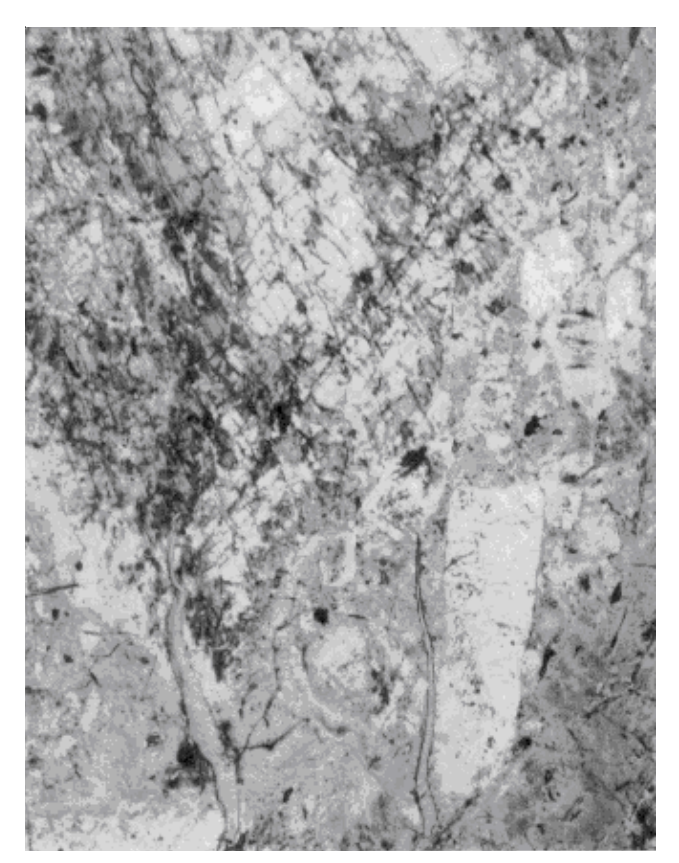
Figure 3: Photomicrograph of thin section 69955,27 (partially crossed polarized light). From Ryder and Norman (1980). Width of field is 2 mm.
Cosmogenic isotopes and exposure ages
Section titled “Cosmogenic isotopes and exposure ages”Drozd et al. (1974) reported cosmic ray exposure ages 81Kr = 4.23 ± 0.21 and 21Ne = 2.13 ± 0.51 m.y. Fruchter et al. (1978, 1981) reported the cosmic-ray-induced activity of 26Al = 70 dpm/kg. and 53Mn = 148 dpm/kg., finding that the radiation history is not consistent with origin of the boulder from South Ray Crater.
Processing
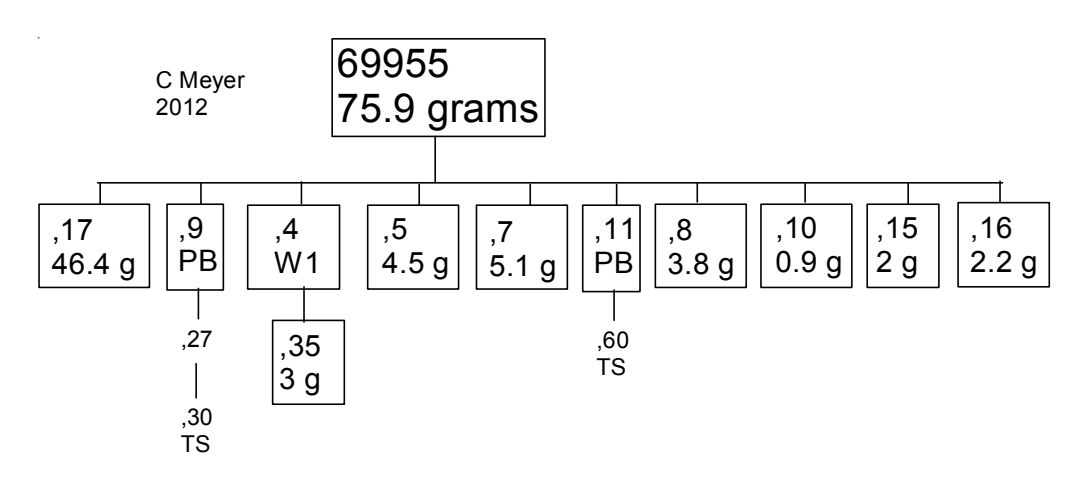
Section titled “Processing”There are 5 thin sections of 69955. Figure 7 shows how it was broken, not sawn.
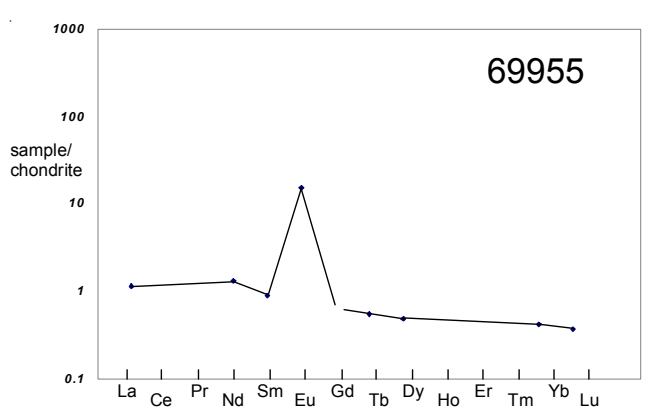
Figure 4: Normalized rare-earth-element diagram for 69955 (data by Laul and Schmitt 1973).
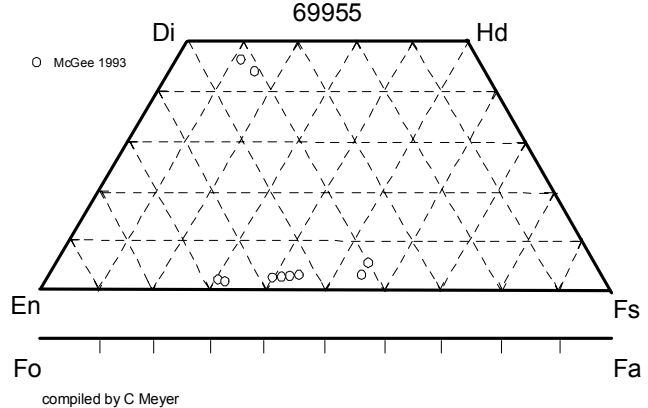
Figure 5: Composition of pyroxene in 69955 (McGee 1993).
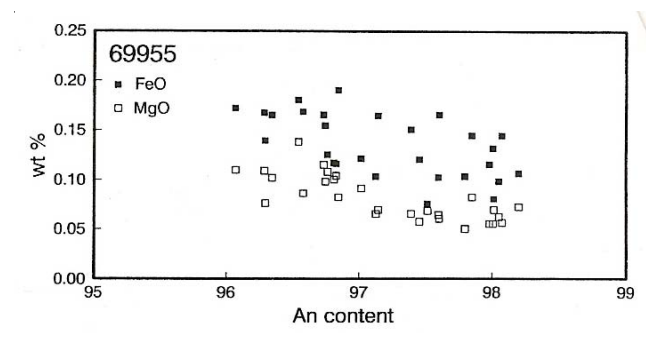
Figure 6: Trace element sin plagioclase (McGee 1993).
Table 1. Chemical composition of 69955.
| reference weight | Rancitelli 73 Rose 73 75.8 g | Laul 73 516 mg | Krahenbuhl73 | ||||
|---|---|---|---|---|---|---|---|
| SiO2 % TiO2 Al2O3 FeO MnO MgO CaO Na2O K2O P2O5 S % sum | <0.0108 | 44.1 0.01 35.15 0.36 0.01 0.23 19.3 0.42 (a) 0.02 0.01 | (b) (b) (b) | (b) 0.04 (b) 35.5 (b) 0.49 (b) 0.011 | (c ) (c ) (c ) (c ) | ||
| (b) 18.9 (b) 0.4 (b) 0.01 | (c ) (c ) (c ) | ||||||
| Sc ppm V | 0.84 7 | (c ) (c ) | |||||
| Cr Co | 350 | (b) 48 0.8 | (c ) (c ) | ||||
| Ni Cu | 43 1.1 | (b) (b) | 9.8 | (d) | |||
| Zn Ga Ge ppb As | 1.2 | (b) | 0.37 | (d) | |||
| 22 | (d) | ||||||
| Se Rb Sr | 0.7 135 | (b) (b) | 9.8 0.15 | (d) (d) | |||
| Y Zr | |||||||
| Nb Mo Ru | |||||||
| Rh Pd ppb | |||||||
| Ag ppb Cd ppb In ppb | 0.58 37 | (d) (d) | |||||
| Sn ppb Sb ppb | 0.21 | (d) | |||||
| Te ppb Cs ppm | 1 0.011 | (d) (d) | |||||
| Ba La Ce | 11 | 10 0.27 | (c ) (c ) | ||||
| Pr Nd Sm | 0.6 0.13 | (c ) (c ) | |||||
| Eu Gd | 0.87 | (c ) | |||||
| Tb Dy Ho | 0.02 0.12 | (c ) (c ) | |||||
| Er Tm | |||||||
| Yb Lu Hf Ta | 0.068 0.009 0.024 0.01 | (c ) (c ) (c ) (c ) | |||||
| W ppb Re ppb | 0.0278 | (d) | |||||
| Os ppb Ir ppb | 0.289 | (d) | |||||
| Pt ppb Au ppb | 0.307 | (d) | |||||
| Th ppm U ppm | 0.14 (a) 0.038 (a) | 0.03 | (c ) 0.026 | (d) | |||
| technique: (a) radiation counting, (b) microchemical XRF, (c ) INAA, (d) RNAA |
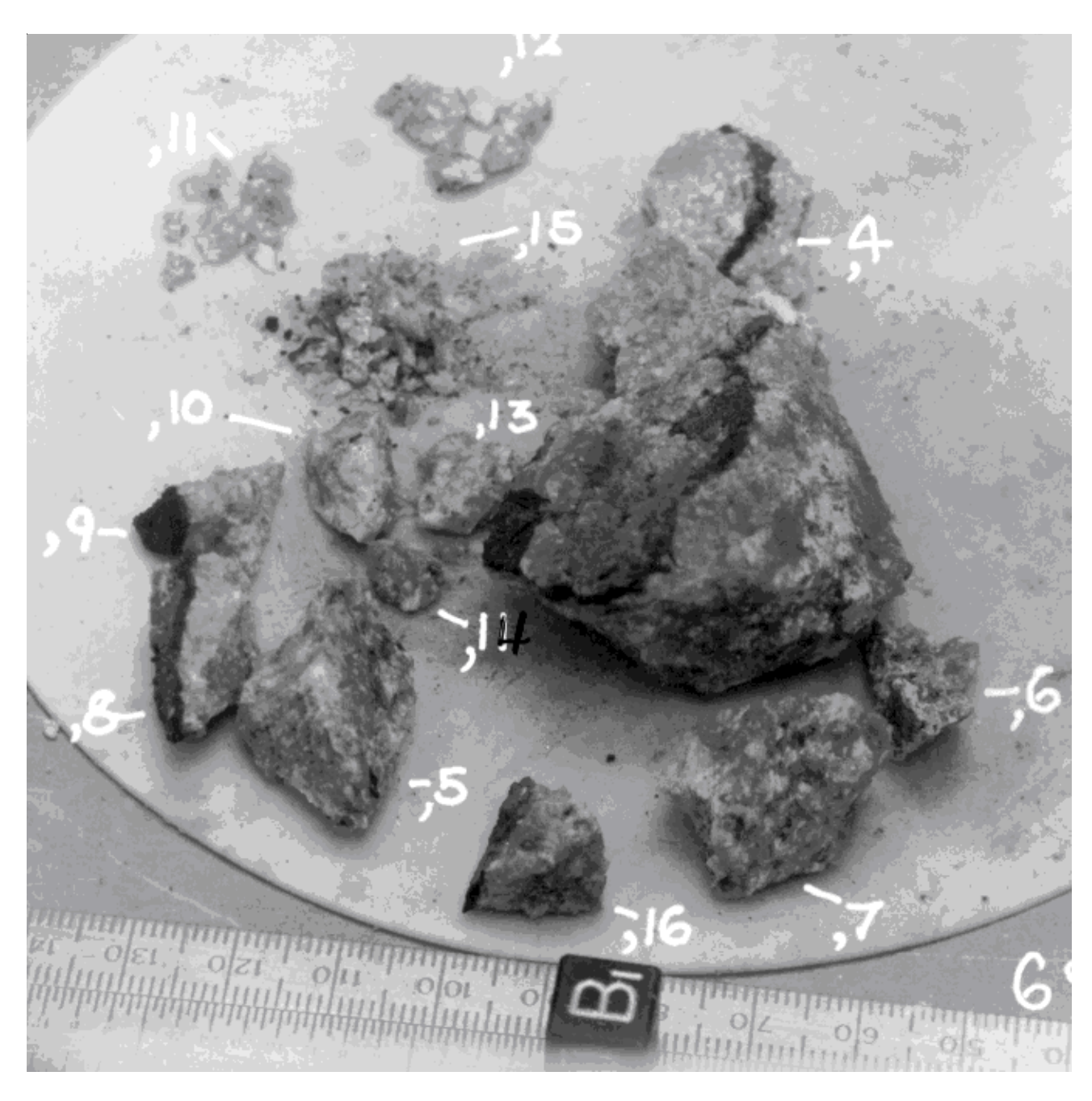
Figure 7: Processing 69955. NASA S73-22189. Cube is 1 cm.
References for 69955
Section titled “References for 69955”Arvidson R., Crozaz G., Drozd R.J., Hohenberg C.M. and Morgan C.J. (1975) Cosmic ray exposure ages of features and events at the Apollo landing sites. The Moon 13, 259 276.
Behrmann C.J., Crozaz G., Drozd R., Hohenberg C., Ralston C., Walker R. and Yuhas D. (1973b) Cosmic-ray exposure history of North Ray and South Ray material. Proc. 4th Lunar Sci. Conf. 1957-1974.
Butler P. (1972a) Lunar Sample Information Catalog Apollo 16. Lunar Receiving Laboratory. MSC 03210 Curator’s Catalog. pp. 370.
Drozd R.J., Hohenberg C.M., Morgan C.J. and Ralston C.E. (1974) Cosmic-ray exposure history at the Apollo 16 and other lunar sites: lunar surface dynamics. Geochim. Cosmochim. Acta 38, 1625-1642.
Fruchter J.S., Reeves J.H., Evans J.C. and Perkins R.W. (1981) Studies of lunar regolith dynamics using measurements of cosmogenic radionuclides in lunar rocks, soils and cores. Proc. 12th Lunar Planet. Sci. Conf. 567 575.
Fruchter J.S., Rancitelli L.A., Evans J.C. and Perkins R.W. (1978a) Lunar surface processes and cosmic ray histories over the past several million years. Proc. 9th Lunar Planet. Sci. Conf. 2019-2032.
Ganapathy R., Morgan J.W., Higuchi H., Anders E. and Anderson A.T. (1974) Meteoritic and volatile elements in Apollo 16 rocks and in separated phases from 14306. Proc. 5th Lunar Sci. Conf. 1659-1683.
Hertogen J., Janssens M.-J., Takahashi H., Palme H. and Anders E. (1977) Lunar basins and craters: Evidence for systematic compositional changes of bombarding population. Proc. 8th Lunar Sci. Conf. 17-45.
Hunter R.H. and Taylor L.A. (1981) Rust and schreibersite in Apollo 16 highland rocks: Manifestations of volatileelement mobility. Proc. 12th Lunar Planet. Sci. Conf. 253 259.
Krahenbuhl U., Ganapathy R., Morgan J.W. and Anders E. (1973a) Volatile elements in Apollo 16 samples: Possible evidence for outgassing of the Moon. Science 180, 858 861.
Krahenbuhl U., Ganapathy R., Morgan J.W. and Anders E. (1973b) Volatile elements in Apollo 16 samples: Implications for highland volcanism and accretion history of the moon. Proc. 4th Lunar Sci. Conf. 1325-1348.
Laul J.C. and Schmitt R.A. (1973b) Chemical composition of Apollo 15, 16, and 17 samples. Proc. 4th Lunar Sci. Conf. 1349-1367.
LSPET (1973b) The Apollo 16 lunar samples: Petrographic and chemical description. Science 179, 23-34.
LSPET (1972c) Preliminary examination of lunar samples. In Apollo 16 Preliminary Science Report. NASA SP-315, 7-1—7-58.
McGee J.J. (1993) Lunar ferroan anorthosites: Mineralogy, compositional variations and petrogenesis. J. Geophys. Res. 98, 9089-9105.
Meyer C. (1979) Trace elements in plagioclase from the lunar highlands. In Papers presented to the Conference on the Lunar Highlands Crust (abs). LPI Contr. 394, 111 113. Lunar Planetary Institute, Houston
Misra K.C. and Taylor L.A. (1975) Characteristics of metal particles in Apollo 16 rocks. Proc. 6th Lunar Sci. Conf. 615-639.
Pepin R.O., Basford J.R., Dragon J.C., Johnson N.L., Coscio M.R. and Murthy V.R. (1974) Rare gases and trace elements in Apollo 15 drill fines: Depositional chronologies and K-Ar ages and production rates of spallation-porduced 3 He, 22Ne and 38Ar vrs depth. Proc. 5th Lunar Sci. Conf. 2149 2184.
Rancitelli L.A., Perkins R.W., Felix W.D. and Wogman N.A. (1973) Lunar surface and solar process analyses from cosmogenic radionuclide measurements at the Apollo 16 site (abs). Lunar Sci. IV, 609-612. Lunar Planetary Institute, Houston.
Rancitelli L.A., Perkins R.W., Felix W.D. and Wogman N.A. (1973b) Primordial radiouclides in soils and rocks from the Apollo 16 site(abs). Lunar Sci. IV, 615-617. Lunar Planetary Institute, Houston.
Rose H.J., Cuttitta F., Berman S., Carron M.K., Christian R.P., Dwornik E.J., Greenland L.P. and Ligon D.T. (1973) Compositional data for twenty-two Apollo 16 samples. Proc. 4th Lunar Sci. Conf. 1149-1158.
Ryder G. and Norman M.D. (1979b) Catalog of pristine non-mare materials Part 2. Anorthosites. Revised. Curators Office JSC #14603
Ryder G. and Norman M.D. (1980) Catalog of Apollo 16 rocks (3 vol.). Curator’s Office pub. #52, JSC #16904
Sutton R.L. (1981) Documentation of Apollo 16 samples. In Geology of the Apollo 16 area, central lunar highlands. (Ulrich et al. ) U.S.G.S. Prof. Paper 1048.