Sample 70035
70035 Ilmenite Basalt 5765 grams
Section titled “70035 Ilmenite Basalt 5765 grams”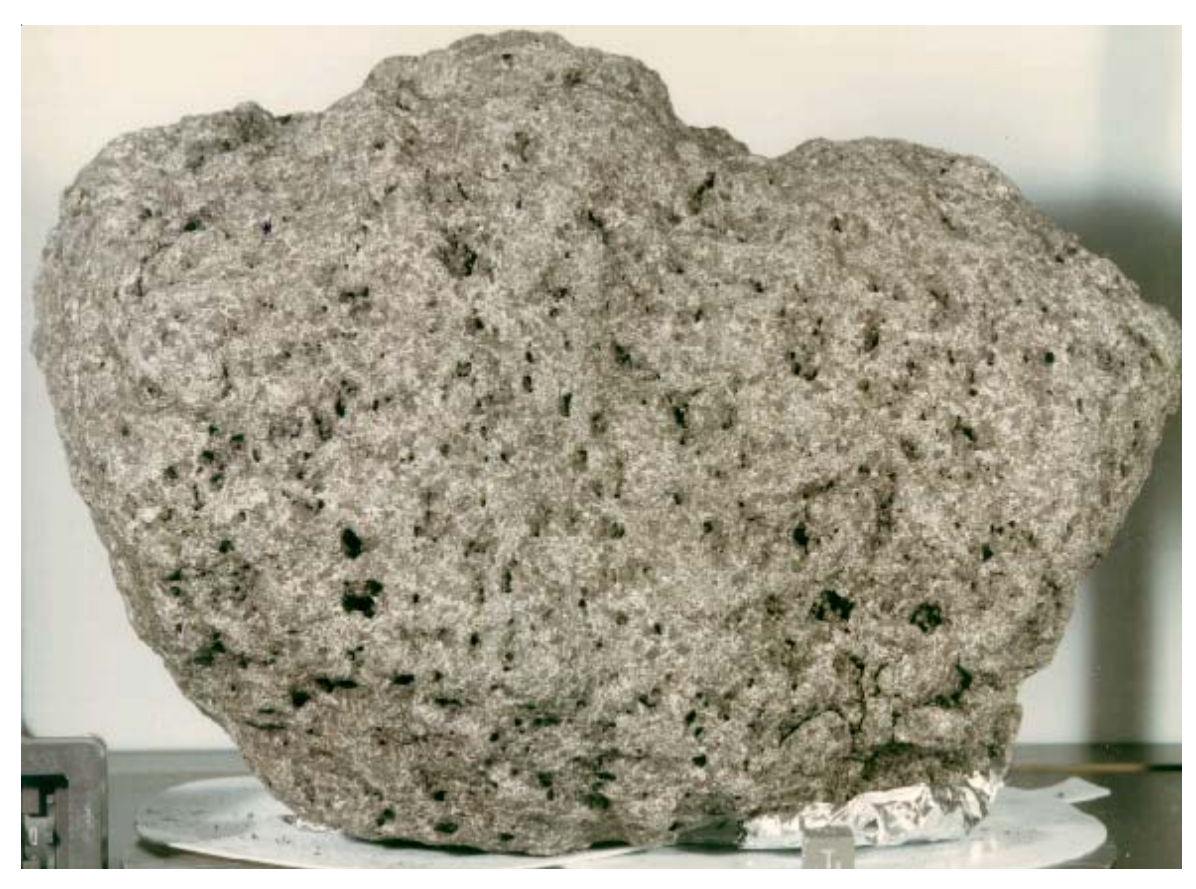
Figure 1: Photograph of top surface of 70035 illustrating vugs and vesicles. Note the smooth, rounded surface shaped by micrometeorite bombardment. Small cube is 1 cm. NASA photo # S72-56385.
the rim of a subdued crater about 45 meters east 70035 is 3.7 b.y. old and has been exposed on the lunar northeast of the LM. This large sample was not surface for ~ 100 m.y. It is typical of the high Ti basalts “oriented”. The bottom surface of this sample is coated from the moon and has been used for several public with glass (figure 11). One side is flat (from the displays (figure 12).
Introduction boulder?). The other surfaces are rounded and have Sample 70035 is a vesicular, medium–grained, high- micrometeorite pits. Ti basalt (figure 1). It was collected from a boulder on
| Mineralogical Mode of 70035 | ||||||||||
|---|---|---|---|---|---|---|---|---|---|---|
| Brown et et al. 1975 | Weigand 1973 | Roedder and Weiblen 1975 | ||||||||
| Olivine | 0.9 vol. % | 2.5 | ||||||||
| Pyroxene | 47.5 | 46 | 56.6 | |||||||
| Plagioclase | 25.9 | 26 | 21.6 | |||||||
| Opaques | 23.7 | 22 | 15.4 | |||||||
| Silica | 1.6 | 1.6 | ||||||||
| Mesostasis | 0.4 | 2 | 4.4 | |||||||
| Vesicles | 1.5 |
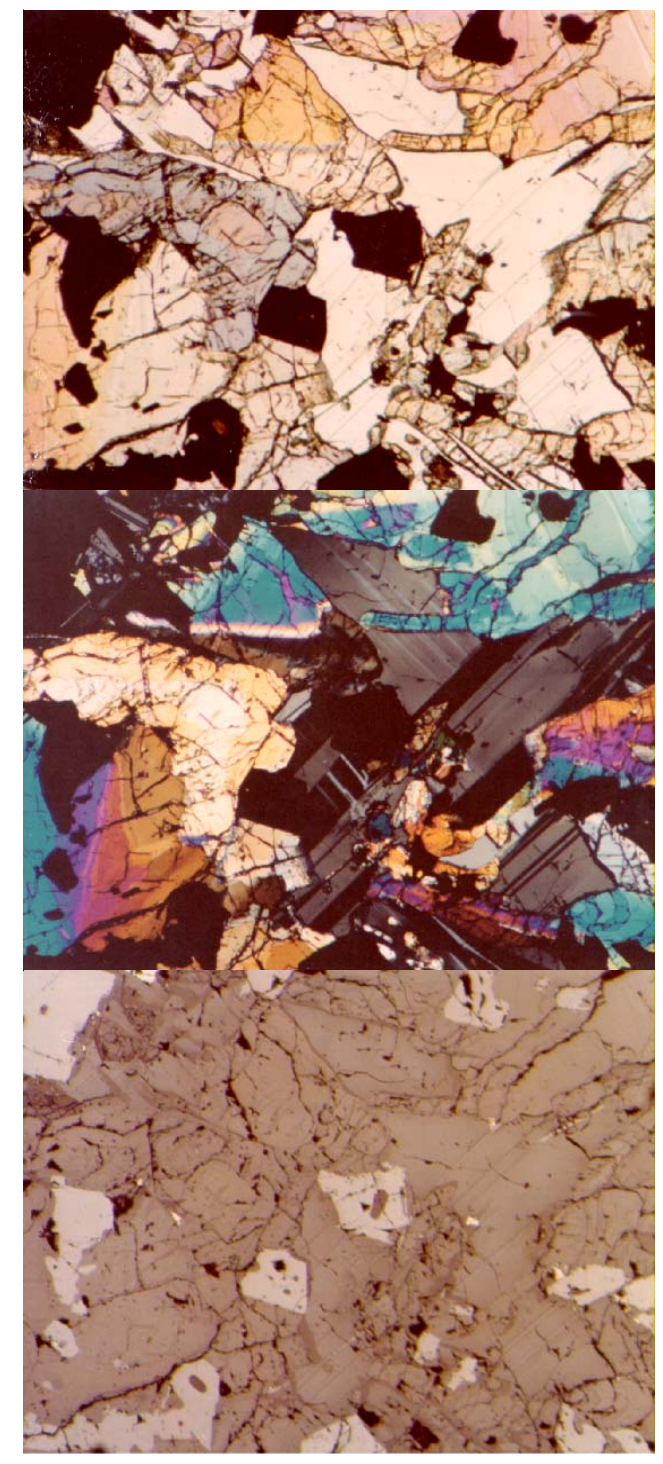
Figure 2: Photomicrographs of thin section 70035,14. Each view of same area, 2.7 mm wide. a) Partially polarized light #S79-26730, b) crossed-polarized light #S79-26631, c) reflected light #S79-26729.
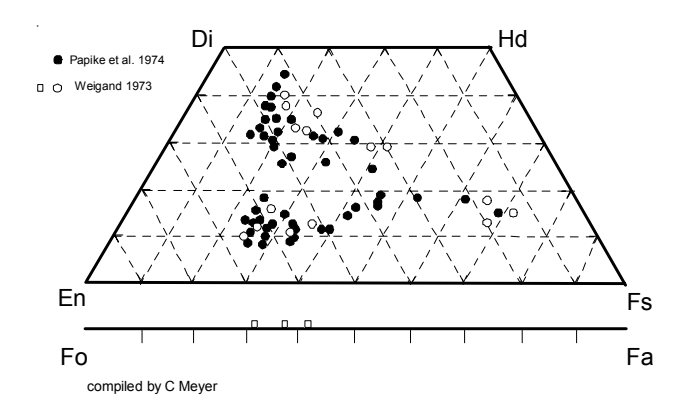
Figure 3: Pyroxene and olivine composition of 70035 (data replotted from Papike et al. 1974, Weigand 1973).
Petrography
Section titled “Petrography”Ridley (1973), Weigand (1973), McGee et al. (1977) and Neal and Taylor (1993) have described this large basalt. It is a hypidiomorphic granular basalt with large anhedral clinopyoxene enclosing armalcolite, ilmenite, ulvöspinel and chrome spinel. Interstitial plagioclase encloses ilmenite and olivine (figure 2). The mesostasis includes cristobalite, K-feldspar, tranquillityite, ilmenite, ulvöspinel, troilite and pale brown granitic glass.
El Goresy and Ramdohr (1975) showed that subsolidus reduction of the opaques in 70035 and other Apollo 17 basalts occurred below 830 deg. C. The cooling rate was less than 1 deg. C/hr. (Usselman et al. 1975).
Mineralogy
Section titled “Mineralogy”Pyroxene: Weigand (1973) and Papike et al. (1973) give pyroxene data (figure 3). Augite cores contains up to $3.5 % \text{ TiO}_2$ , $4.3 % \text{Al}_2\text{O}_3$ and $1% \text{Cr}_2\text{O}_3$ (Weigand 1973).
Plagioclase: Weigand (1973), Crawford (1973), Delaney and Sutton (1991) and Delaney et al. (1992) discuss plagioclase zonation (An88-83).
Opaques: El Goresy and Ramdohr (1975) studied the subsolidus reduction of ilmenite to rutile, spinel and metallic iron in 70035. They also found that the ulvöspinel reduced to form exsolution of ilmenite and metallic iron.
Glass: Ilmenite in 70035 contains glass inclusions of two types, a) 6-7% $K_2O$ and b) 0.4% $K_2O$ (Roedder and Weiblen 1975).
Metallic iron: El Goresy and Ramdohr (1975) reported a network of metallic iron that penetrates cracks and cleavages through opaque phases as well as silicates. The composition of iron in 70017 has not been reported.
Chemistry
Section titled “Chemistry”The chemical composition of 70035 is given in table 1. It is typical of Apollo 17 basalts (figures 4 and 5). The trace element content indicates that it is a type A basalt (figure 6).
Radiogenic age dating
Section titled “Radiogenic age dating”Stettler et al. (1973), Evensen et al. (1973a, b) and Nyquist et al. (1974) have dated 70035 (see figures 7 9 and summary table). The ages of basalts from Apollo 17 are similar to those of Apollo 11 (Paces et al. 1991).
Cosmogenic isotopes and exposure ages
Section titled “Cosmogenic isotopes and exposure ages”Stettler et al. (1973) determined an exposure age of 95-100 m.y. by the 38Ar method. Drozd et al. (1977) determined 122 ± 3 m.y. by 81Kr method.
Other Studies
Section titled “Other Studies”Pearce et al. (1974) determined the magnetic properties of 70035 and found that Apollo 17 basalts contained more metallic iron than most other basalts (consistent with petrology).
Processing
Section titled “Processing”According to the Apollo 17 Catalog (Butler 1973; page 39), 70035 was opened in the Command Module and studied by Jack Schmitt who picked it up with bare hands (permission granted).
This rock is discussed in great detail in the Apollo 17 catalog by Neal and Taylor (1993). It has been sawn on two occasions (1973 and 1981) (figures 10-11). Nine pieces are used for public display (figure 12).
List of Photos #s for 70035
Section titled “List of Photos #s for 70035”S72-56381 – 386
S72-56418 – 448 B&W
S75-34392 – 398 color
S79-26729 – 731 TS
S81-27728 – 729 color
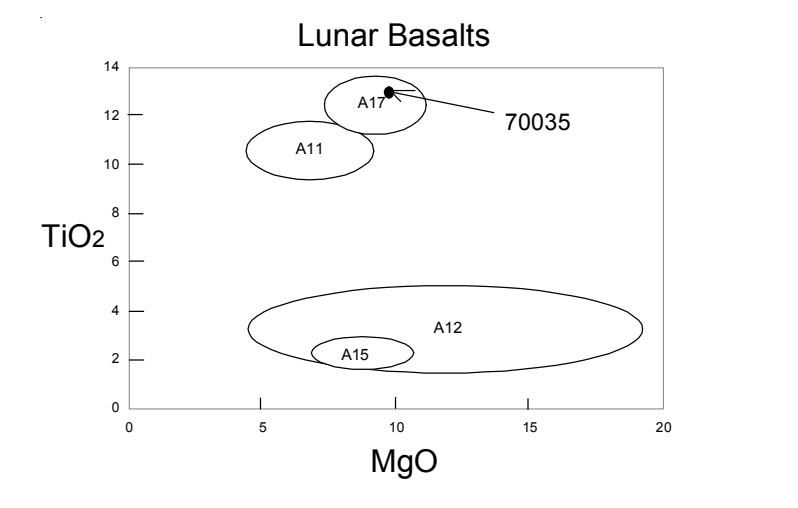
Figure 4: 70035 is a typical high Ti Apollo 17 basalt.
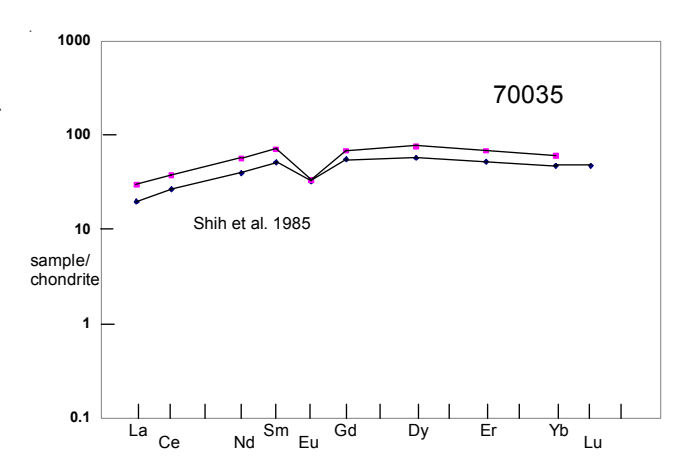
Figure 5: Normalized rare-earth-element diagram for 70035 (data from Shih et al. 1975).
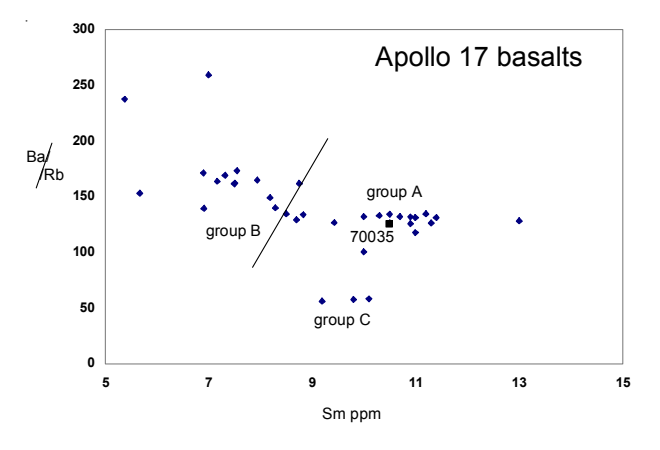
Figure 6: Trace element content of Apollo 17 basalts showing 70035 is type A.
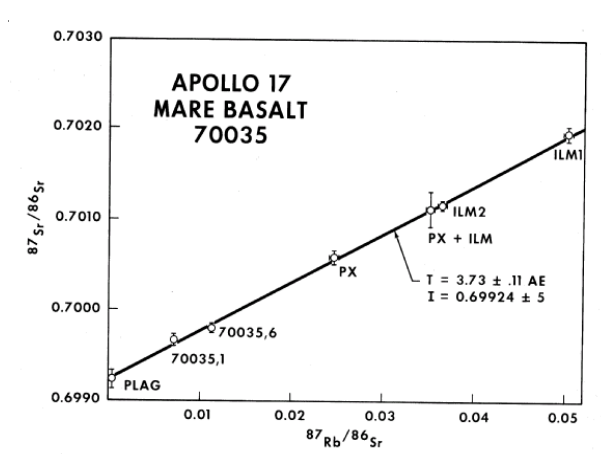
Figure 7: Rb-Sr isochron for 70035 (from Nyquist et al. 1974).
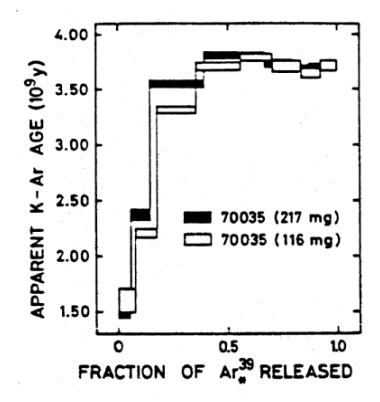
Figure 9: Ar-Ar release diagram for 70035 (from Stettler et al. 1974).
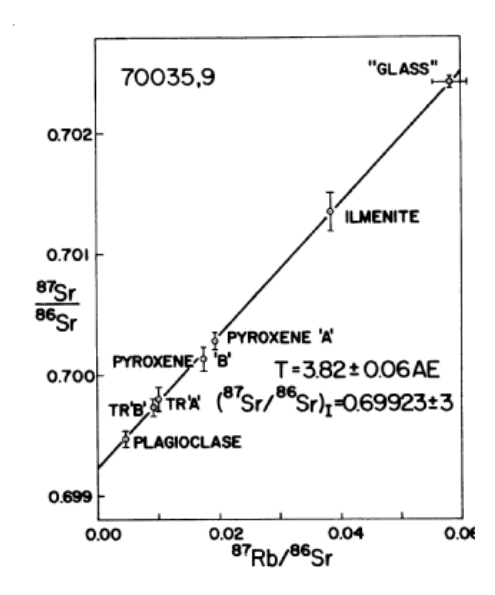
Figure 8: Rb-Sr isochron diagram for 70035 (from Evensen et al. 1973).
Summary of Age Data for 70035
Section titled “Summary of Age Data for 70035”Rb-Sr Ar-Ar Evensen et al. 1973a,b 3.82 ± 0.06
Stettler et al. 1973 3.75 ± 0.07
Nyquist et al. 1974 3.73 ± 0.11
Caution: Old decay constants
Table 1. Chemical composition of 70035.
| reference LSPET 73 weight SiO2 % TiO2 Al2O3 FeO MnO MgO CaO Na2O K2O P2O5 S % sum | 37.8 (a) 13 8.85 (a) 18.5 (a) 0.28 (a) 9.89 (a) 10.1 (a) 0.35 0.06 0.05 (a) 0.15 (a) | Shih 75 Rhodes76 Wiesmann75 | Hughes85 | Evenson73 | ||||||
|---|---|---|---|---|---|---|---|---|---|---|
| (a) 13 | 13 | (b) | ||||||||
| (a) 0.36 (a) 0.04 | 0.31 0.05 | (b) | Gibson74 0.158 | |||||||
| Sc ppm | 82.5 | (c ) | ||||||||
| V Cr | 4174 (a) 3890 | 3634 | (b) | |||||||
| Co Ni | 2 | (a) | 20.7 | (c ) | ||||||
| Cu Zn | 4 | (a) | ||||||||
| Ga Ge ppb As | ||||||||||
| Se Rb Sr | 0.7 176 75 | (a) 0.461 (a) 174 | 0.628 161 | (b) (b) | 0.58 164 | 0.51 158 | (b) (b) | |||
| Y Zr | 205 | (a) | (a) 217 | 200 | (b) 144 | (c ) | ||||
| Nb Mo Ru | 20 | (a) | ||||||||
| Rh | ||||||||||
| Pd ppb Ag ppb | ||||||||||
| Cd ppb In ppb | ||||||||||
| Sn ppb Sb ppb | ||||||||||
| Te ppb Cs ppm | ||||||||||
| Ba La | 62.1 4.79 | 79.5 7.04 | (b) (b) | 62.1 | 61.1 | (b) | ||||
| Ce Pr | 16.4 | 23.4 | (b) | |||||||
| Nd Sm | 18.2 7.63 | 25.9 10.5 | (b) (b) | |||||||
| Eu Gd | 1.82 11 | 1.88 13.5 | (b) (b) | |||||||
| Tb Dy | 14.1 | 18.8 | (b) | |||||||
| Ho Er | 8.4 | 11 | (b) | |||||||
| Tm Yb | 7.79 | 10 | (b) | |||||||
| Lu Hf | 1.17 | 4.9 | (c ) | |||||||
| Ta W ppb | ||||||||||
| Re ppb Os ppb | ||||||||||
| Ir ppb Pt ppb | ||||||||||
| Au ppb Th ppm | ||||||||||
| U ppm technique: (a) XRF, (b) IDMS, (c ) INAA | 0.091 | 0.12 | (b) |
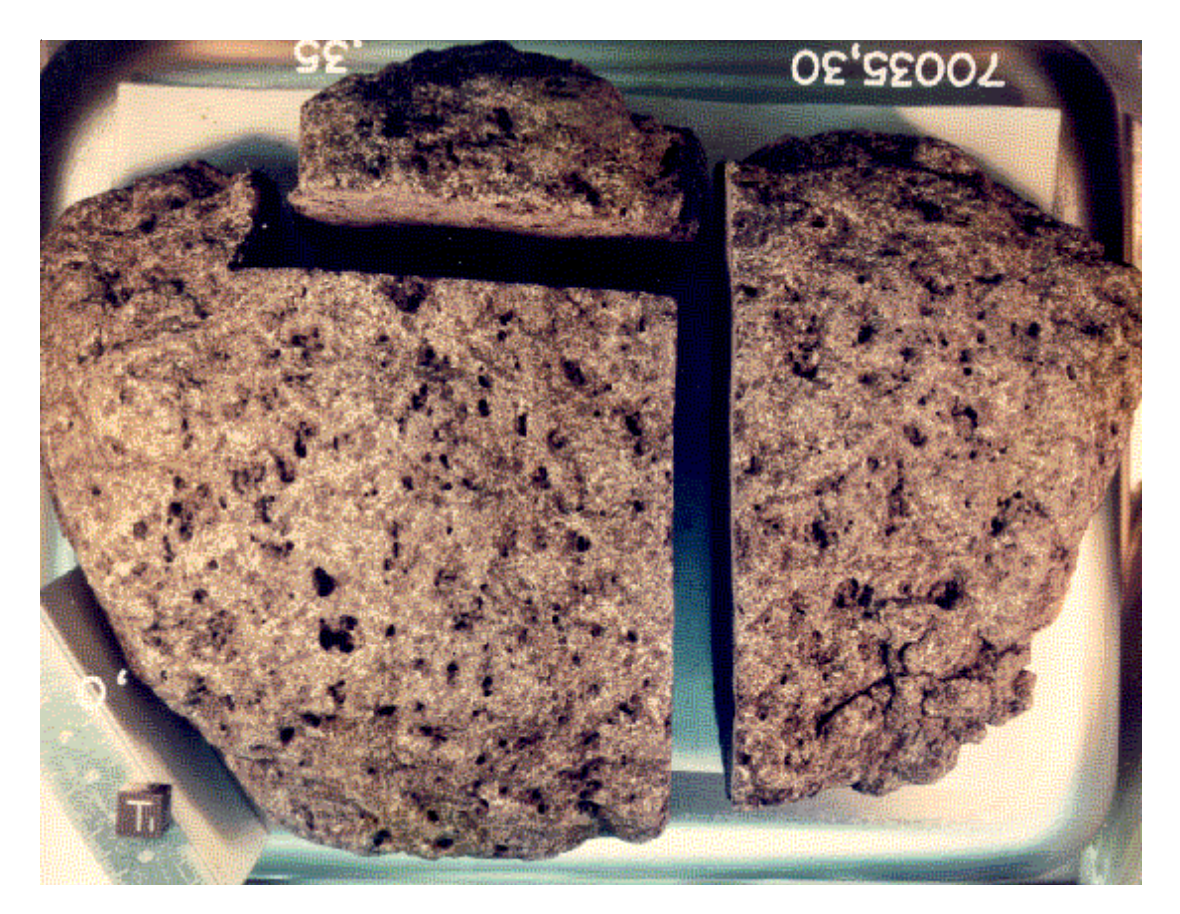
Figure 10: First saw cuts of 70035 made in 1972. Cube is 1 cm. NASA S75-34392. Compare with figure 1.
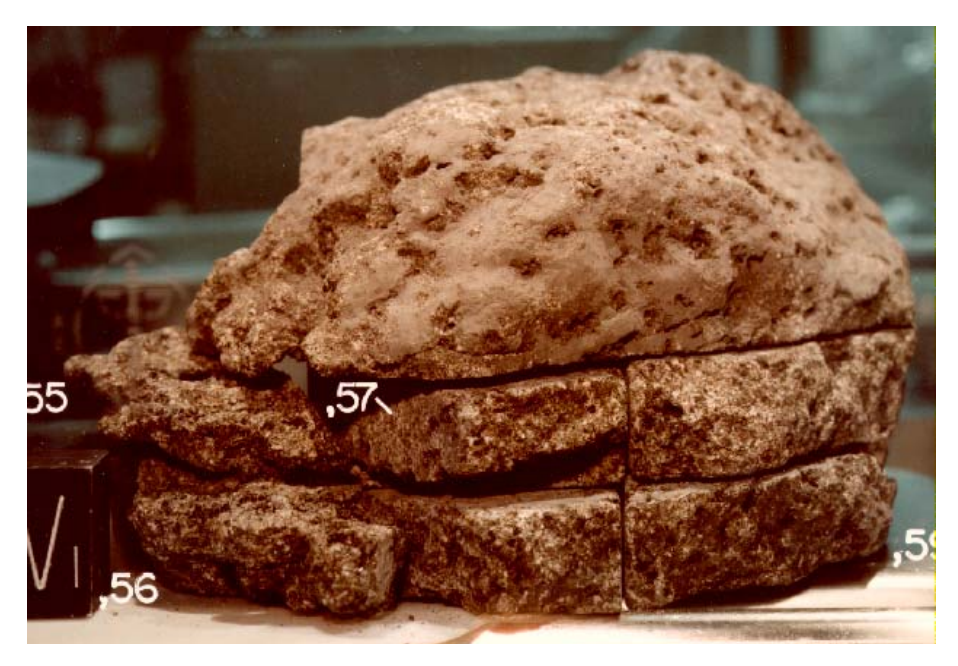
Figure 11: Additional saw cuts of 70035 made in 1981 (see flow diagram). Note glass coating in this side. NASA S81-27729. Cube is 1 inch.
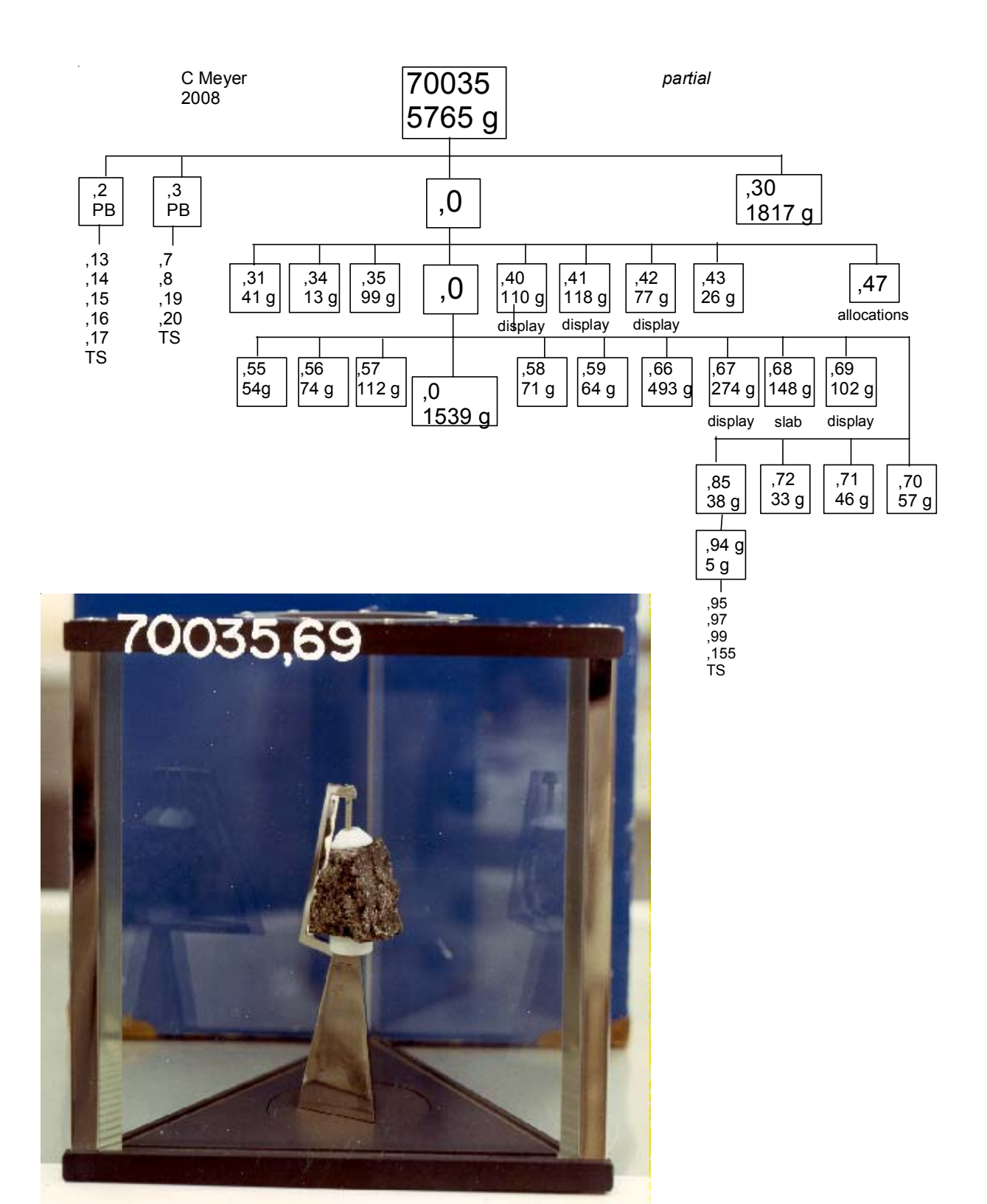
Figure 12: A piece of 70035 in its dry nitrogen display case. NASA S84-34617.
References for 70035
Section titled “References for 70035”Brown G.M., Peckett A., Emeleus C.H., Phillips R. and Pinsent R.H. (1975a) Petrology and mineralogy of Apollo 17 mare basalts. Proc. 6th Lunar Sci. Conf. 1-13.
Butler P. (1973) Lunar Sample Information Catalog Apollo 17. Lunar Receiving Laboratory. MSC 03211 Curator’s Catalog. pp. 447.
Crawford M.L. (1973) Crystallization of plagioclase in mare basalts. Proc. 4th Lunar Sci. Conf. 705-717.
Delaney J.S. and Sutton S.R. (1991) Fe-Mn-Mg in plagioclase from lunar basalt and highland samples (abs). Lunar Planet. Sci. XXII, 299-300. Lunar Planetary Institute, Houston
Delaney J.S., Sutton S.R., Bait S. and Smith J.V. (1992) In situ microXANES determination of ferrous/ferric ratio in terrestrial and extraterrestrial plagioclase: First reconnaissance (abs). Lunar Planet. Sci. XXIII, 299-300. Lunar Planetary Institute, Houston
Drozd R.J., Hohenberg C.M., Morgan C.J., Podosek F.A. and Wroge M.L. (1977) Cosmic-ray exposure history at Taurus-Littrow. Proc. 8th Lunar Sci. Conf. 3027-3043.
El Goresy A., Ramdohr P., Medenbach O. and Bernhardt H.-J. (1974a) Taurus-Littrow TiO2 -rich basalts: Opaque mineralogy and geochemistry. Proc. 5th Lunar Sci. Conf. 627-652.
El Goresy A., Ramdohr P., Medenbach O. and Bernhardt H.-J. (1974b) Taurus-Littrow crystalline rocks: Opaque mineralogy and geochemistry (abs). Lunar Sci. V, 209-211. Lunar Planetary Institute, Houston
E1 Goresy A. and Ramdohr P. (1975a) Subsolidus reduction of lunar opaque oxides: Textures, assemblages, geochemistry, and evidence for a late-stage endogenic gaseous mixture. Proc. 6th Lunar Sci. Conf. 729-745.
El Goresy A. and Ramdohr P. (1975b) Subsolidus reduction of lunar opaque oxides: Evidence, assemblages, geochemical relevance, and evidence for a late-stage reducing gaseous mixture (abs). Lunar Sci. VI, 245-247. Lunar Planetary Institute, Houston
El Goresy A. and Ramdohr P. (1975c) Taurus-Littrow TiO2 rich basalts: Opaque mineralogy and geochemistry (abs). Lunar Sci. VI, 248-250. Lunar Planetary Institute, Houston
Evensen N.M., Murthy V.R. and Coscio M.R. (1973) Rb-Sr ages of some mare basalts and the isotopic and trace element systematics in lunar fines. Proc. 4th Lunar Sci. Conf. 1707 1724.
Evensen N.M., Murthy V.R. and Coscio M.R. (1973b) Taurus-Littrow: Age of mare volcanism; chemical and Rb-Sr isotopic systematics of the dark mantle soil (abs). EOS 54, 587-588.
Gibson E.K. and Moore G.W. (1974a) Sulfur abundances and distributions in the valley of Taurus-Littrow. Proc. 5th Lunar Sci. Conf. 1823-1837.
Gibson E.K., Usselman T.M. and Morris R.V. (1976a) Sulfur in the Apollo 17 basalts and their source regions. Proc. 7th Lunar Sci. Conf. 1491-1505.
Green D.H., Ringwood A.E., Hibberson W.O. and Ware N.G. (1975a) Experimental petrology of Apollo 17 mare basalts. Proc. 6th Lunar Sci. Conf. 871-893.
Haggerty S.E. (1973b) Apollo 17: Armalcolite paragenesis and subsolidus reduction of chromian-ulvospinel and chromian-picro ilmenite (abs). EOS 54, 593-594.
Hughes S.S. and Schmitt R.A. (1985) Zr-Hf-Ta fractionation during lunar evolution. Proc. 16th Lunar Planet. Sci. Conf. D31 in J. Geophys. Res. 90.
Lindstrom M.M. and Haskin L.A. (1978) Causes of compositional variations within mare basalt suites. Proc. 9th Lunar Planet. Sci. Conf. 465-486.
LSPET (1973) Apollo 17 lunar samples: Chemical and petrographic description. Science 182, 659-672.
LSPET (1973) Preliminary Examination of lunar samples. Apollo 17 Preliminary Science Rpt. NASA SP-330. 7-1 – 7-46.
McGee P.E. Warner J.L. and Simonds C.H. (1977) Introduction to the Apollo Collections: Part 1 Lunar Igneous Rocks.
Muehlberger et al. (1973) Documentation and environment of the Apollo 17 samples: Apreliminary report. Astrogeology 71 322 pp superceeded by Astrogeolgy 73 (1975) and by Wolfe et al. (1981)
Muehlberger W.R. and many others (1973) Preliminary Geological Investigation of the Apollo 17 Landing Site*. In* Apollo 17 Preliminary Science Report. NASA SP-330.
Neal C.R., Taylor L.A., Patchen A.D., Hughes S.S. and Schmitt R.A. (1990a) The significance of fractional crystallization in the petrogenesis of Apollo 17 Type A and B high-Ti basalts. Geochim. Cosmochim. Acta 54, 1817 1833.
Neal C.R. and Taylor L.A. (1993) Catalog of Apollo 17 rocks. Vol. 2 Basalts
Nyquist L.E. (1977) Lunar Rb-Sr chronology. Phys. Chem. Earth 10, 103-142.
Nyquist L.E., Bansal B.M., Wiesmann H. and Jahn B.-M. (1974a) Taurus-Littrow chronology: some constraints on early lunar crustal development. Proc. 5th Lunar Sci. Conf. 1515-1539.
Paces J.B., Nakai S., Neal C.R., Taylor L.A., Halliday A.N. and Lee D.-C. (1991) A strontium and neodymium isotopic study of Apollo 17 high-Ti mare basalts: Resolution of ages, evolution of magmas, and origin of source heterogeneities. Geochim. Cosmochim. Acta 55, 2025-2043.
Papike J.J., Bence A.E. and Lindsley D.H. (1974) Mare basalts from the Taurus-Littrow region of the moon. Proc. 5th Lunar Sci. Conf. 471-504.
Papike J.J., Hodges F.N., Bence A.E., Cameron M. and Rhodes J.M. (1976) Mare basalts: Crystal chemistry, mineralogy and petrology. Rev. Geophys. Space Phys. 14, 475-540.
Pearce G.W., Strangway D.W. and Gose W.A. (1974a) Magnetic properties of Apollo samples and implications for regolith formation. Proc. 5th Lunar Sci. Conf. 2815-2826.
Rhodes J.M., Hubbard N.J., Wiesmann H., Rodgers K.V., Brannon J.C. and Bansal B.M. (1976a) Chemistry, classification, and petrogenesis of Apollo 17 mare basalts. Proc. 7th Lunar Sci. Conf. 1467-1489.
Ridley W.I. (1973) Petrogenesis of basalt 70035: A multistage cooling history (abs). EOS 54, 611-612. AGU
Roedder E. and Weiblen P.W. (1975a) Anomalous low-K silicate melt inclusions in ilmenite from Apollo 17 basalts. Proc. 6th Lunar Sci. Conf. 147-164.
Shih C.-Y., Haskin L.A., Wiesmann H., Bansal B.M. and Brannon J.C. (1975a) On the origin of high-Ti mare basalts. Proc. 6th Lunar Sci. Conf. 1255-1285.
Shih C.-Y., Wiesmann H. and Haskin L.A. (1975b) On the origin of high-Ti mare basalts (abs). Lunar Sci. VI, 735 737. Lunar Planetary Institute, Houston
Stettler A., Eberhardt P., Geiss J., Grogler N. and Maurer P. (1973) Ar39-Ar40 ages and Ar37-Ar38 exposure ages of lunar rocks. Proc. 4th Lunar Sci. Conf. 1865-1888.
Usselman T.M., Lofgren G.E., Donaldson C.H. and Williams R.J. (1975) Experimentally reproduced textures and mineral chemistries of high-titanium mare basalts. Proc. 6th Lunar Sci. Conf. 997-1020.
Weigand P.W. (1973) Petrology of a coarse-grained Apollo 17 ilmenite basalt (abs). EOS 54, 621-622.
Wolfe E.W., Bailey N.G., Lucchitta B.K., Muehlberger W.R., Scott D.H., Sutton R.L and Wilshire H.G. (1981) The geologic investigation of the Taurus-Littrow Valley: Apollo 17 Landing Site. US Geol. Survey Prof. Paper, 1080, pp. 280.