Sample 70139
Ilmenite Basalt 3.16 grams
Section titled “Ilmenite Basalt 3.16 grams”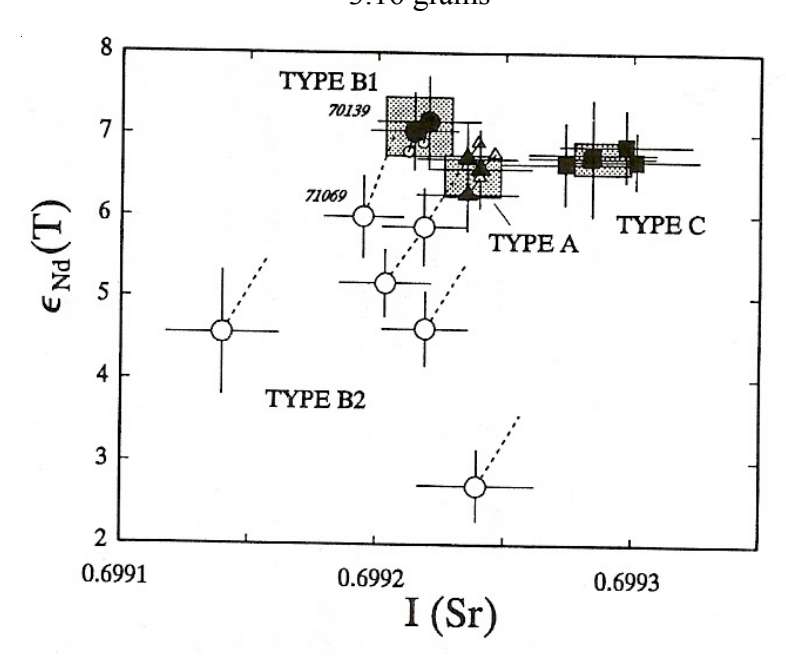
Figure 1: Diagram of initial Sr and Nd isotopes for 3.7 b.y. old high-Ti mare basalts at Apollo 17 (Paces et al. 1991).
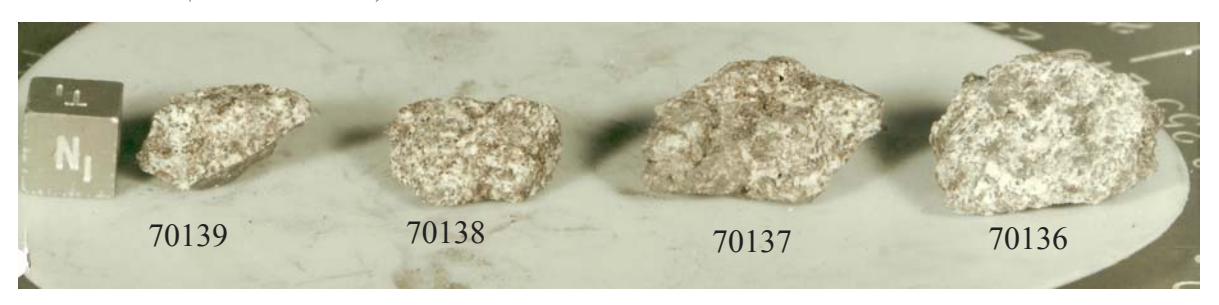
Figure 2: Basalt chips from same bag as 70135. S73-17970
Introduction
Section titled “Introduction”This is a chip off of Geophone Rock – see section on 70135. It is a typical high-Ti mare basalt with an age of 3.71 b.y.
Geophone Rock is a basalt boulder located about 50 meters south of the ALSEP site.
Petrography
Section titled “Petrography”Rhodes et al. (1975) originally postulated that there were 3 lava flows of high Ti basalt at Apollo 17 (A, B and C) and this assumption seems to have held up with further analyses (figure 1). 70139 has the same mineralogy and texture as 70135.
Mineralogical Mode
Section titled “Mineralogical Mode”| 70135 | Roedder 70139 | 70147 | |||
|---|---|---|---|---|---|
| Olivine | 2.8 | 3.8 | 2.5 | ||
| Pyroxene | 46.2 | 51.6 | 35.8 | 48.2 | |
| Plagioclase | 28.4 | 23 | 41.6 | 29.4 | |
| Opaques | 21.9 | 19.6 | 18.2 | 21 | |
| Silica | 0.3 | 0.6 | 1.9 | 0.2 | |
| Meostasis | 0.4 | 1.4 |
Chemistry
Section titled “Chemistry”70139 (and 70135) are high-Ti mare basalts (figure 3). The REE pattern is lower than that of most other Apollo 17 mare basalts (figure 4). Please compare with composition of 70135.
Table 1. Chemical composition of 70139.
| reference Neal90 weight SiO2 % TiO2 Al2O3 FeO MnO MgO CaO Na2O K2O P2O5 S % sum | Paces91 | |||||
|---|---|---|---|---|---|---|
| 13.1 8.32 17.6 0.23 9.6 10 0.36 0.04 | (a) (a) (a) (a) (a) (a) (a) (a) | |||||
| Sc ppm V Cr Co Ni Cu Zn Ga Ge ppb As Se | 80 143 3810 26.2 31 | (a) (a) (a) (a) (a) | ||||
| Rb Sr | 180 | 0.281 (a) 146 | 0.282 146 | (b) (b) | ||
| Y Zr Nb Mo Ru Rh Pd ppb Ag ppb Cd ppb In ppb Sn ppb Sb ppb Te ppb | 160 | (a) | ||||
| Cs ppm Ba La Ce | 0.02 67 3.1 13 | (a) (a) (a) (a) | ||||
| Pr Nd Sm Eu Gd | 15 4.8 1.4 | (a) | (a) 12.3 (a) 5.3 | 12.4 5.38 | (b) (b) | |
| Tb Dy Ho Er | 1.5 9.7 | (a) (a) | ||||
| Tm Yb Lu Hf Ta W ppb Re ppb Os ppb Ir ppb Pt ppb | 5.4 0.81 5.7 1.2 | (a) (a) (a) (a) | ||||
| Au ppb Th ppm U ppm technique: (a) INAA, (b) IDMS | 0.3 0.1 | (a) (a) |
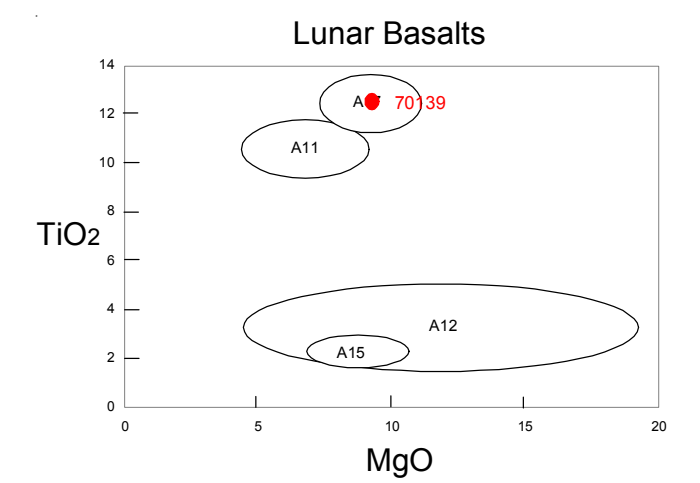
Figure 3: Composition of mare basalts collected from Apollo missions.
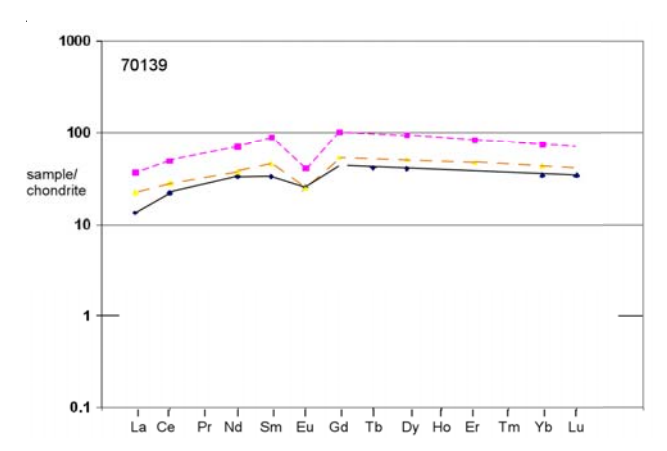
Figure 4: Normalized rare-earth-element diagram for70139 compared with type A and type B basalts from Apollo 17 (dat by Neal et al. 1990).
Radiogenic age dating
Section titled “Radiogenic age dating”Paces et al. (1991) dated 70139 at 3650 ± 120 m.y. by Rb/Sr internal isochron and 3710 ± 120 m.y. by the more reliable Sm/Nd method. This is concordant with the age for 70135 as determined by Nyquist et al. (1975).
Processing
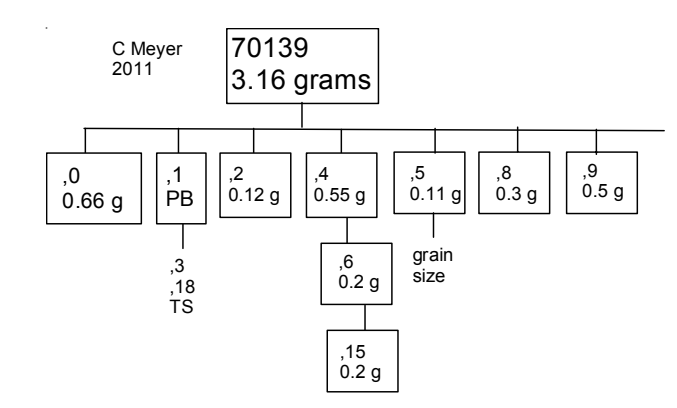
Section titled “Processing”70139 is a basalt chip from the bag (10E) used to return 70135 and is most certainly a chip of same (Butler 1973). There are two thin sections of 70139.
References for 70139
Section titled “References for 70139”Butler P. (1973) Lunar Sample Information Catalog Apollo 17. Lunar Receiving Laboratory. MSC 03211 Curator’s Catalog. pp. 447.
LSPET (1973) Apollo 17 lunar samples: Chemical and petrographic description. Science 182, 659-672.
LSPET (1973) Preliminary Examination of lunar samples. Apollo 17 Preliminary Science Rpt. NASA SP-330. 7-1 – 7-46.
Muehlberger et al. (1973) Documentation and environment of the Apollo 17 samples: Apreliminary report. Astrogeology 71 322 pp superceeded by Astrogeolgy 73 (1975) and by Wolfe et al. (1981)
Muehlberger W.R. and many others (1973) Preliminary Geological Investigation of the Apollo 17 Landing Site*. In* Apollo 17 Preliminary Science Report. NASA SP-330.
Neal C.R. and Taylor L.A. (1993) Catalog of Apollo 17 rocks. Vol. 2 Basalts
Neal C.R., Taylor L.A., Patchen A.D., Hughes S.S. and Schmitt R.A. (1990a) The significance of fractional crystallization in the petrogenesis of Apollo 17 Type A and B high-Ti basalts. Geochim. Cosmochim. Acta 54, 1817 1833.
Paces J.B., Nakai S., Neal C.R., Taylor L.A., Halliday A.N. and Lee D.-C. (1991) A strontium and neodymium isotopic study of Apollo 17 high-Ti mare basalts: Resolution of ages, evolution of magmas, and origin of source heterogeneities. Geochim. Cosmochim. Acta 55, 2025-2043.
Warner R.D., Taylor G.J., Conrad G.H., Northrop H.R., Barker S., Keil K., Ma M.-S. and Schmitt R. (1979a) Apollo 17 high-Ti mare basalts: New bulk compositional data, magma types, and petrogenesis. Proc. 10th Lunar Planet. Sci. Conf. 225-247.
Wolfe E.W., Lucchitta B.K., Reed V.S., Ulrich G.E. and Sanchez A.G. (1975) Geology of the tarus-Littrow valley floor. Proc. 6th Lunar Sci. Conf. 2463-2482.
Wolfe E.W., Bailey N.G., Lucchitta B.K., Muehlberger W.R., Scott D.H., Sutton R.L and Wilshire H.G. (1981) The geologic investigation of the Taurus-Littrow Valley: Apollo 17 Landing Site. US Geol. Survey Prof. Paper, 1080, pp. 280.