Sample 77017
77017 Feldspathic Granulitic Impactite 1730 grams
Section titled “77017 Feldspathic Granulitic Impactite 1730 grams”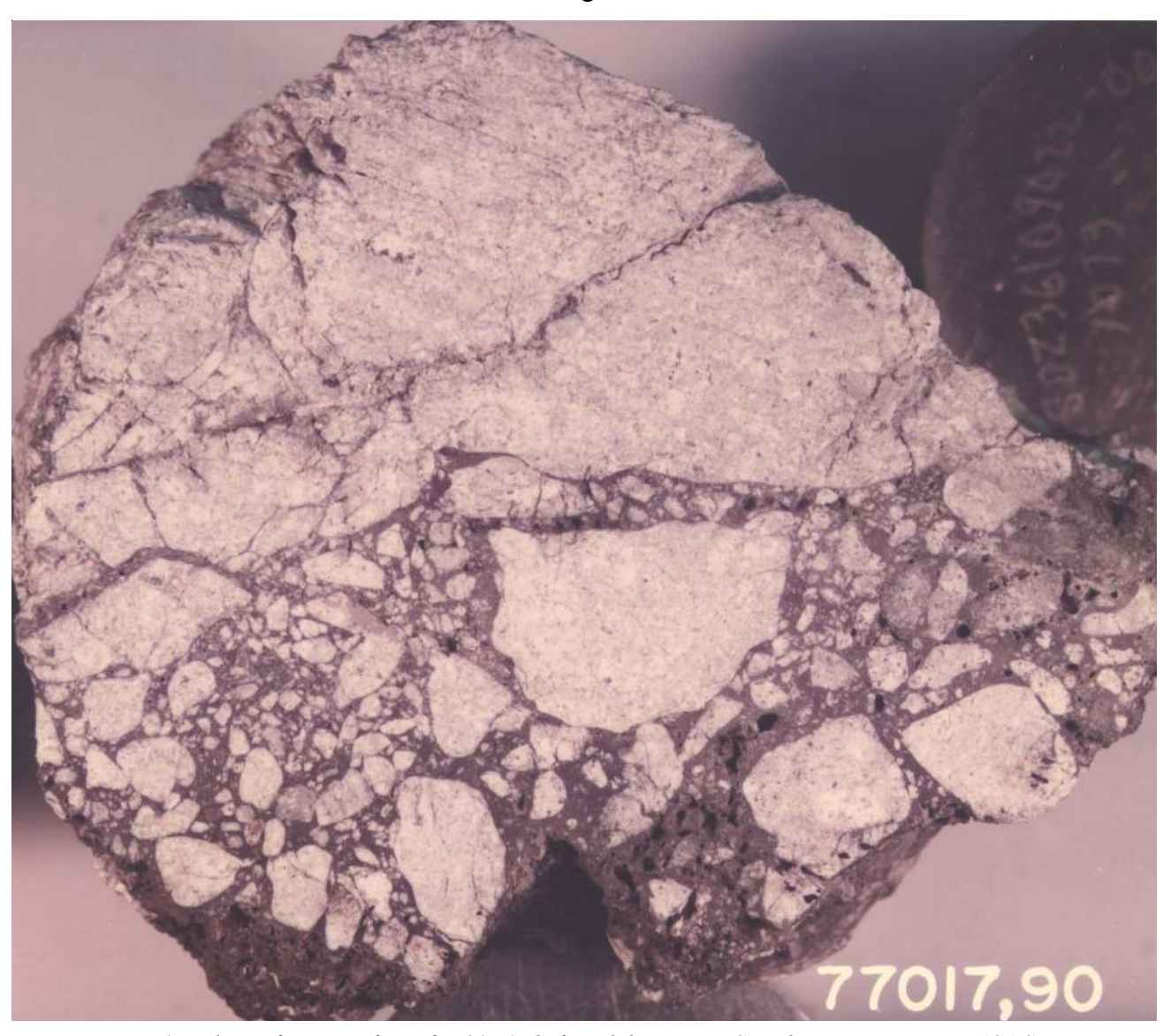
Figure 1 : Photo of sawn surface of 77017,15 before slab was cut. Sample is 7 cm across. NASA S75- 34250. See also figure 16 .
Introduction
Section titled “Introduction”Lunar sample 77017 contains a large, annealed feldpathic breccia set in a frothy black glass matrix. A photograph of a slab cut through this rock reveals how the anorthositic portion has been incorporated in the black glass matrix (figure 1).
This rock sample has experienced several thermal and shock events. The feldspathic portion is an annealed gabbroic rock. However, Warner et al. (1977) recognized that the feldspathic portion of 77017 was
an impactite, because it contained a high concentration of meteoritic siderophile elements. Shock features indicate subsequent impact followed by the addition of black glass of mare composition.
Hudgins et al. (2008) recently described, analyzed and dated 77017. The major metamorphic event forming the feldspathic portion was at about 4 b.y., while the glass-forming event was about ~1.5 b.y. The sample has been exposed to cosmic ray irradation for about 100 m.y.
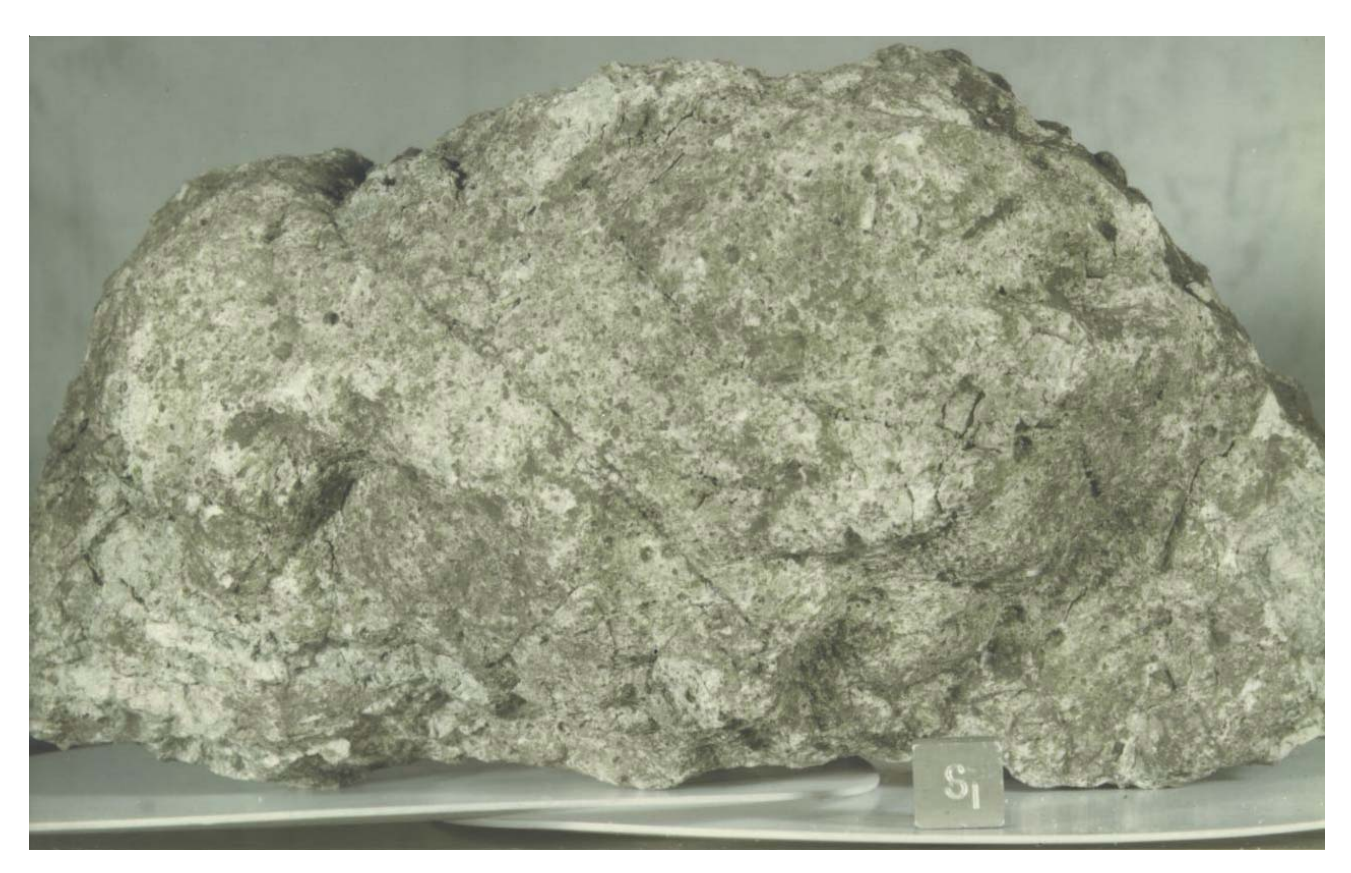
Figure 2: Photo of “anorthositic” side of 77017 showing numerous zap pits. Cube is 1 cm. S73-17770 (faded).
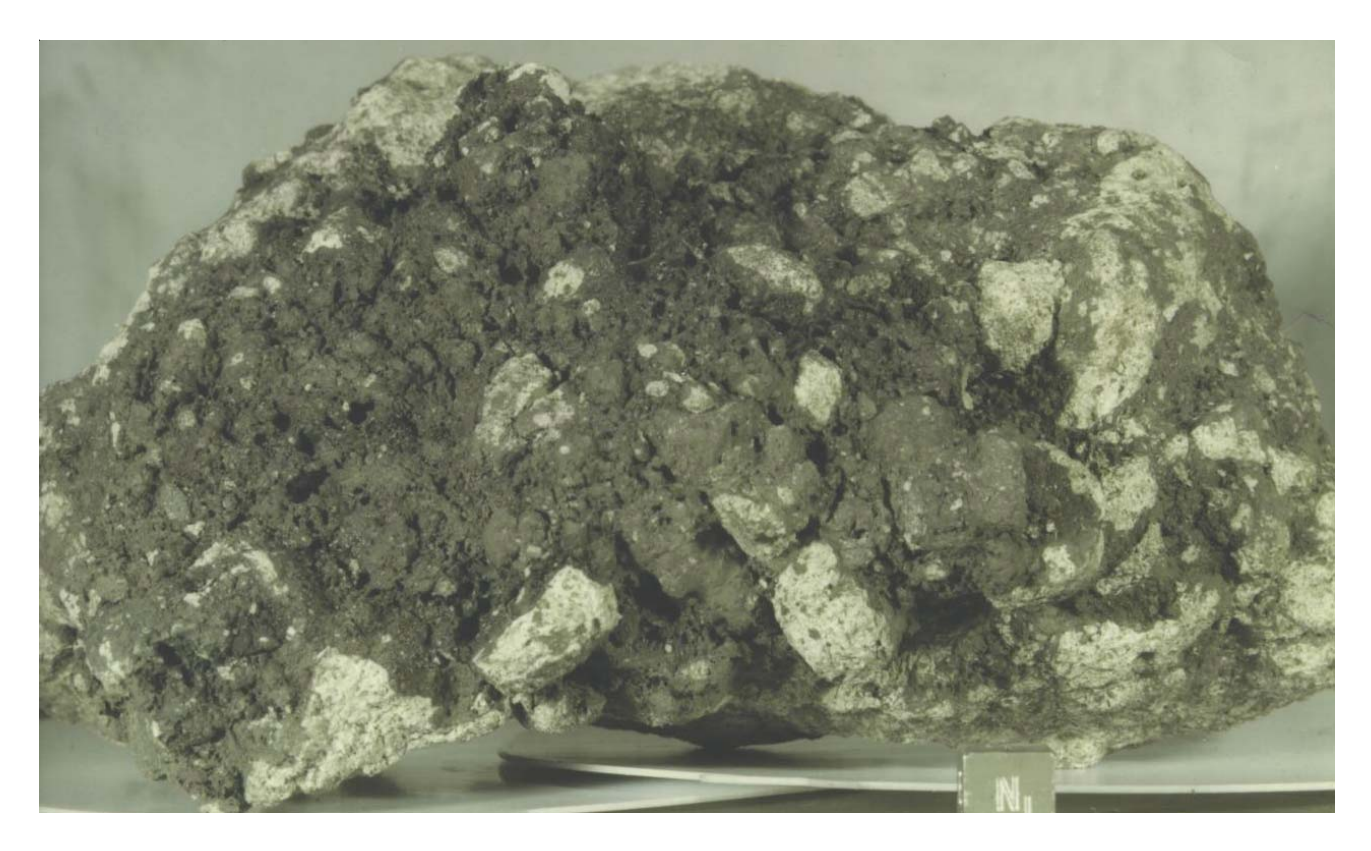
Figure 3: Photo of frothy side of 77017 showing chunks of feltdpathic material in frothy black glass coating. Cube is 1 cm. S73-17768.
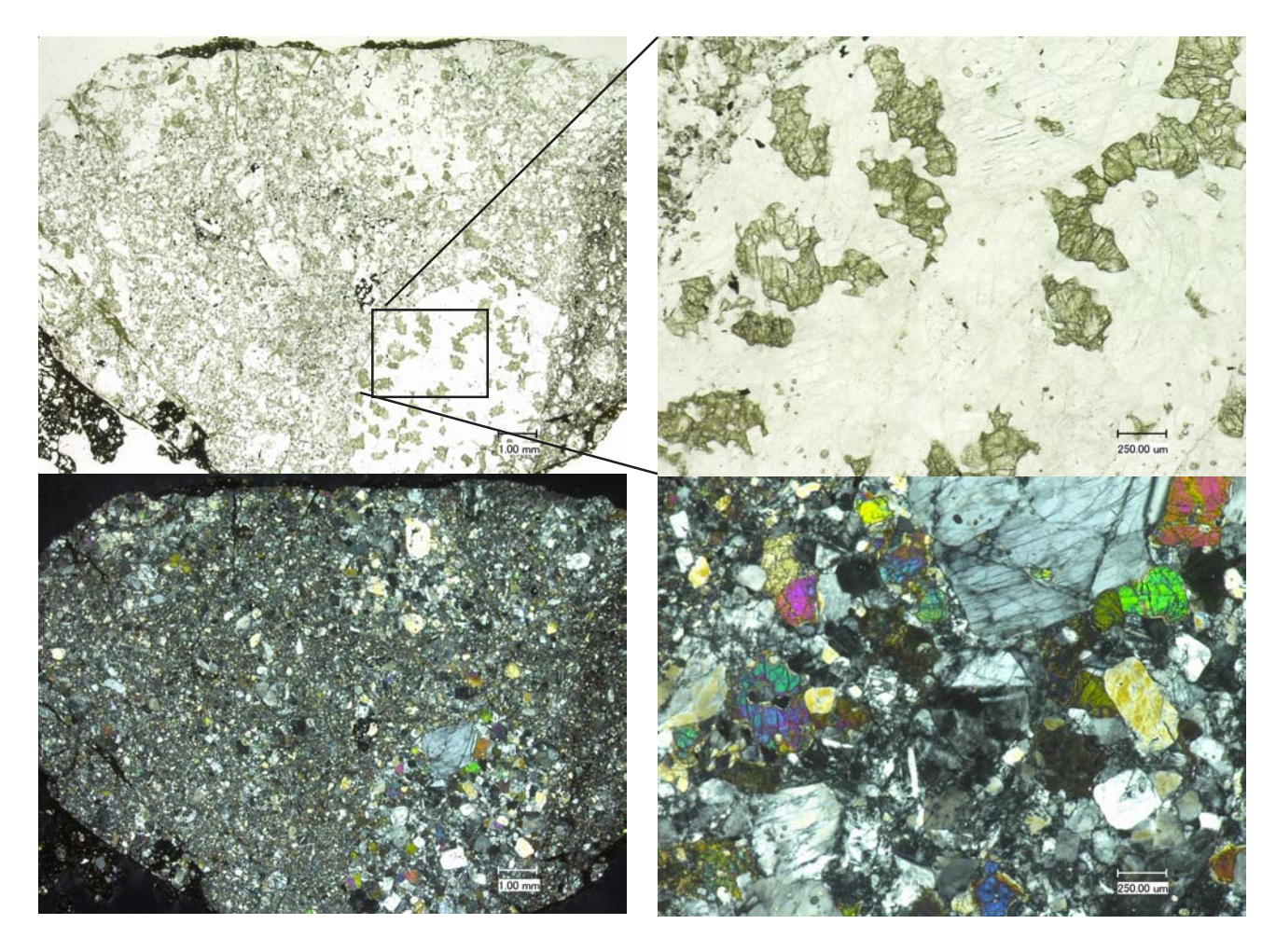
Figure 4a: Photomicrographs of thin section 77017,69 by C Meyer @ 20x.
Figure 4a: Photomicrographs of norite clast in thin section 77017,69 by C Meyer @ 200x.
Petrography
Section titled “Petrography”77017 has been described by Helz and Appelman (1974), McCallum et al. (1974), Ashwal (1975), McGee et al. (1979), Meyer (1994), Cushing et al. (1999) and Hudgins et al. (2008). The feldspathic portion has been described as an olivine-bearing, anorthositic gabbro with a relatively coarse-grained poikilitic (or poikiloblastic) texture (figure 4). According to McCallum et al. (1974) there are areas with relict lithic clasts of annealed troctolitic anorthosite and anorthosite. Mineral clasts of plagioclase, olivine, pink spinel and ilmenite are enclosed within pigeonite and augite oikocrysts. All minerals show a restricted composition range and the various feldspathic areas all appear to be of similar type.
An early shock event has caused partial granulation, producing a fine-grained cataclastic matrix (figures 4 and 5). The proportions and compositions of minerals in the crushed areas are the same as in the uncrushed, indicating that the breccia is monomict. However, black glass has intruded the fragments of feldspathic breccia. The glass has a compsoition of mare basalt and is foreign. Finally, additional shock features such as undulatory extinction, mosaicism and partial vitrification of plagioclase indicate another, mild shock event.
Plagioclase in relict anorthosite and troctolitic anorthosite clasts has well-developed polygonal grain boundaries. This relict granulitic texture is indicative
Mineralogical Mode for 77017
Section titled “Mineralogical Mode for 77017”| McCallum et | |
|---|---|
| al. 1974 | |
| Plagioclase | 75% |
| Olivine | ~5% |
| Pigeonite | 10 |
| Augite | 10 |
| Opaque | trace |
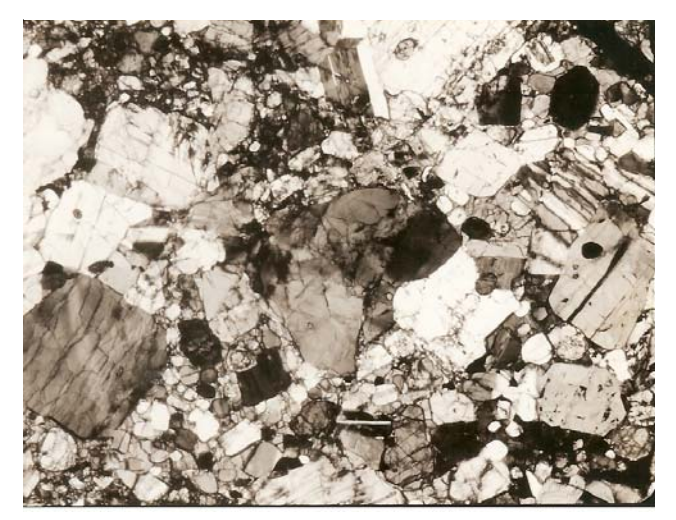
Figure 5: Thin section photomicrograph, with crossed nicols, of poikiloblastic portion of 77017.
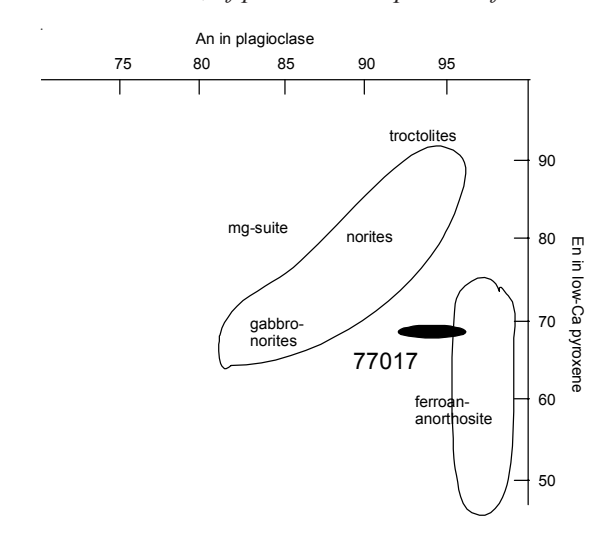
Figure 6: Plagioclase and pyroxene composition of lunar highlands samples showing 77017.
of extensive subsolidus annealing at high temperature. Temperatures of this metamorphism can be calculated from the composition of pyroxene pairs: 1050 to 1100 deg C (McCallum et al. 1974) or 1137 deg C (Cushing et al. 1999). Helz and Appelman (1974) and Lindstrom and Lindstrom (1986) interpret the feldspathic clasts in 77017 to represent a plutonic anorthositic norite lithology that was brecciated and metamorphosed to produce the poikilitic texture.
Mineralogy
Section titled “Mineralogy”Plagioclase: Plagioclase (An92-97) grains in 77017 are characteristically highly fractured and display offset twinning, undulatory extinction and mosaicism (figure 5).
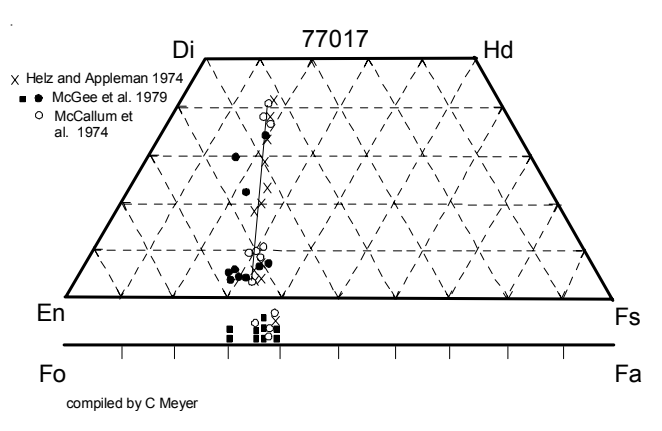
Figure 7: Pyroxene and olivine composition of feldspathic portion of 77017 (from Helz and Appleman 1974, McCallum et al 1974, McGee et al. 1979).
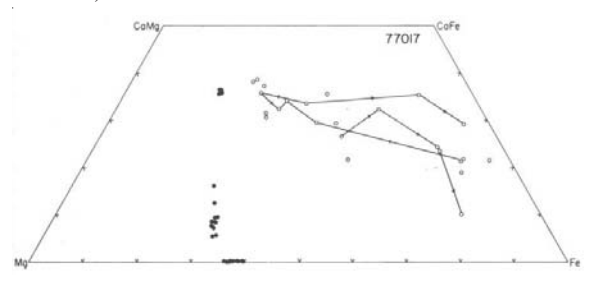
Figure 8: Pyroxene and olivine from 77017 (Hodges and Kushiro 1974). Open symbols are of a mare basalt clast and filled circles are of the feldspathic, granulitic portion.
Olivine: Olivine in 77017 is Fo58-62. Much is made of olivine “necklaces” in large plagioclase.
Pyroxene: Helz and Appelman (1974), Hodges and Kushiro (1974), Cushing et al. (1999), McCallum et al. (1974) and Hudgins et al. (2008) reported pyroxene composition (figures 7 and 8). Pyroxene oikocrysts are typically homogeneous. According to Hudgins et al., high-Ca clinopyroxene is Wo21-42En43-57Fs15-22, low-Ca clinopyroxene is Wo5-17En58-66Fs25-34 and orthopyroxene is Wo3-5En61-71Fs26-35. Augite oikocrysts have low-Ca exsolution. Other pyroxene grains found in the black glass are apparently from mare basalt (figure 8).
Spinel: Taylor and Williams (1974) reported pink spinel.
Ilmenite: Ilmenite grains have poikilitic texture, enclosing plagioclase and mafic minerals. Ilmenite in 77017 has 3.1 - 4.9 % MgO (Hudgins et al. 2008).
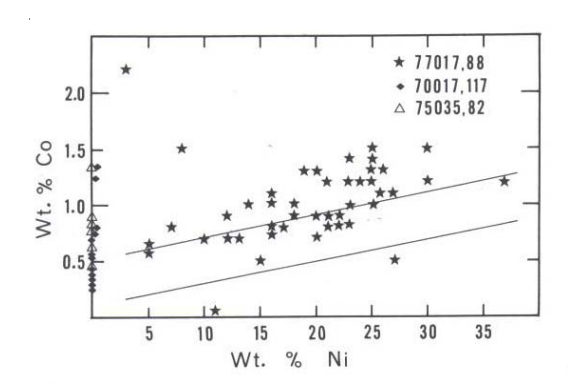
Figure 9: Ni and Co in metal grains in 77017 (from Taylor and Williams 1974).
Metal: Taylor and Williams (1974) and Hewins and Goldstein (1975) found the metal grain in 77017 were high in Ni and Co, but generally within the range of meteoritic metal (figure 9).
Chemistry
Section titled “Chemistry”LSPET (1973), Hubbard et al. (1974), Laul et al. (1974), Morgan et al. (1974), Lindstrom and Lindstrom (1986) and Hudgins et al. (2008) determined the chemical composition of 77017 including trace elements and siderophiles (tables and figure 10). The apparent lack of trace elements that normally are abundant in KREEP has been discussed by Warner et al. (1977). The high content of meteoritic siderophiles (Ir, Au etc) in the feldspathic portion strongly indicates that this rock was formed or influenced by impact.
Gibson and Moore (1974) determined S = 955 ppm. Moore et al. (1974) and Petrowski et al. (1974) determined C = 80 ppm and 25 ppm respectively. Moore and Lewis (1976) and Muller et al. (1976) determined nitrogen 45 = ppm and 5 ppm, respectively.
Radiogenic age dating
Section titled “Radiogenic age dating”Kirsten and Horn (1974), Phinney et al. (1975) and Hudgins et al. (2008) determined the “age” of 77017 by the Ar/Ar plateau technique (figures 11-13) – but it is not clear what these ages mean. The high temperature plateau at about 4 b.y. may be the time of (granulitic) metamorphism.
Nunes et al. (1975) reported U/Th/Pb analyses and Nyquist et al. (1974) reported Rb/Sr studies, but these studies did not yield radiometric ages.
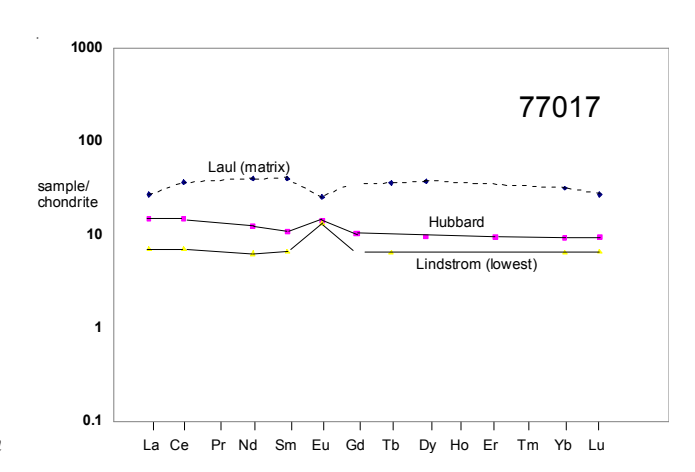
Figure 10: Normalized rare-earth-element diagram for 77017 (see tables).
Summary of Age Data for 77017
Section titled “Summary of Age Data for 77017”| Ar/Ar | |
|---|---|
| Kirsten and Horn 1974 | 3.98 ± 0.1 b.y. |
| and 1.5 ± 0.3 b.y. | |
| Phinney et al. 1975 | 3.82 ± 0.02 b.y. |
| Hudgins et al. 2008 | 4.016 ± 0.039 b.y. |
| and ~ 2.3 b.y. |
Ages have been corrected using decay constants recommended by Steiger and Jager 1977.
Cosmogenic isotopes and exposure ages
Section titled “Cosmogenic isotopes and exposure ages”Kirsten and Horn (1974), Phinney et al. (1975) and Hudgins et al. (2008) determined cosmic ray expsoure ages of 80 m.y., 224 ± 20 m.y., 133 ± 9.5 m.y., respectively, by the 38Ar method.
Other Studies
Section titled “Other Studies”Mayeda et al. (1975) determined the oxygen isotopic composition of mineral separates from 77017, discussing the temperature of equilibration. But these mineral separates could not be pure!
Charette and Adams (1977) compared spectra of 77017 with other samples.
Huffman et al. (1974), Nagata et al. (1974, 1975), Pearce et al. (1974), Schwerer and Nagata (1976) and Cisowski et al. (1983) determined magnetic properties. Mizutani and Osako (1974) determined the elastic wave velocity of 77017 and also measured thermal diffusivity.
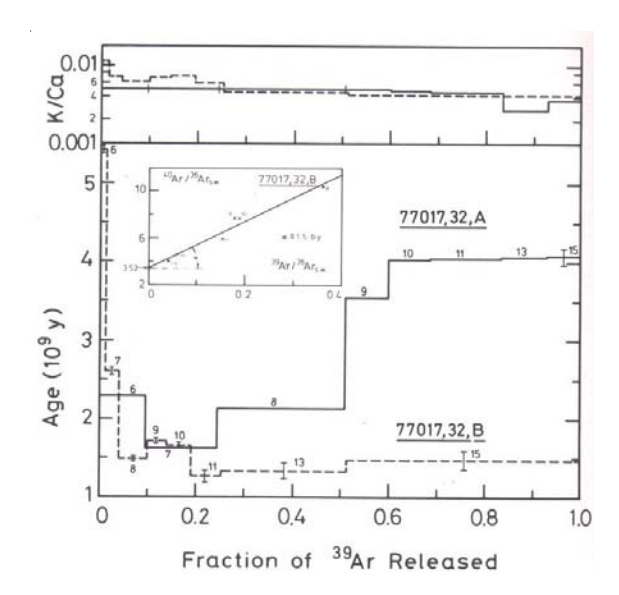
Figure 11: Ar/Ar plateau diagrams for 77017 (Kirsten and Horn 1974).
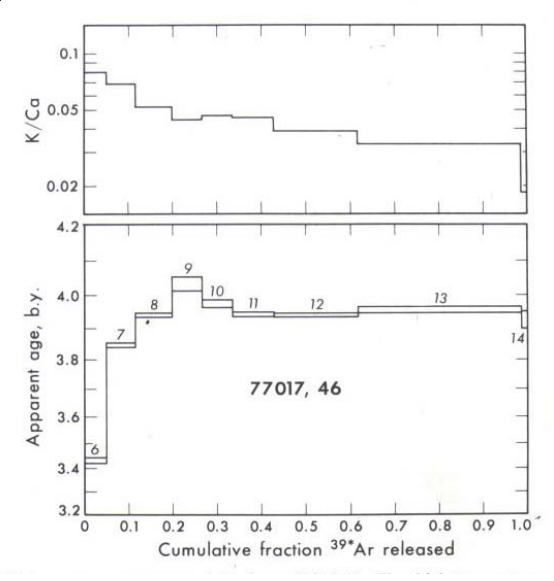
Figure 12: Ar/Ar plateau diagram for 77017 (Phinney et al. 1975).
Processing
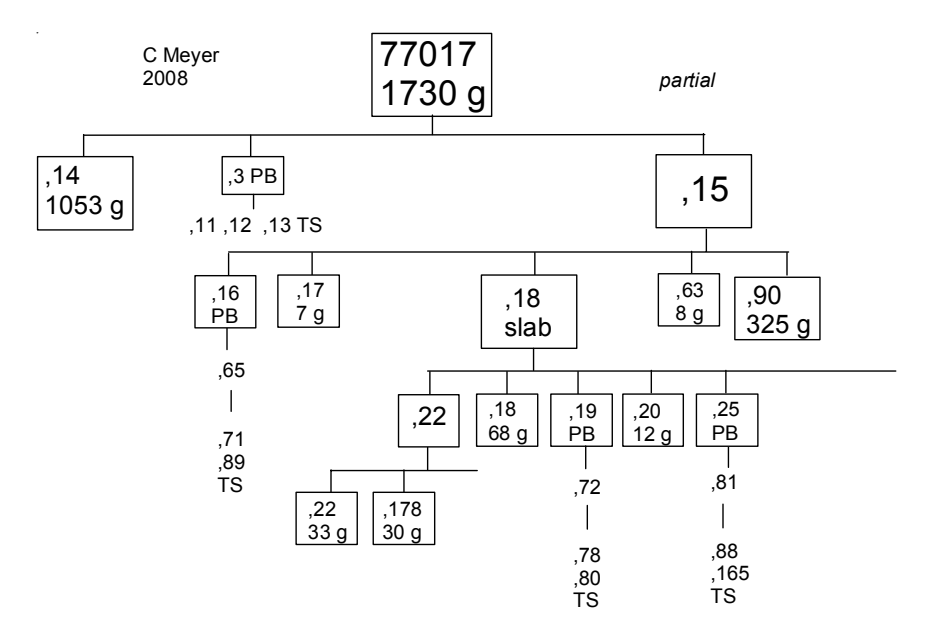
Section titled “Processing”A slab was cut through the middle of 77017 (figure 16). A large piece (,14 = 1053 g) remains unstudied. One suspects, but one does not know, that all the feldspathic material is the same. However, to make real progress, it would seem best that a consortium chief, with a petrologic background, should carefully organize future study so that chemistry, petrography and isotope studies can be matched to their respective lithology.
There are 32 thin sections of 77017 (see diagram).
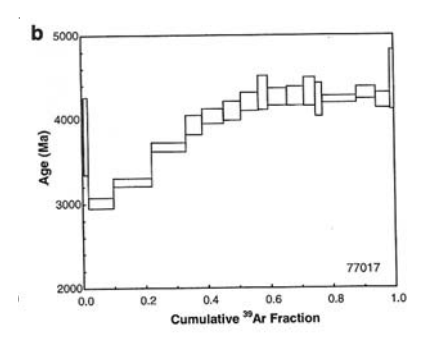
Figure 13: Ar/Ar plateau diagram for 77017 (Hudgins et al. 2008).
References for 77017
Section titled “References for 77017”Adams J.B. and Charette M.P. (1975) Spectral reflectance of highland rock types at Apollo 17: Evidence from Boulder 1, Station 2. The Moon 14, 483-489.
Ashwal L.D. (1975) Petrologic evidence for a plutonic igneous origin of anorthositic norite clasts in 67955 and 77017. Proc. 6th Lunar Sci. Conf. 221-230.
Bence A.E., Delano J.W., Papike J.J. and Cameron K.L. (1974) Petrology of the highlands massifs at Taurus-Littrow: An analysis of the 2-4 mm soil fraction. Proc. 5th Lunar Sci. Conf. 785-827.
Brecher A., Menke W.H. and Morash K.R. (1974) Comparative magnetic studies of some Apollo 17 rocks and soils and their implications. Proc. 5th Lunar Sci. Conf. 2795 2814.
Brecher A., Menke W.H., Adams J.B. and Gaffey M.J. (1975) The effects of heating and subsolidus reduction on lunar materials: An analysis by magnetic methods, optical, Mossbauer, and X-ray diffraction spectroscopy. Proc. 6th Lunar Sci. Conf. 3091-3109.
Butler P. (1973) Lunar Sample Information Catalog Apollo 17. Lunar Receiving Laboratory. MSC 03211 Curator’s Catalog. pp. 447.
Charette M.P. and Adams J.B. (1977) Spectral reflectance of lunar highland rocks (abs). Lunar Sci. VIII, 172-174. Lunar Planetary Institute, Houston
Cisowski S.M., Collinson D.W., Runcom S.K., Stephenson A. and Fuller M. (1983) A review of lunar paleointensity data and implications for the origin of lunar magnetism. Proc. 13th Lunar Planet. Sci. Conf. A691-A704.
Cushing J.A., Taylor G.J., Norman M.D. and Keil K. (1993a) The granulite suite: Impact melts and metamorphic breccias
Table 1a. Chemical composition of 77017.
| reference weight | LSPET 73 Hubbard74 ,57 | Laul 74 | ”matrix” gray | Morgan 74 Hubbard74 Wiesmann75 | Nunes74 | ||||||||
|---|---|---|---|---|---|---|---|---|---|---|---|---|---|
| SiO2 % TiO2 Al2O3 FeO MnO MgO CaO Na2O K2O P2O5 S % sum | 44.09 0.41 26.59 6.19 0.08 6.06 15.43 0.3 0.06 0.03 0.15 | (a) (a) (a) | (a) 0.75 (a) 26 (a) 6.2 (a) 0.085 0.155 (a) 6 (a) 14.5 (a) 0.31 (a) 0.05 | 5.3 18.9 12.1 8 11.7 0.39 0.1 | 0.35 27.1 5.7 0.077 6 15.7 0.36 0.076 | (b) (b) (b) (b) (b) (b) (b) (b) | 0.43 0.051 | (c ) | |||||
| Sc ppm V Cr Co Ni | 889 95 | 12 40 (a) 959 24 (a) 290 | 36 70 1984 27 290 | 9.8 40 862 23 300 | (b) (b) (b) (b) | (b) 443 | (d) | 881 | (c ) | ||||
| Cu Zn | 4 | (a) | 2.5 | (d) | |||||||||
| Ga Ge ppb | 110 | (d) | |||||||||||
| As Se | 68 | (d) | |||||||||||
| Rb Sr | 1.2 141 | (a) (a) | 1.34 | (d) 1.3 141 | (c ) (c ) | ||||||||
| Y Zr Nb Mo Ru Rh | 14 50 4.1 | (a) (a) (a) | 200 | (b) | 59.1 | (c ) | |||||||
| Pd ppb Ag ppb Cd ppb In ppb | 0.87 9 | (d) (d) | |||||||||||
| Sn ppb Sb ppb Te ppb Cs ppm Ba La Ce | 30 3.3 9 | 70 6.4 22 | 40 3.6 10 | (b) (b) (b) | 0.72 1.9 0.061 (d) | (d) (d) | 49 3.48 8.9 | (c ) (c ) (c ) | |||||
| Pr Nd Sm Eu Gd | 5 1.5 0.78 | 18 5.9 1.42 | 5 1.7 0.81 | (b) (b) (b) | 5.56 1.6 0.794 2.01 | (c ) (c ) (c ) (c ) | |||||||
| Tb Dy | 0.3 2.4 | 1.3 9 | 0.3 2.4 | (b) (b) | 2.34 | (c ) | |||||||
| Ho | |||||||||||||
| Er Tm | 1.5 | (c ) | |||||||||||
| Yb Lu Hf Ta | 1.6 0.21 1.5 0.22 | 5.1 0.66 4.9 0.85 | 1.4 0.18 1 0.14 | (b) (b) (b) (b) | 1.5 0.23 1.6 | (c ) (c ) (c ) | |||||||
| W ppb Re ppb | 1.73 | (d) | |||||||||||
| Os ppb Ir ppb | 10 | 9 | 10 | (b) 17 | (d) | ||||||||
| Pt ppb Au ppb | 3 | 3 | 3 | (b) 5.65 | (d) | ||||||||
| Th ppm U ppm | 0.4 | 0.6 | (b) | 0.137 (d) 0.22 | 1.025 (c ) 0.27 | 1.49 0.415 | (d) (d) | ||||||
| technique: (a) XRF, (b) INAA, (c ) IDMS, (d) RNAA |
Table 1b. Chemical composition of 77017.
| reference Lindstrom and Lindstrom 86 | |||||||||||
|---|---|---|---|---|---|---|---|---|---|---|---|
| weight SiO2 % | 151G | 151 | 152 | 153 | 154 | 155 | 2 | 57 | 57D | 57G | |
| TiO2 Al2O3 | 1.17 24.9 | 0.7 24.7 | 0.41 24.9 | 0.41 26.59 | 0.75 26 | 5.3 18.9 | 0.35 27.1 | (a) (a) | |||
| FeO MnO | 6.34 | 5.99 | 6.18 | 6.21 | 6.02 | 6.02 | 6.19 0.08 | 6.2 0.085 | 12.1 0.155 | 5.7 0.077 | (a) (a) |
| MgO | 6.2 | 6.5 | 6.1 | 6.06 | 6 | 8 | 6 | (a) | |||
| CaO Na2O | 15.5 0.36 | 14.9 0.33 | 15.3 0.34 | 15.4 0.34 | 14.9 0.34 | 15 0.33 | 15.43 0.3 | 14.5 0.31 | 11.7 0.39 | 15.7 0.36 | (a) (a) |
| K2O P2O5 | 0.05 | 0.05 | 0.1 | 0.076 | (a) | ||||||
| S % sum | |||||||||||
| Sc ppm | 15.1 | 13.4 | 12 | 13.1 | 11.8 | 11.5 | 12 | 36 | 9.8 | (a) | |
| V Cr | 1018 | 1092 | 853 | 932 | 986 | 839 | 881 | 960 | 1986 | 863 | (a) |
| Co | 28.5 | 24.8 | 27 | 25.2 | 24.9 | 24.6 | 24 | 27 | 23 | (a) | |
| Ni Cu | 360 | 300 | 312 | 297 | 296 | 290 | 290 | 290 | 300 | (a) | |
| Zn Ga | |||||||||||
| Ge ppb As | |||||||||||
| Se Rb | 1.31 | (a) | |||||||||
| Sr Y | 165 | 155 | 170 | 147 | 151 | 150 | 142 | (a) | |||
| Zr Nb | 40 | 30 | 38 | 50 | 32 | 48 | 59 | 200 | (a) | ||
| Mo Ru | |||||||||||
| Rh | |||||||||||
| Pd ppb Ag ppb | |||||||||||
| Cd ppb In ppb | |||||||||||
| Sn ppb Sb ppb | |||||||||||
| Te ppb Cs ppm | 0.1 | 0.07 | 0.09 | 0.11 | 0.06 | 0.05 | (a) | ||||
| Ba La | 45 2.76 | 34 1.68 | 45 3.17 | 46 3.46 | 47 2.69 | 50 2.4 | 49 3.48 | 30 3.3 | 70 6.4 | 40 3.6 | (a) (a) |
| Ce Pr | 7.1 | 4.3 | 8.3 | 9.2 | 6.6 | 5.7 | 8.9 | 9 | 22 | 10 | (a) |
| Nd Sm | 4.5 1.61 | 2.9 0.984 | 5 1.621 | 5.7 1.824 | 4 1.258 | 3.4 1.164 | 5.56 1.6 | 5 1.5 | 18 5.9 | 5 1.7 | (a) (a) |
| Eu | 0.835 | 0.75 | 0.765 | 0.762 | 0.74 | 0.745 | 0.794 | 0.78 | 1.42 | 0.8 | (a) |
| Gd Tb | 0.41 | 0.235 | 0.403 | 0.44 | 0.29 | 0.295 | 0.3 | 1.3 | 0.3 | (a) | |
| Dy Ho | |||||||||||
| Er Tm | |||||||||||
| Yb Lu | 1.57 0.237 | 1.06 0.163 | 1.6 0.24 | 1.61 0.248 | 1.26 0.193 | 1.28 0.203 | 1.5 | 1.6 0.21 | 5.1 0.66 | 1.4 0.18 | (a) (a) |
| Hf Ta | 1.57 0.28 | 0.8 0.103 | 1.1 0.112 | 1.27 0.152 | 0.89 0.128 | 1.16 0.148 | 1.6 | 1.5 0.22 | 4.9 0.85 | 1 0.14 | (a) (a) |
| W ppb Re ppb | |||||||||||
| Os ppb | |||||||||||
| Ir ppb Pt ppb | 15 | 14 | 13 | 13 | 13 | 13 | 10 | 9 | 10 | (a) | |
| Au ppb Th ppm | 6.2 0.47 | 4.1 0.52 | 4.8 0.52 | 3.5 0.72 | 7.9 0.84 | 3.5 0.71 | 3 0.4 | 3 0.6 | 3 | (a) (a) | |
| U ppm technique: (a) INAA | 0.11 | 0.05 | 0.18 | 0.17 | 0.13 | 0.06 | 0.22 | (a) |
| reference Hudgins et al. 2008 weight SiO2 % TiO2 Al2O3 FeO MnO MgO CaO Na2O K2O P2O5 S % sum | |||||
|---|---|---|---|---|---|
| Sc ppm V | 11.02 | 11.4 | 11.76 | 11.91 | (a) |
| Cr Co Ni Cu Zn Ga Ge ppb As Se Rb | 30.8 372 | 27.3 312 | 26.5 298 | 27 300 | (a) (a) |
| Sr | 144 | 140 | 150 | 150 | (a) |
| Y Zr Nb Mo Ru Rh Pd ppb Ag ppb Cd ppb In ppb Sn ppb Sb ppb Te ppb Cs ppm | 47 | 45 | 50 | 51 | (a) |
| Ba La Ce | 49 3.81 9.6 | 45 3.26 8.3 | 51 3.61 9.1 | 47 4.14 10.6 | (a) (a) (a) |
| Pr Nd Sm Eu Gd | 5.4 1.74 0.8 | 4.7 1.55 0.8 | 6.4 1.78 0.8 | 7 2.06 0.82 | (a) (a) (a) |
| Tb Dy Ho Er Tm | 0.37 | 0.33 | 0.39 | 0.44 | (a) |
| Yb Lu Hf Ta W ppb Re ppb Os ppb | 1.5 0.212 1.5 0.37 | 1.41 0.197 1.48 0.25 | 1.62 0.224 1.25 0.18 | 1.81 0.248 1.45 0.2 | (a) (a) (a) (a) |
| Ir ppb | 15.8 | 14.7 | 13.7 | 13.5 | (a) |
| Pt ppb Au ppb Th ppm U ppm technique: (a) INAA | 5.2 0.91 0.27 | 4.8 0.7 0.21 | 4.3 0.68 0.2 | 4.1 0.88 0.25 | (a) (a) (a) |
Table 1c. Chemical composition of 77017. of the early lunar crust (abs). Lunar Planet. Sci. XXIV, 369 370. Lunar Planet. Institute, Houston
Cushing J.A., Taylor G.J., Norman M.D. and Keil K. (1993b) Refining the granulite suite. In Workshop on Geology of the Apollo 17 Landing Site. LPI Tech. Rpt. 92-09.4-5. Lunar Planet. Institute, Houston
Cushing J.A., Taylor G.J., Norman M.D. and Keil K. (1999) The granulitic impactite suite: Impact melts and metamorphic breccias of the early lunar crust. Meteoritics & Planet. Sci. 34, 185-195.
Elkins-Tanton Linda T., Hager B.H. and Grove T.L. (2004) Magmatic effects of the lunar late heavy bombardment. Earth Planet. Sci. Lett. 222, 17-27.
Gibson E.K. and Moore G.W. (1974a) Sulfur abundances and distributions in the valley of Taurus-Littrow. Proc. 5th Lunar Sci. Conf. 1823-1837.
Helz R.T. and Appleman D.E. (1974) Poikilitic and cumulate textures in rock 77017, a crushed anorthositic gabbro (abs). Lunar Sci. V, 322-324. Lunar Planetary Institute, Houston
Hertogen J., Janssens M.-J., Takahashi H., Palme H. and Anders E. (1977) Lunar basins and craters: Evidence for systematic compositional changes of bombarding population. Proc. 8th Lunar Sci. Conf. 17-45.
Hewins R.H. and Goldstein J.I. (1975a) The provenance of metal in anorthositic rocks. Proc. 6th Lunar Sci. Conf. 343 362.
Hodges F.N. and Kushiro I. (1974a) Apollo 17 petrology and experimental determination of differentiation sequences in model Moon compositions. Proc. 5th Lunar Sci. Conf. 505-520.
Horai K. and Winkler J.L. (1976) Thermal diffusivity of four Apollo 17 rock samples. Proc. 7th Lunar Sci. Conf. 3183-3204.
Hubbard N.J., Rhodes J.M., Wiesmann H., Shih C.Y. and Bansal B.M. (1974) The chemical definition and interpretation of rock types from the non-mare regions of the Moon. Proc. 5th Lunar Sci. Conf. 1227-1246.
Hudgins J.A., Spray J.G., Kelley S.P., Korotev R.L. and Sherlock S. (2008) A laser probe 40Ar-39Ar and INAA investigation of four Apollo granulitic breccias (abs). MAPS Japan
Hudgins J.A. , John G. Spray, Simon P., Kelley S.P., Korotev R.L., Sherlock S.C. (2008) A laser probe 40Ar/39Ar and INAA investigation of four Apollo granulitic breccias. Geochim. Cosmochim. Acta 72, 5781-5798.
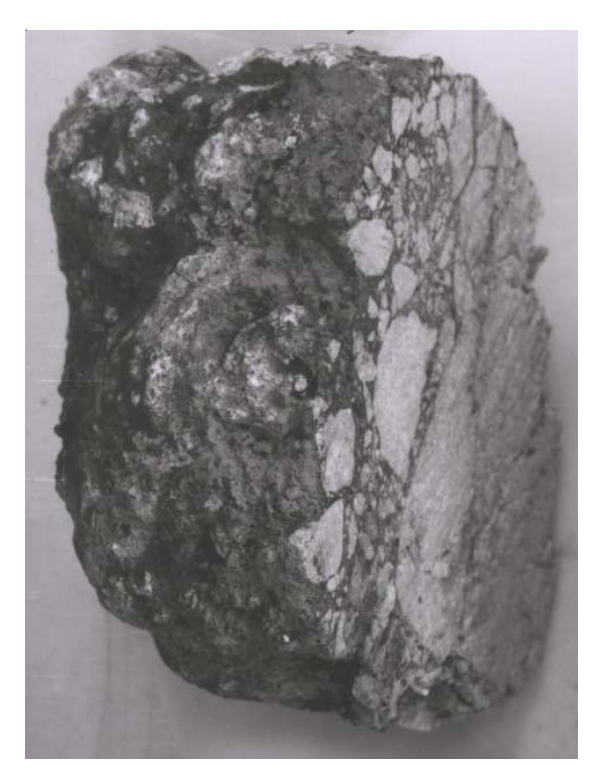
Figure 14: 77017,15 after saw cut. S73- 28611. Ruler is marked in cm.
Huebner J.S., Lipin B.R. and Wiggins L.B. (1976) Partioning of chromium betweeen silicate crystals and melts. Proc. 7th Lunar Sci. Conf. 1195-1220.
Huffman G.P., Schwerer F.C., Fisher R.M. and Nagata T. (1974) Iron distribution and metallic-ferrous ratios for Apollo lunar samples: Mossbauer and magnetic analyses. Proc. 5th Lunar Sci. Conf. 2779-2794.
James O.B. (1980) Rocks of the early lunar crust. Proc. 11th Lunar Planet. Sci. Conf. 365-393.
James O.B. (1993) The ancient lunar crust, Apollo 17 region (abs). In Workshop on Geology of the Apollo 17 Landing Site. LPI Tech. Rpt. 92-09, 17-18. Lunar Planetary Institute, Houston.
James O.B. (1994) Siderophile and volatile elements in Apollo 17 impact melts (abs). Lunar Planet. Sci. XXV, 617-618. Lunar Planetary Institute, Houston.
James O.B. (1995) Siderophile elements in lunar impact melts: Nature of the impactors (abs). Lunar Planet. Sci. XXVI, 671-672. Lunar Planetary Institute, Houston.
James O.B. (1996) Siderophile elements in lunar impact melts define nature of the impactors (abs). Lunar Planet. Sci. XXVII, 603-604. Lunar Planetary Institute, Houston.
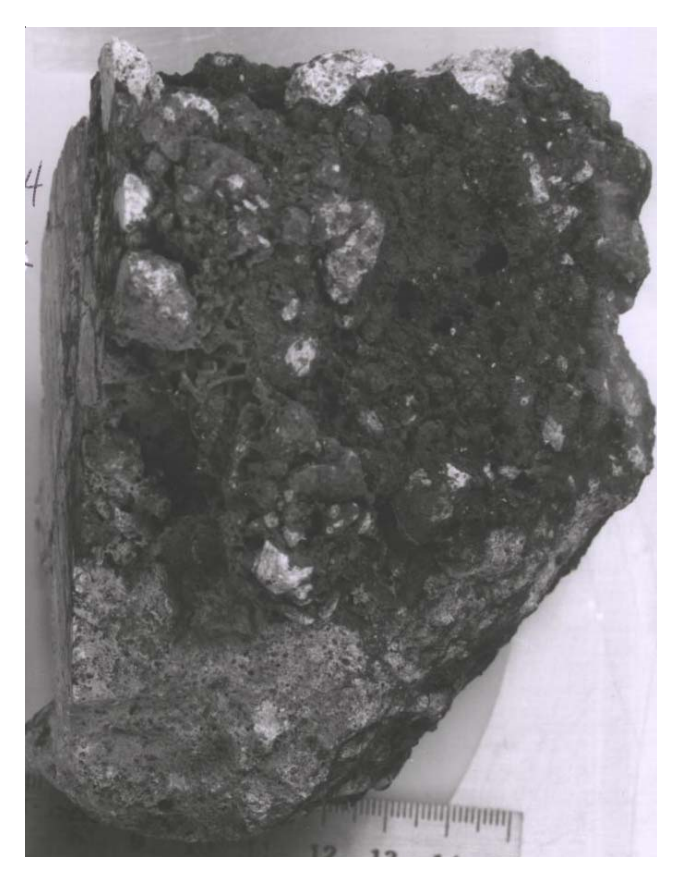
Figure 15: Photo of 77017,14 after saw cut. S73- 28611. Ruler is in cm.
James O.B. (2002) Distinctive meteoritic components in lunar “cataclysm” impact breccias (abs#1210). Lunar Planet. Sci. XXXIII Lunar Planetary Institute, Houston.
Kirsten T. and Horn P. (1974a) Chronology of the Taurus-Littrow region III: ages of mare basalts and highland breccias and some remarks about the interpretation of lunar highland rock ages. Proc. 5th Lunar Sci. Conf. 1451-1475.
Laul J.C.. Hill D.W. and Schmitt R.A. (1974d Chemical studies of Apollo 16 and 17 samples. Proc. 5th Lunar Sci. Conf. 1047-1066.
Lindstrom M.M. and Lindstrom D.J. (1986) Lunar granulites and their precursor anorthositic norites of the early lunar crust. Proc. 16th Lunar Planet. Sci. Conf. in J. Geophys. Res. 91, D263-D276.
LSPET (1973) Apollo 17 lunar samples: Chemical and petrographic description. Science 182, 659-672.
LSPET (1973) Preliminary Examination of lunar samples. Apollo 17 Preliminary Science Rpt. NASA SP-330. 7-1 – 7-46.
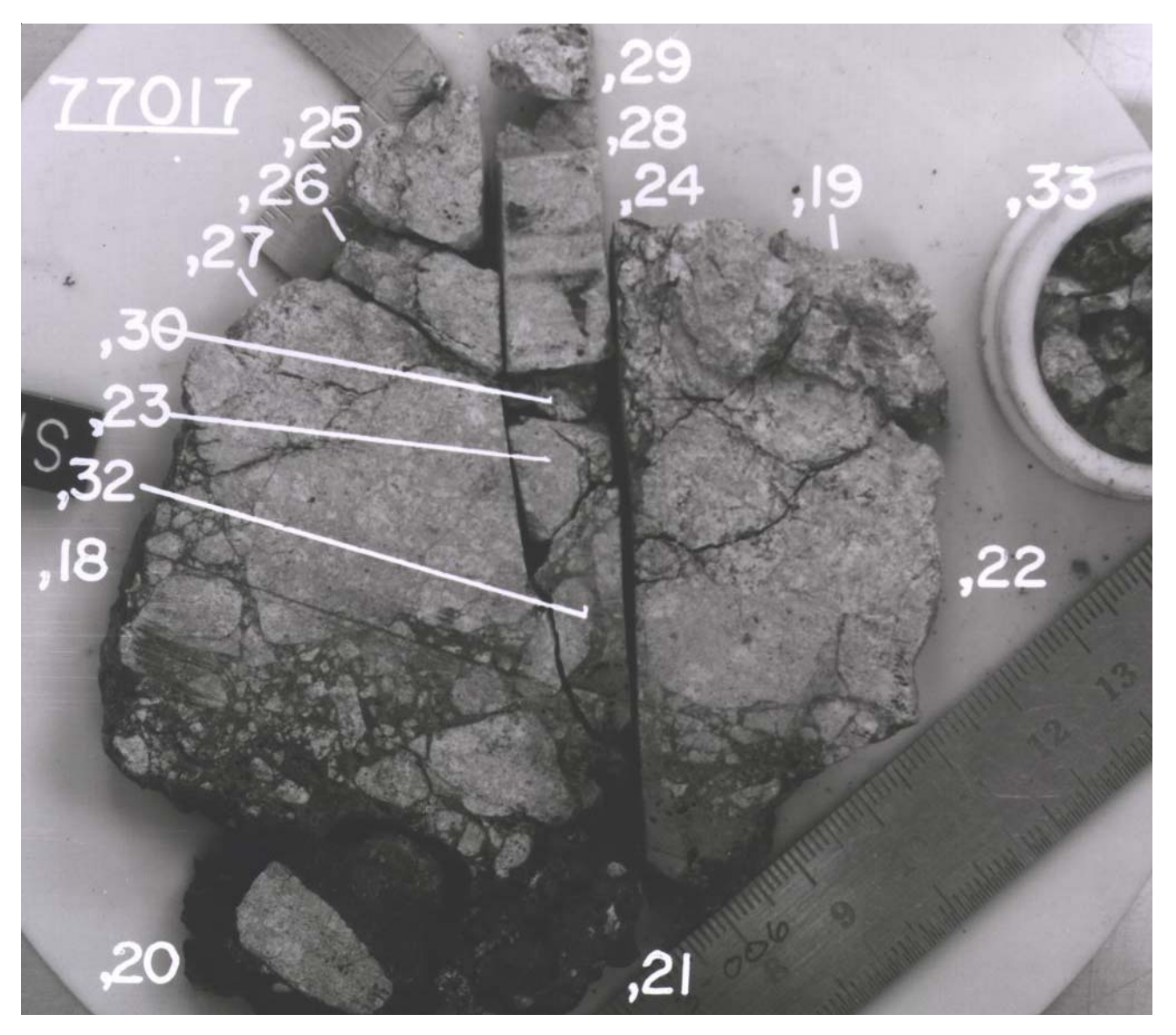
Figure 16: Processing photo showing subdivision of slab of 77017,18. S73-28613. Ruler is marked in cm.
Mayeda T.K., Shearer J. and Clayton R.N. (1975) Oxygen isotope fractionation of Apollo 17 rocks. Proc. 6th Lunar Sci. Conf. 1799-1802.
McCallum I.S., Mathez E.A., Okamura F.P. and Ghose S. (1974a) Petrology and crystal chemistry of poikilitic anorthositic gabbro 77017. Proc. 5th Lunar Sci. Conf. 287 302.
McGee P.E., Simonds C.H., Warner J.L. and Phinney W.C. (1979) Introduction to the Apollo Collections: Part II Lunar Breccias. Curators Office.
Meyer C. (1994) Catalog of Apollo 17 rocks. Vol. 4 North Massif Curator’s Office
Mizutani H. and Osako M. (1974a) Elastic-wave velocities and thermal diffusivities of Apollo 17 rocks and their geophysical implications. Proc. 5th Lunar Sci. Conf. 2891 2901.
Moore C.B., Lewis C.F. and Cripe J.D. (1974a) Total carbon and sulfur contents of Apollo 17 lunar samples. Proc. 5th Lunar Sci. Conf. 1897-1906.
Moore C.B. and Lewis C.F. (1976) Total nitrogen contents of Apollo 15, 16 and 17 lunar rocks and breccias (abs). Lunar Sci. VII, 571-573. Lunar Planetary Institute, Houston.
Morgan J.W., Ganapathy R., Higuchi H., Krahenbuhl U. and Anders E. (1974) Lunar basins: Tentative characterization of projectiles, from meteoritic dements in Apollo 17 boulders. Proc. 5th Lunar Sci. Conf. 1703-1736.
Muehlberger et al. (1973) Documentation and environment of the Apollo 17 samples: A preliminary report. Astrogeology 71 322 pp superceeded by Astrogeolgy 73 (1975) and by Wolfe et al. (1981)
Muehlberger W.R. and many others (1973) Preliminary Geological Investigation of the Apollo 17 Landing Site*. In* Apollo 17 Preliminary Science Report. NASA SP-330.
Müller O., Grallath E. and Tolg G. (1976a) Nitrogen in lunar igneous rocks. Proc. 7th Lunar Sci. Conf. 1615-1622.
Nagata T., Sugiura N., Fisher R.M., Schwerer F.C., Fuller M.D. and Dunn J.R. (1974a) Magnetic properties of Apollo 11-17 lunar materials with special reference to effects of meteorite impact. Proc. 5th Lunar Sci. Conf. 2827-2839.
Nagata T., Fisher R.M., Schwerer F.C., Fuller M.D. and Dunn J.R. (1975a) Effects of meteorite impact on magnetic properties of Apollo lunar materials. Proc. 6th Lunar Sci. Conf. 3111-3122.
Nunes P.D., Tatsumoto M. and Unruh D.M. (1974b) U-Th-Pb systematics of some Apollo 17 lunar samples and implications for a lunar basin excavation chronology. Proc. 5th Lunar Sci. Conf. 1487-1514.
Nunes P.D., Tatsumoto M. and Unruh D.M. (1975a) U-Th-Pb systematics of anorthositic gabbros 78155 and 77017 implications for early lunar evolution. Proc. 6th Lunar Sci. Conf. 1431-1444.
Nyquist L.E., Bansal B.M., Wiesmann H. and Jahn B.-M. (1974a) Taurus-Littrow chronology: some constraints on early lunar crustal development. Proc. 5th Lunar Sci. Conf. 1515-1539.
Pearce G.W., Strangway D.W. and Gose W.A. (1974a) Magnetic properties of Apollo samples and implications for regolith formation. Proc. 5th Lunar Sci. Conf. 2815-2826.
Petrowski C., Kerridge J.F. and Kaplan I.R. (1974) Light element geochemistry of the Apollo 17 site. Proc. 5th Lunar Sci. Conf. 1939-1948.
Phinney D., Kahl S.B. and Reynolds J.H. (1975) 40Ar-39Ar dating of Apollo 16 and 17 rocks. Proc. 6th Lunar Sci. Conf. 1593-1608.
Schwerer F.C. and Nagata T. (1976) Ferromagneticsuperparamagnetic granulometry of lunar surface materials. Proc. 7th Lunar Sci. Conf. 759-778.
Simonds C.H., Warner J.L. and Phinney W.C. (1976) Thermal regimes in cratered terrain with emphsis on the role of impact melt. Am. Mineral. 61, 569-577.
Stewart D.B. (1975) Apollonian metamorphic rocks—The products of prolonged subsolidus equilibration (abs). Lunar Sci. VI, 774-776. Lunar Planetary Institute, Houston.
Taylor L.A. and Williams K.L. (1974a) Formational history of lunar rocks: applications of experimental geochemistry of the opaque minerals. Proc. 5th Lunar Sci. Conf. 585-596.
Warner J.L., Phinney W.C., Bickel C.E. and Simonds C.H. (1977) Feldspathic granulitic impactites and pre-final bombardment lunar evolution. Proc. 8th Lunar Sci. Conf. 2051-2066.
Wiesmann H. and Hubbard N.J. (1975) A compilation of the Lunar Sample Data Generated by the Gast, Nyquist and Hubbard Lunar Sample PI-Ships. Unpublished. JSC
.
Wolfe E.W., Bailey N.G., Lucchitta B.K., Muehlberger W.R., Scott D.H., Sutton R.L and Wilshire H.G. (1981) The geologic investigation of the Taurus-Littrow Valley: Apollo 17 Landing Site. US Geol. Survey Prof. Paper, 1080, pp. 280.