Sample 79002
79001 – 743.4 grams 79002 - 409.4 grams
Section titled “79001 – 743.4 grams 79002 - 409.4 grams”Double drive tube 51.3 cm
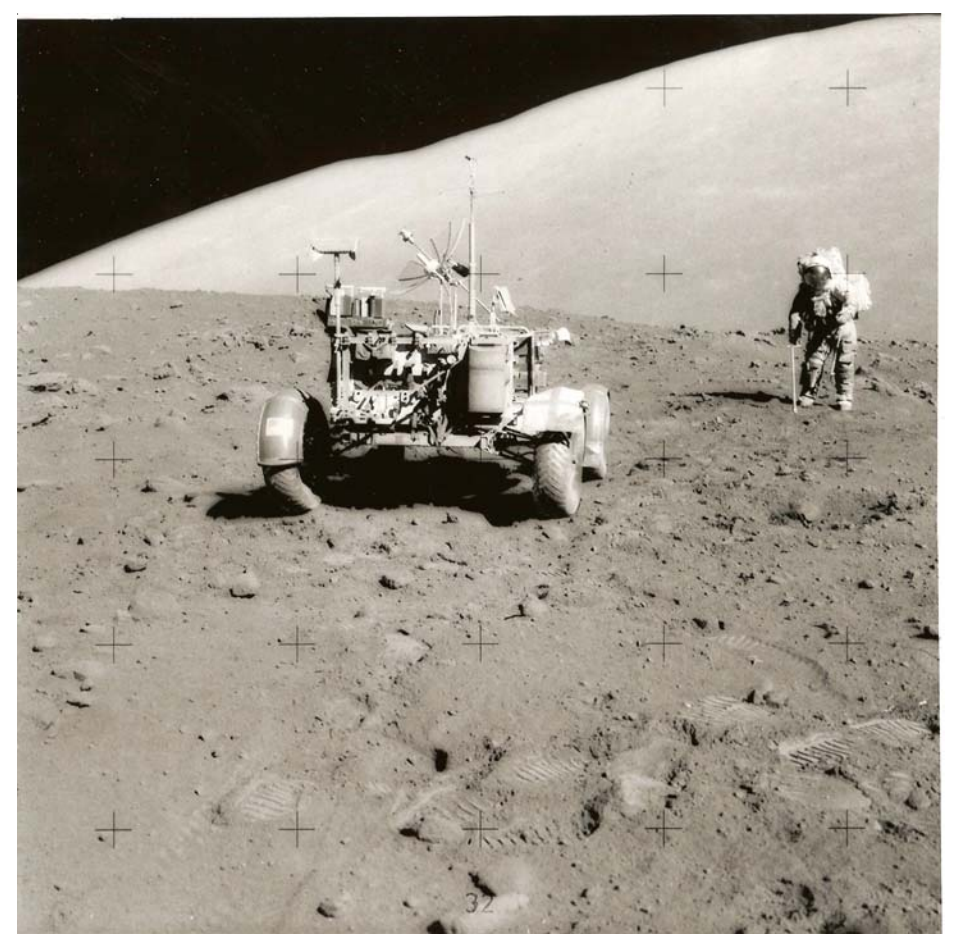
Figure 1: Astronaut collecting double drive tube on rough terrain caused by ejecta from of Van Serg Crater. AS17-143-21836 (note map for fender!)
Introduction
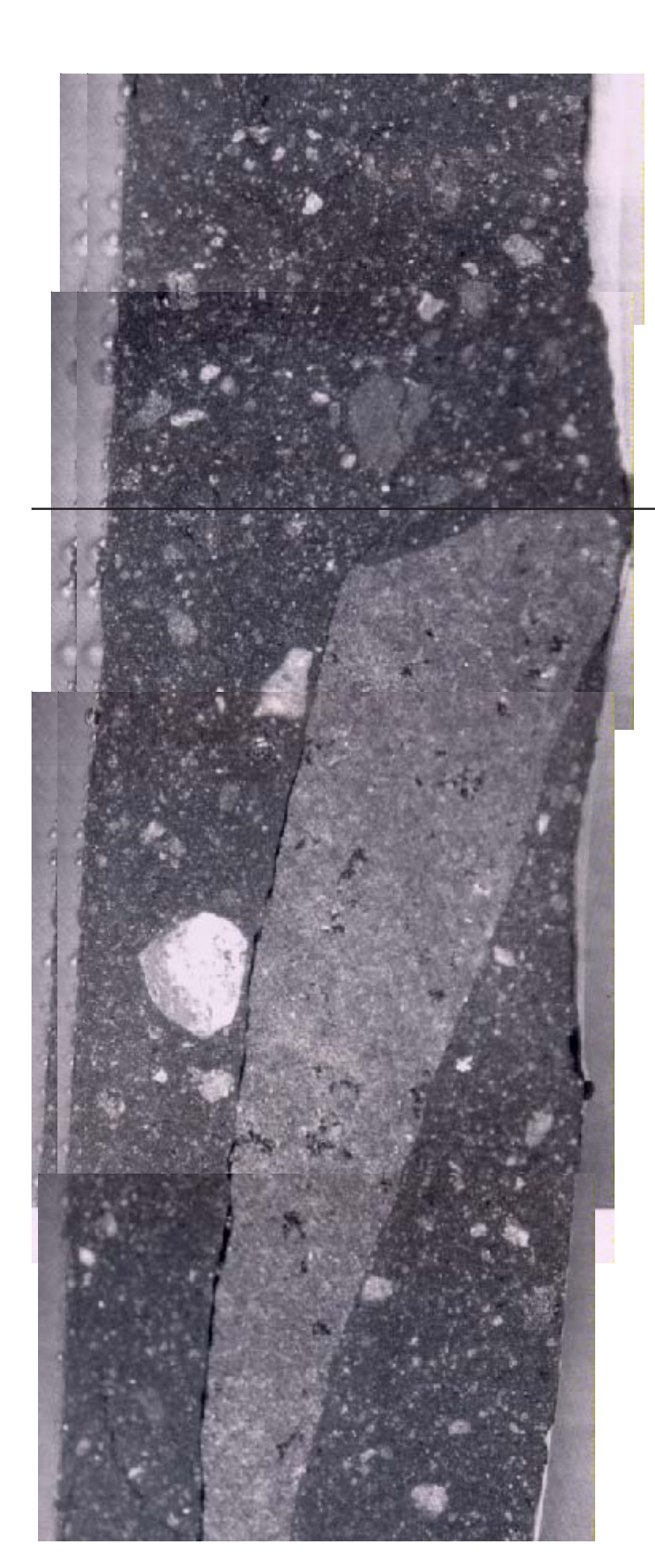
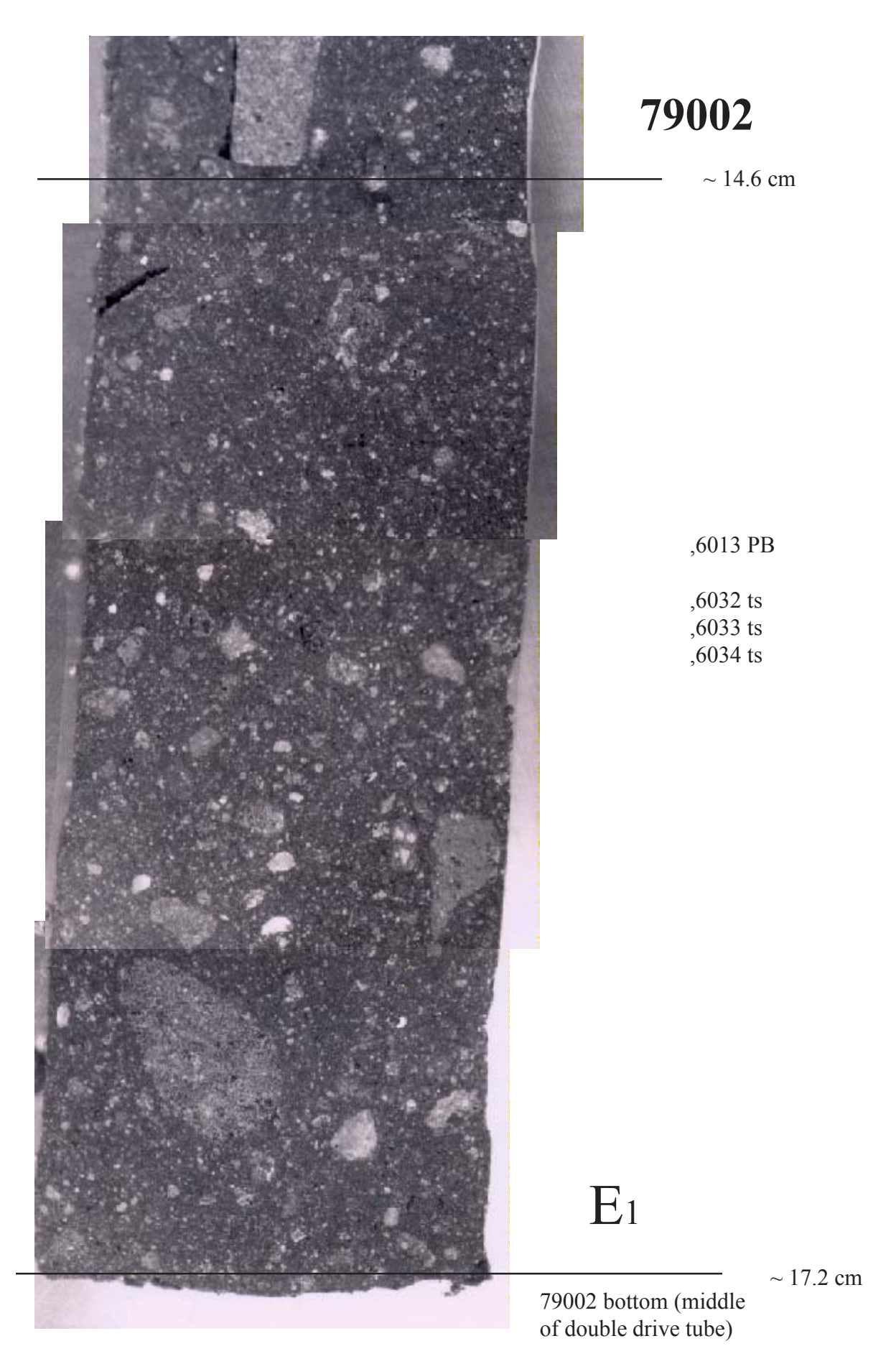
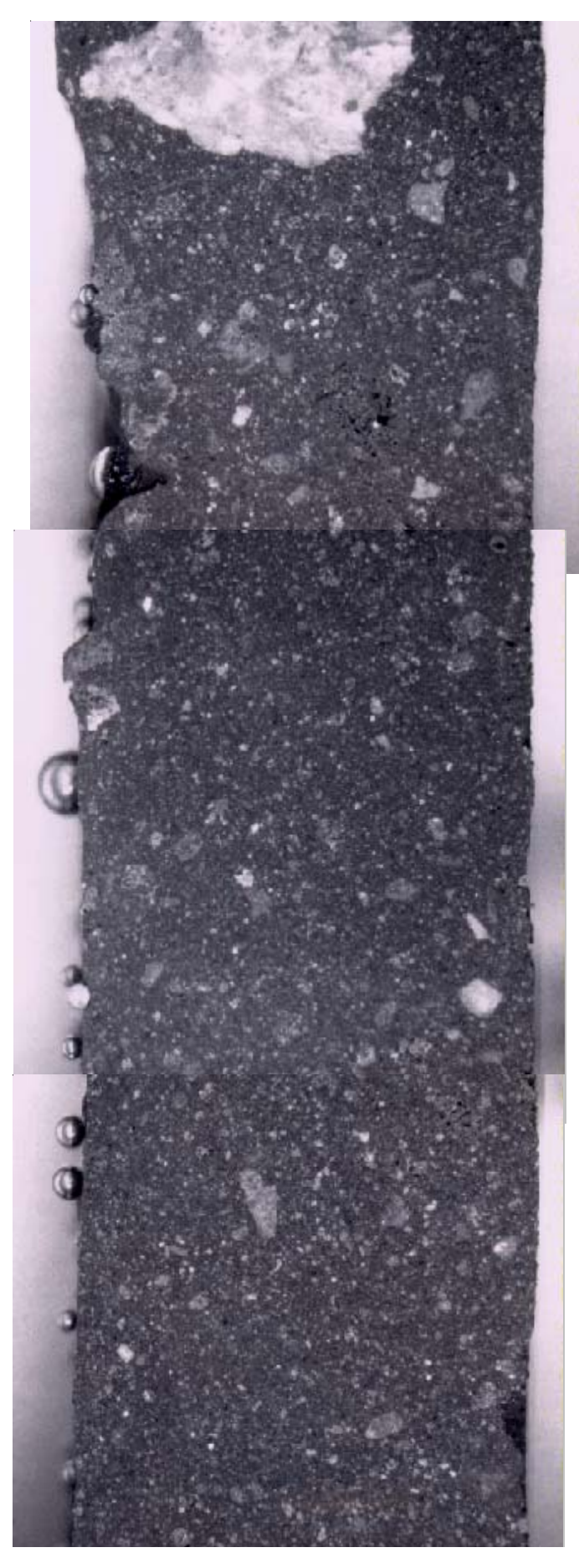
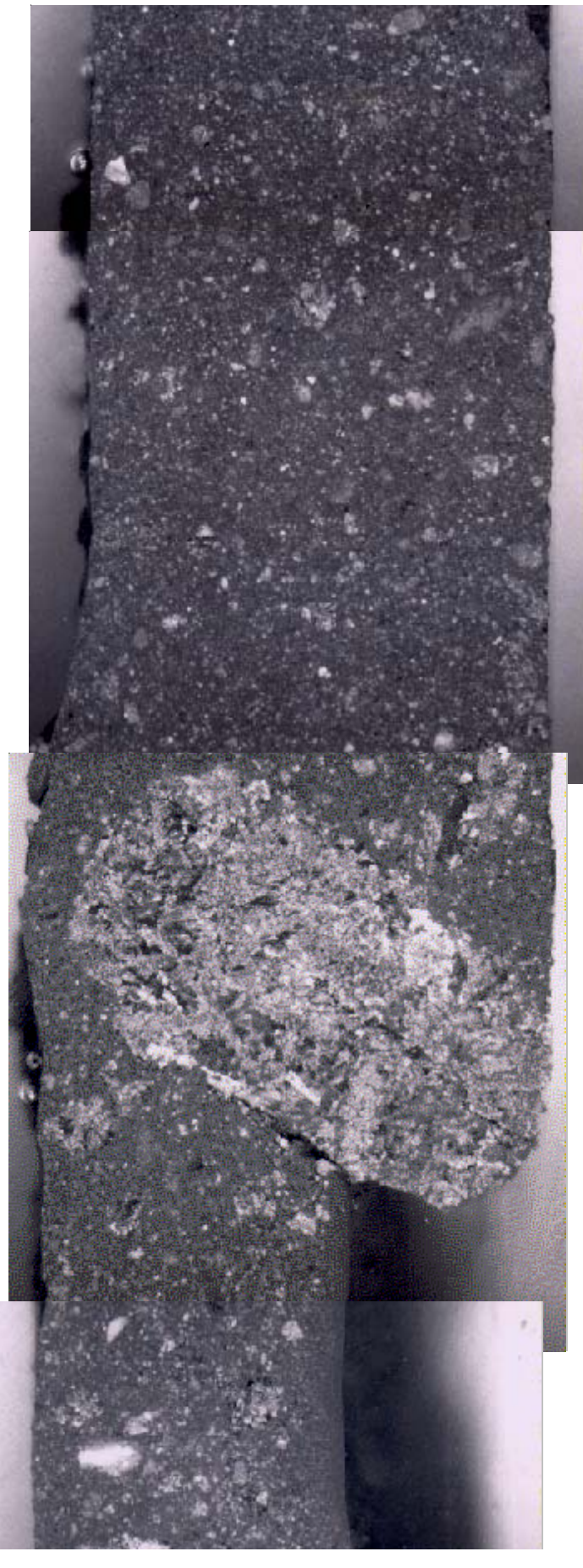
Section titled “Introduction”A double drive tube was successfully collected at station 9, on the ejecta blanket of Van Serg Crater (figure 1). The location was about 70 m downslope from the rim (figure 2) and about 1 m from the trench sample (79220). 79002 is the upper section, 79001 the lower section of the core. The obvious stratigraphy seen in the trench is not duplicated in the core.
Petrography
Section titled “Petrography”The maturity index Is /FeO of the every 5 mm depth has been determined (figure 3). A very mature layer is found at 5 – 8 cm depth. Morris et al. (1989) found the Is /FeO to be ~ 40 in that zone, compared to a value of
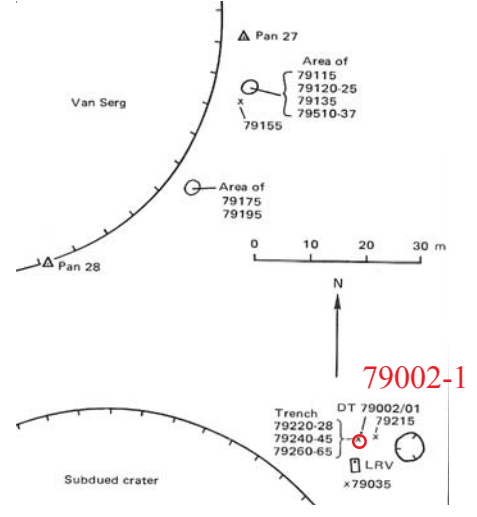
Figure 2: Map of station 9, Apollo 17 showing location of drive tube.
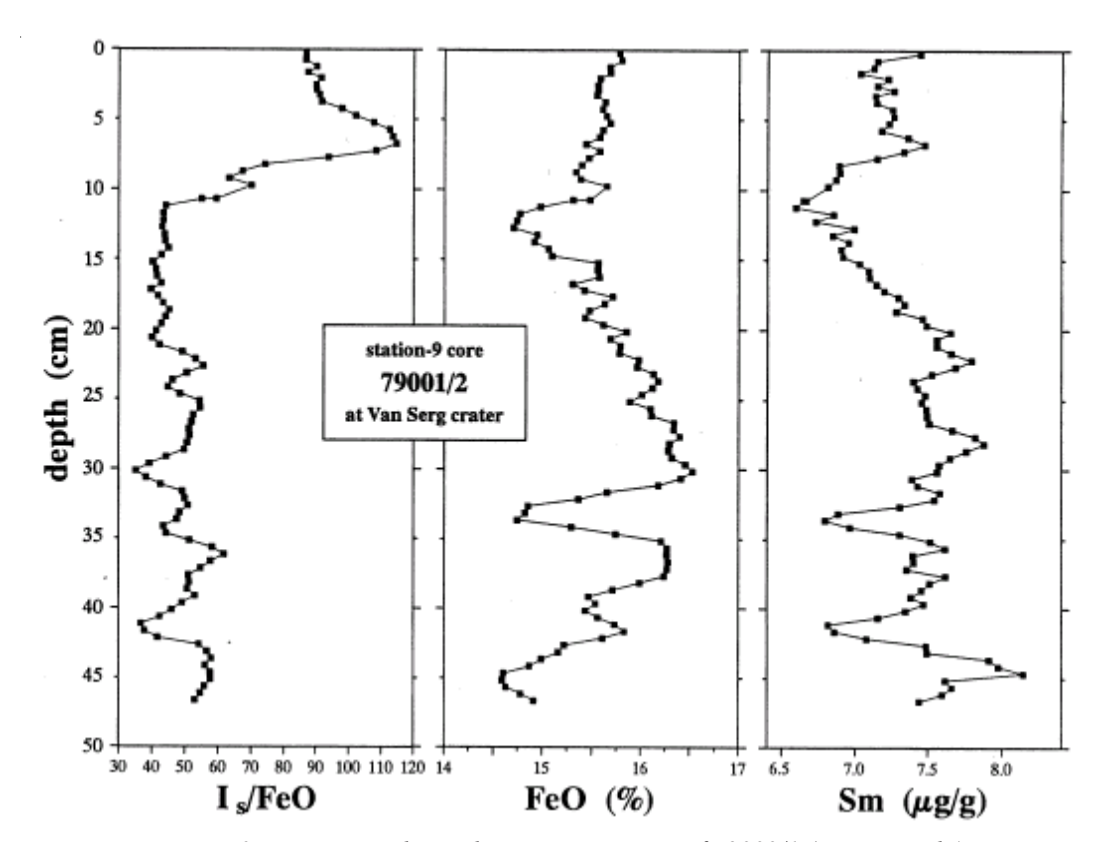
Figure 3: Maturity index and samarium content of 79002/1 (Morris et al. )
~25 for the rest of the core. McKay et al. (1988) found higher agglutinate content (44 %) in that zone as well (figure 5).
There were three visually obvious transitions from light to dark at about 10, 30 and 35 cm depth, but only the first of these transitions correlates with the maturity index.
Graf (1993) plotted the grain size distribution for data obtained by McKay et al. (figure 6).
Chemistry
Section titled “Chemistry”Morris et al. (1989) determined the composition of 133 splits along the entire length of 79002/1 (every 5 mm). The core was found to be quite homogeneous along its length (the average is given in table 1). The mature section at the top, and the bottom 5 cm may have slightly different composition, as noted by Morris et al., but they are not statistically significant. However, the core has not been analyzed for all elements.
For comparison, Korotev and Kremser (1992) give a more complete analysis for 79221 – collected only 1 meter away.
Transcript
Section titled “Transcript”CC We have had a change of heart here again, as usual. And we’re going to drop station 10 now that we’ve hurried you so much, and we’re going to get a double core here. And we’d like to get some football-size rocks while you’re doing that. And then we’re going to leave here and go back to the LM.
LMP You don’t want a double core here. I don’t think we can do it, Bob. It’s too rocky.
CDR You don’t think we’ll get through that stuff you just trenched?
LMP Well, I’m afraid there are rocks all through it.
CDR Let’s try it.
- — LMP The first core was easy: the second one a little tougher: and then it got tough down at the end. There, I’m getting a picture of you. Okay. I got it.
CDR Core but it want to slide out. It’s full. No rocks in it. It looks just like the same stuff we’ve been traveling through.
CDR It’s very loose spoil, just any little movement and you’ll lose some of it. The top rammed down – Oh, almost half way without any effort. The bottom rammed down about an inch.
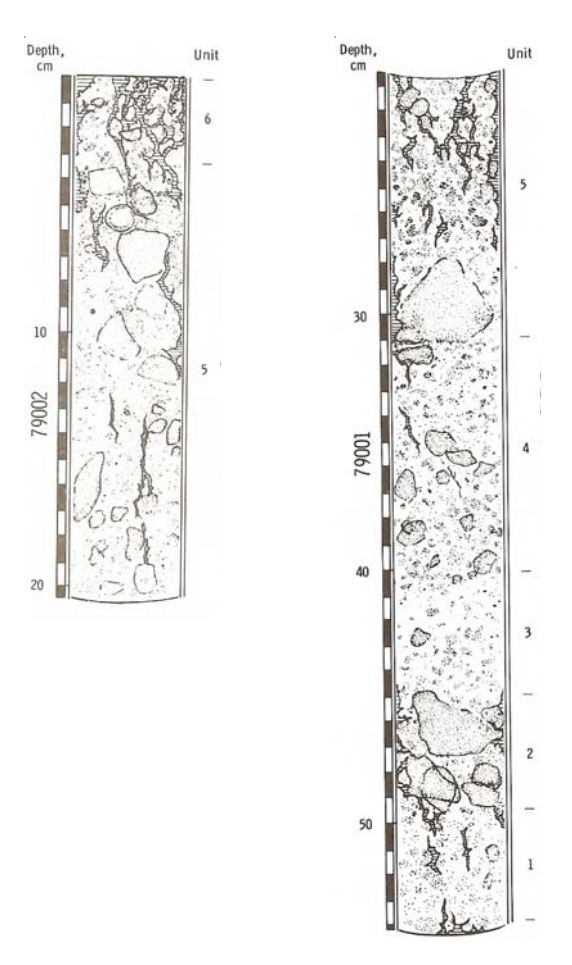
Figure 4: Artist sketch of X-ray of double drive tube 79002 and 79001. 79002 is the top Length is 54 cm.
Other Studies
Section titled “Other Studies”Stone and Clayton (1989) determined the isotopic composition of nitrogen as function of release temperature (figure 7).
Processing
Section titled “Processing”According to Mitchell et al. (1973), it took less than 19 hammer blows to drive the core. A footnote in table 8 therein, mentions that 41 cm3 of material may have fallen out of the top of 79001 (a section in the middle)!
Duke and Nagle (1976) give a preliminary “description” of the X-ray image of the core (there is no mention of a missing section). 79002 (upper section) was not dissected until 1986 and described in newsletter 47. 79001 was dissected in 1987 and described in newsletter 49.
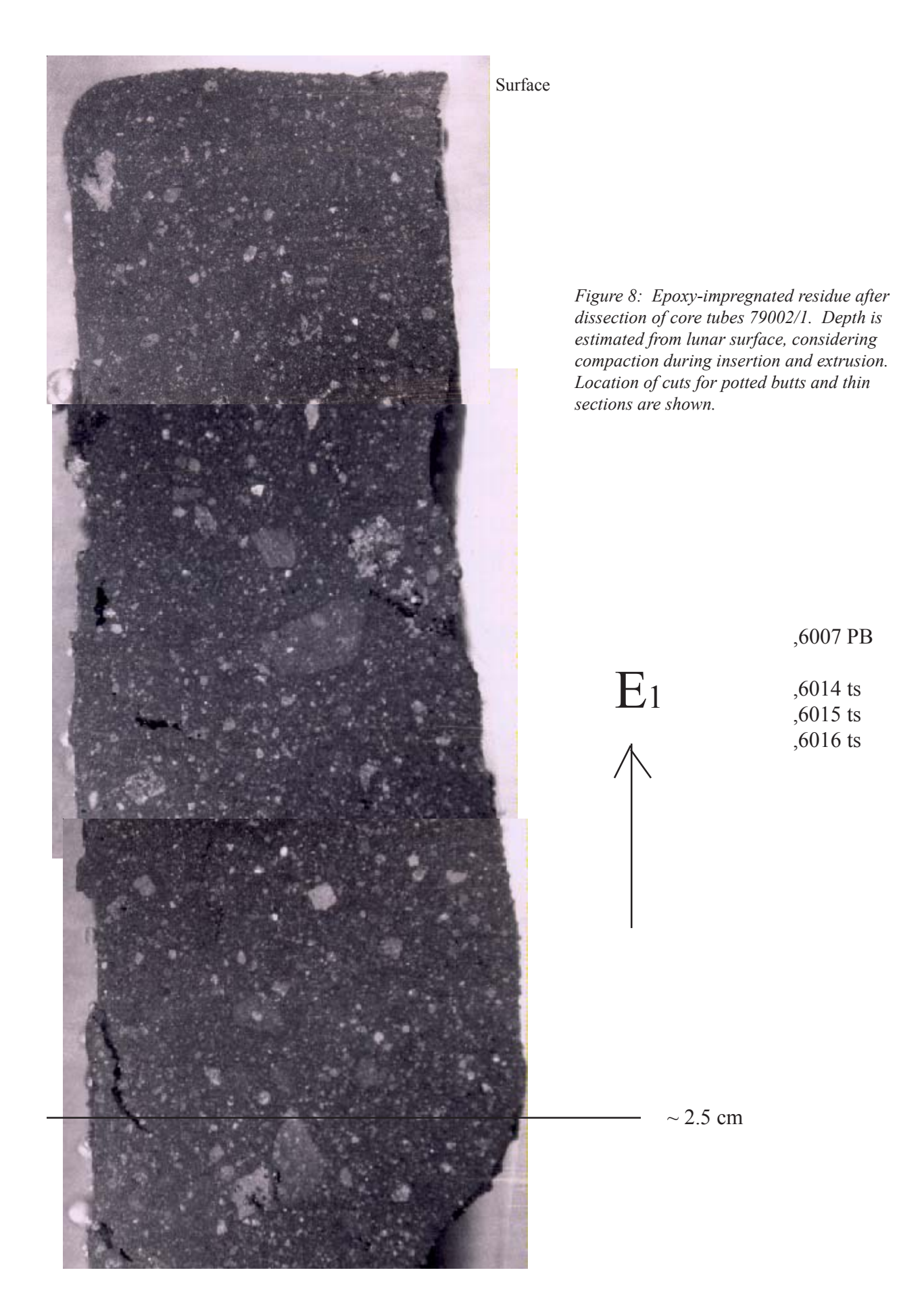
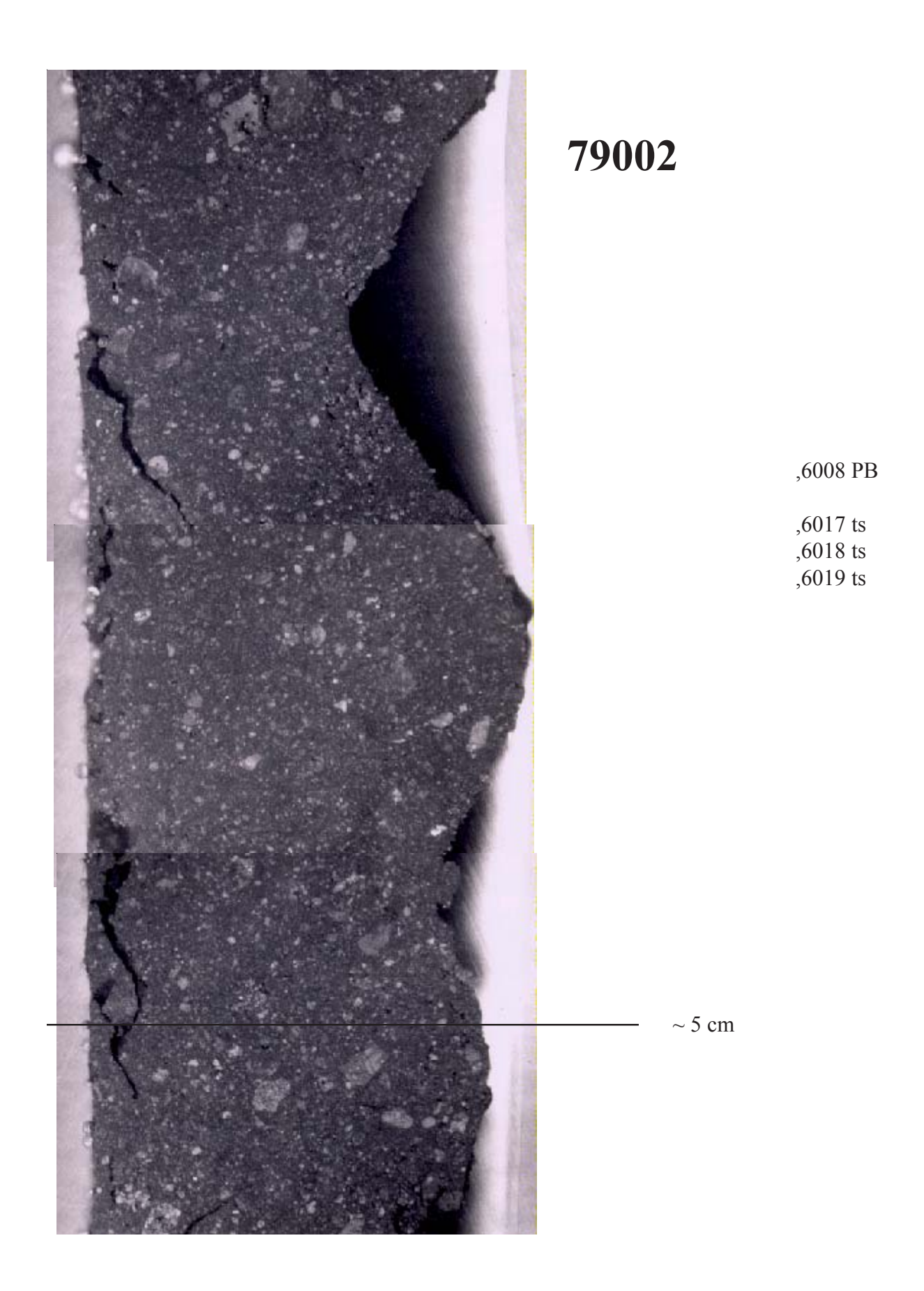
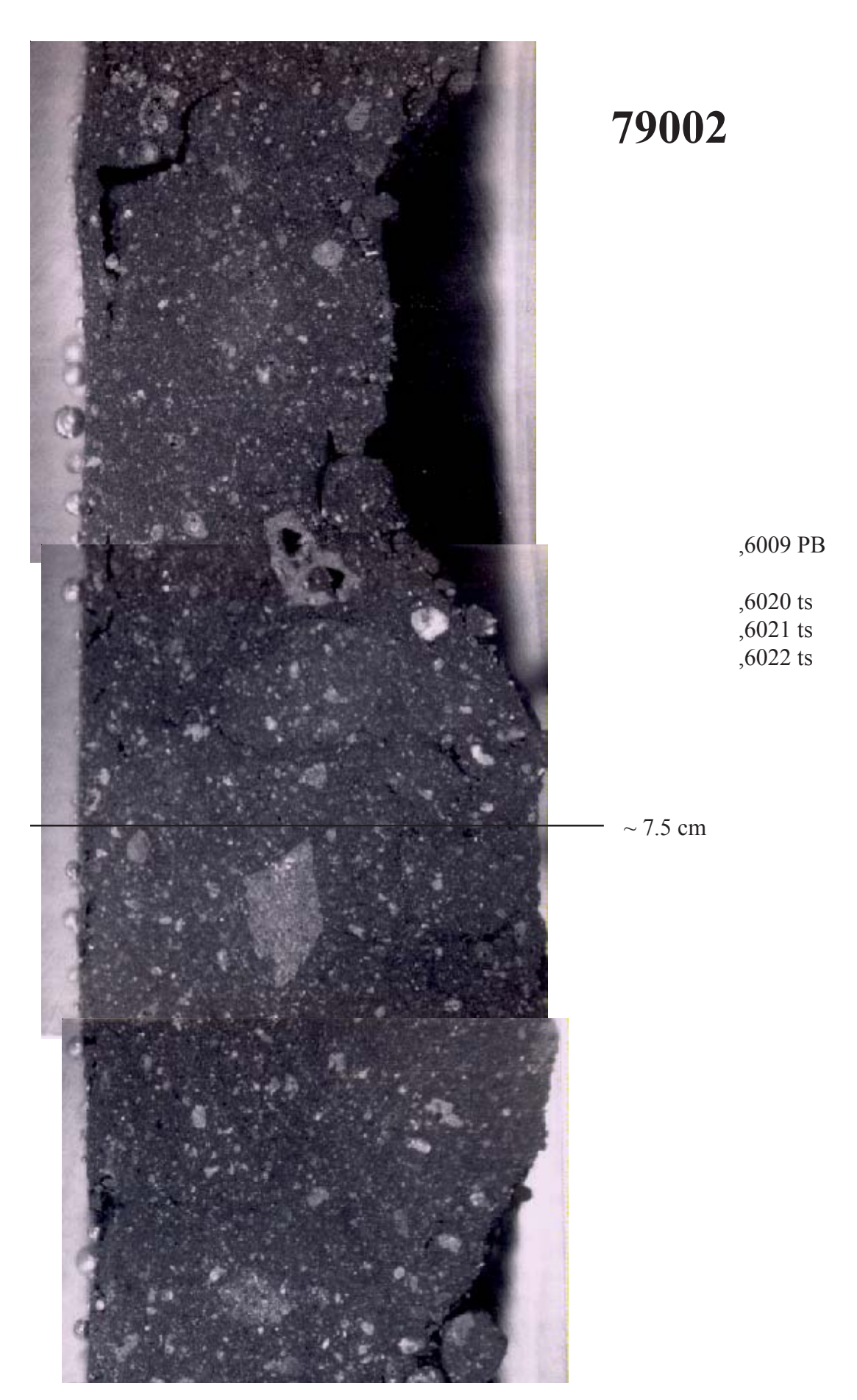
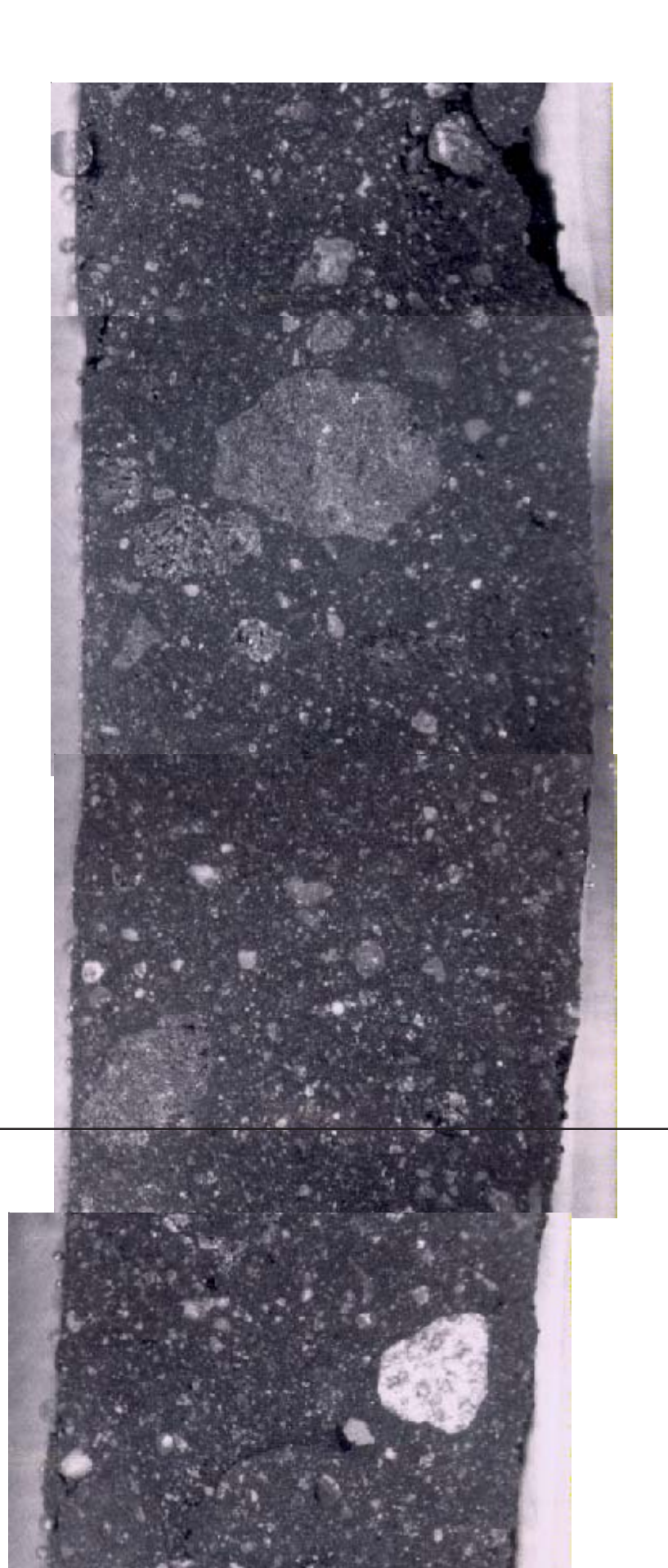
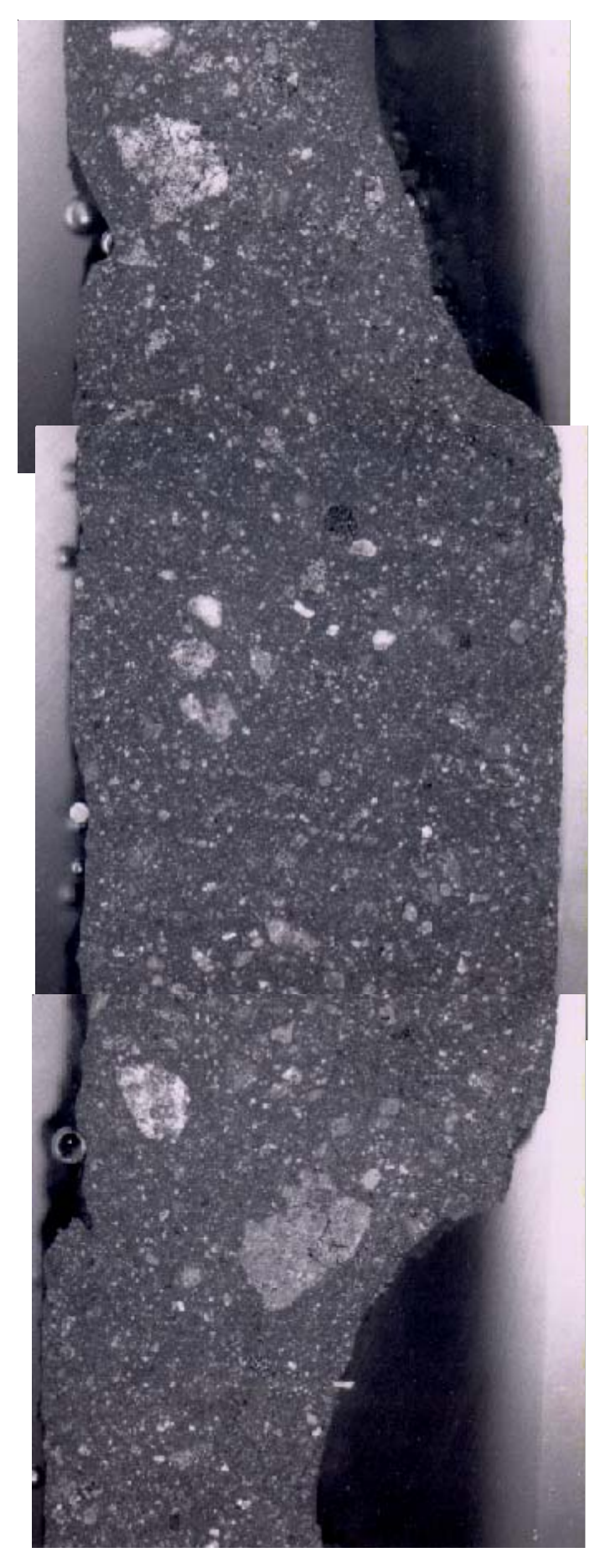
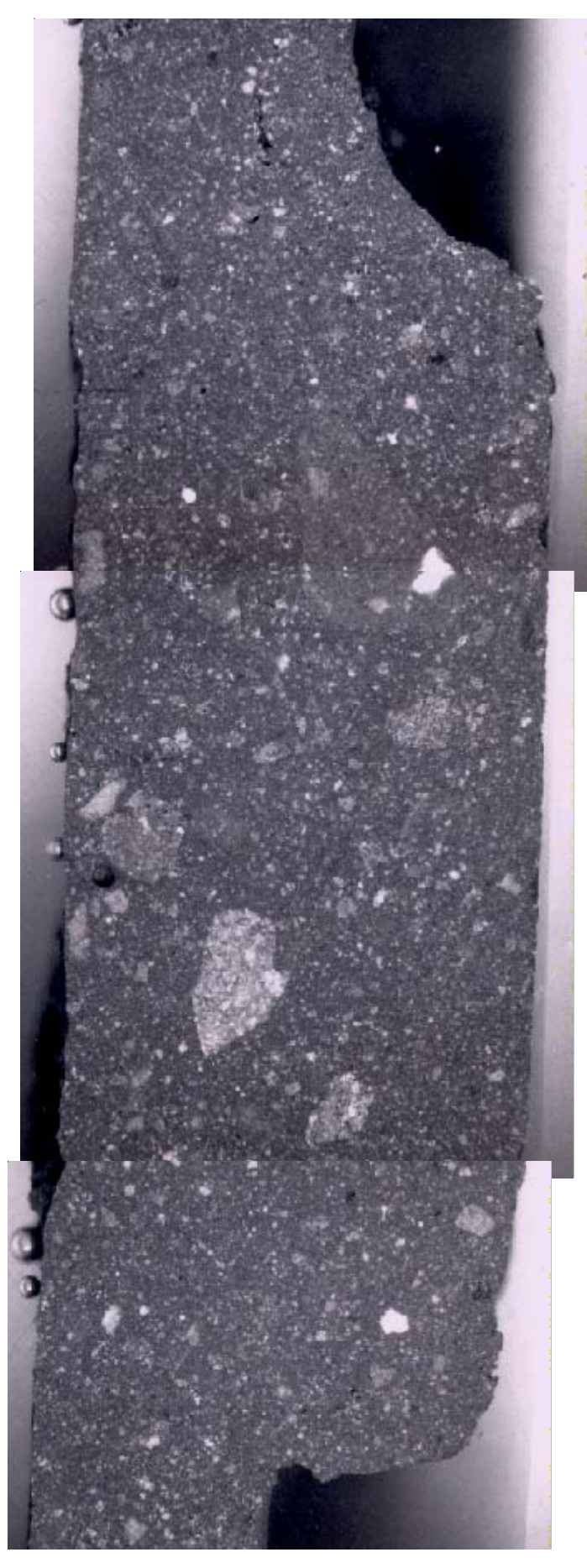
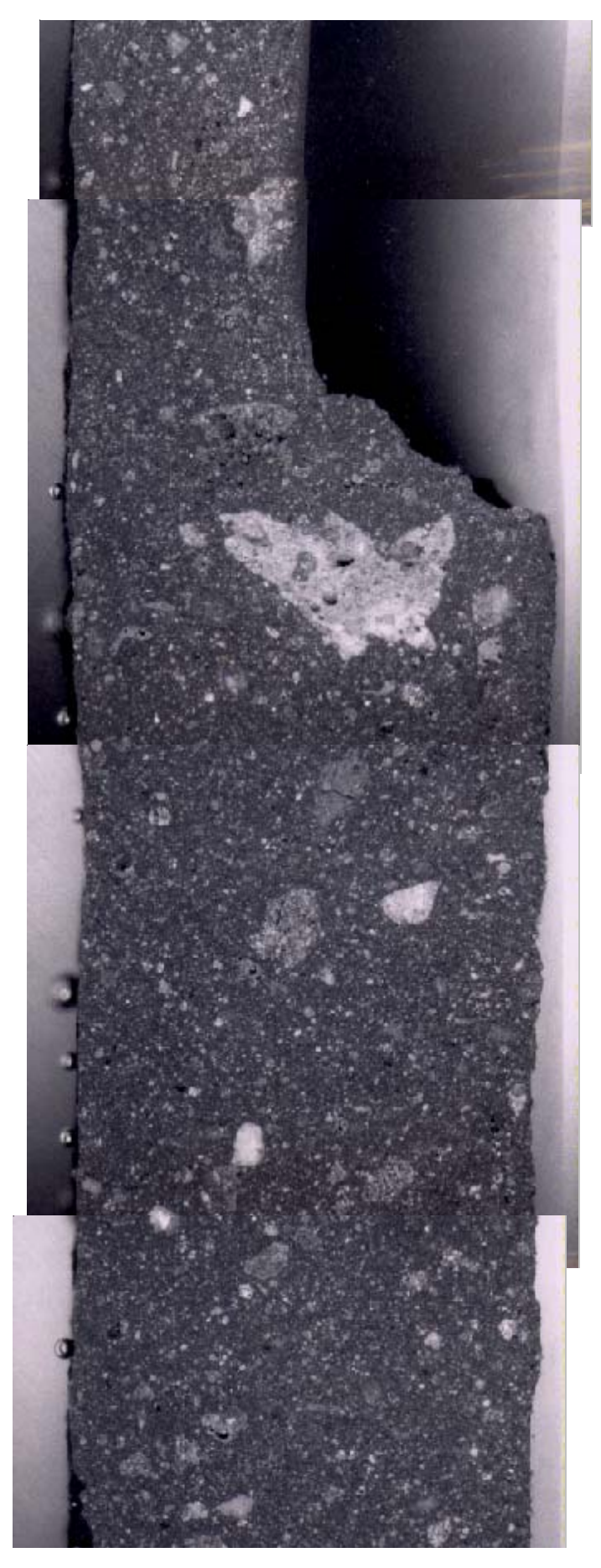
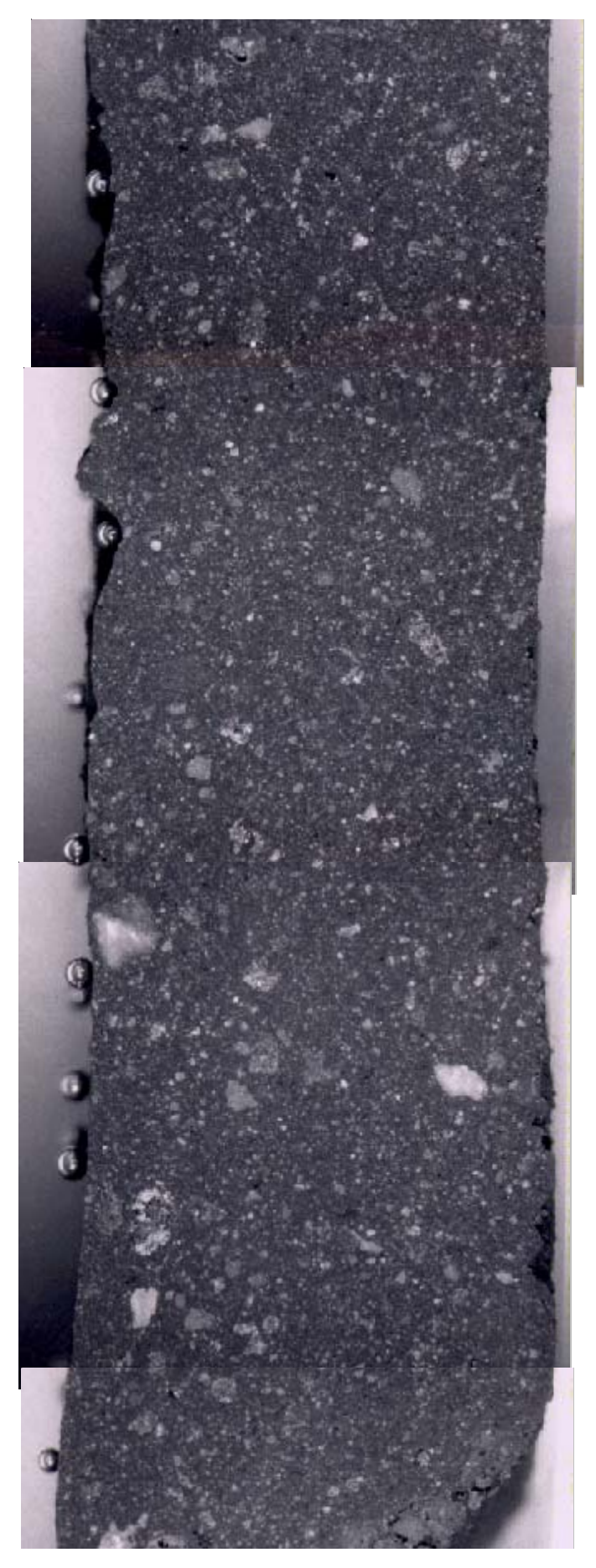
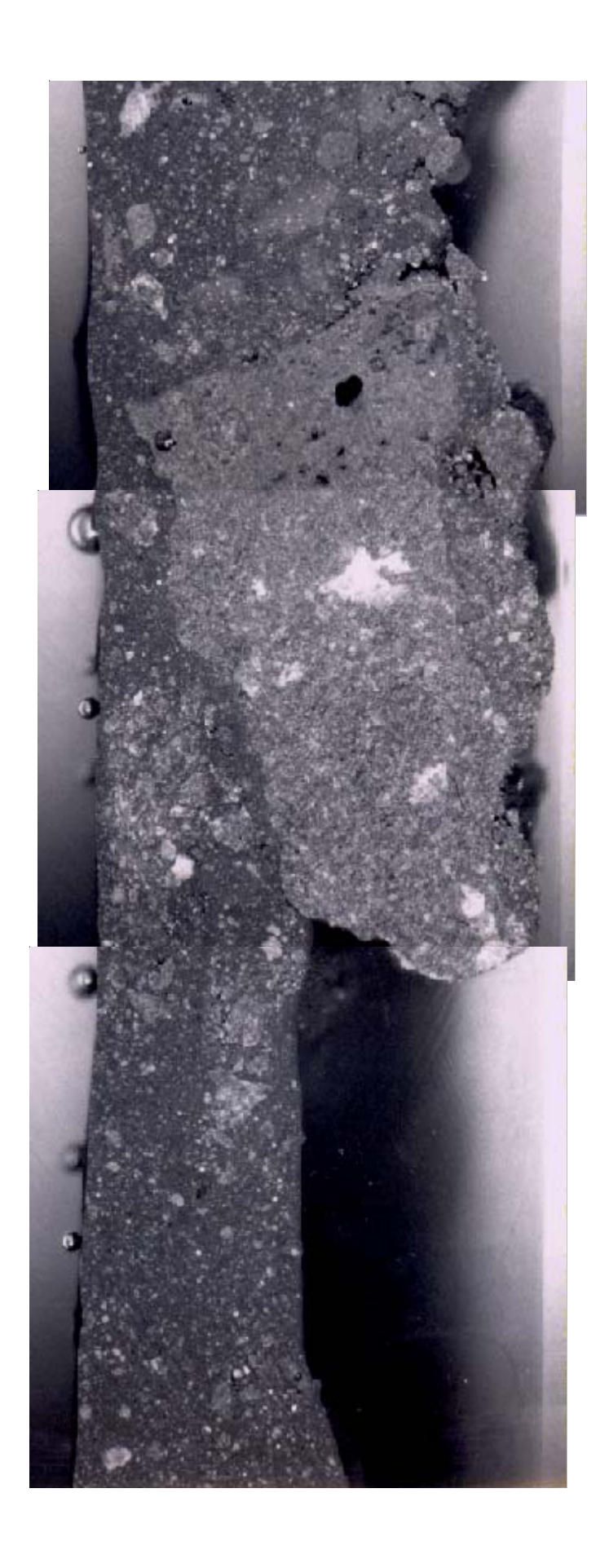
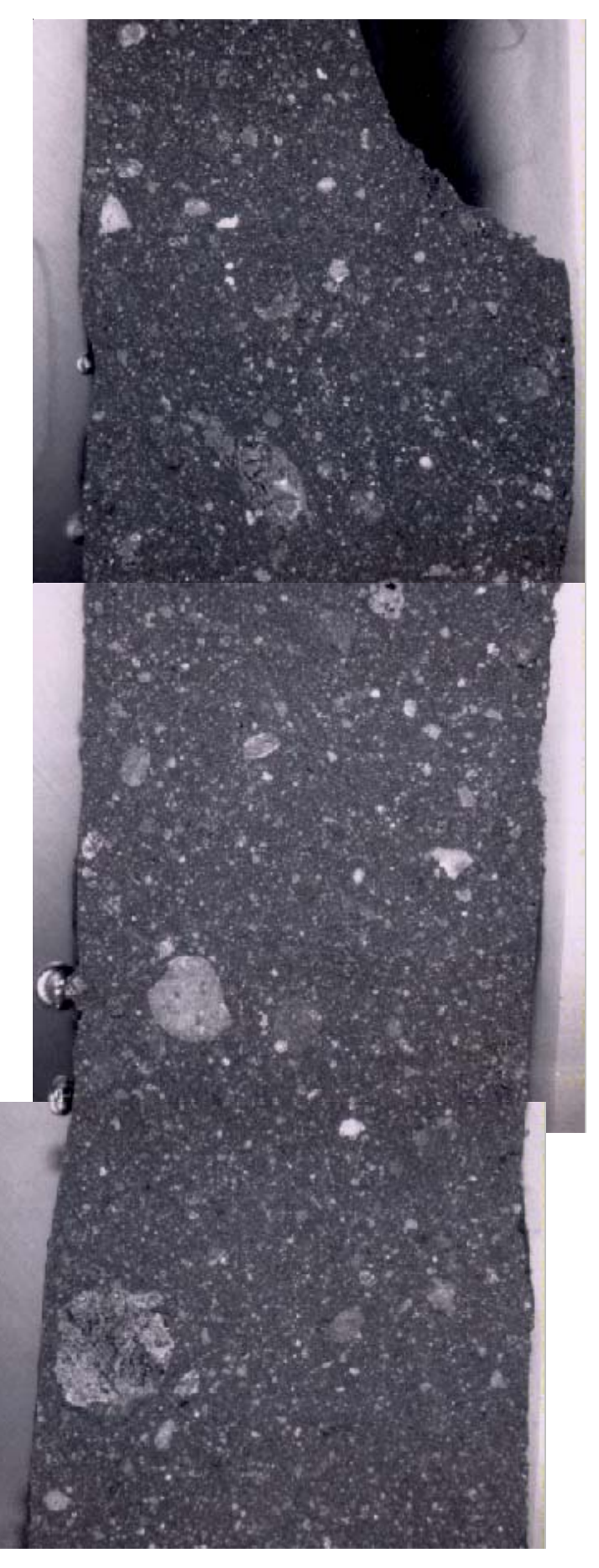
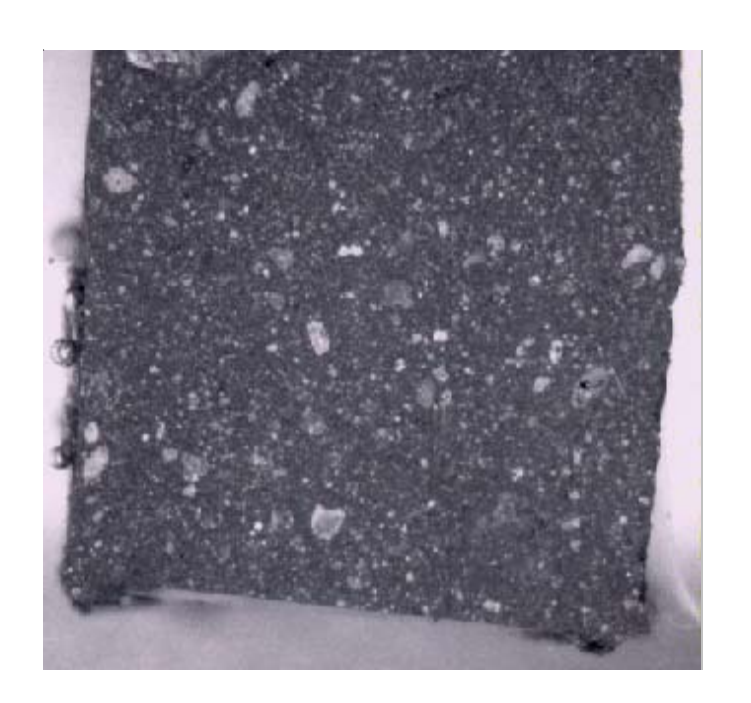
Three sets of thin sections were prepared from epoxyimpregnated residue (figure 8). A detailed petrological
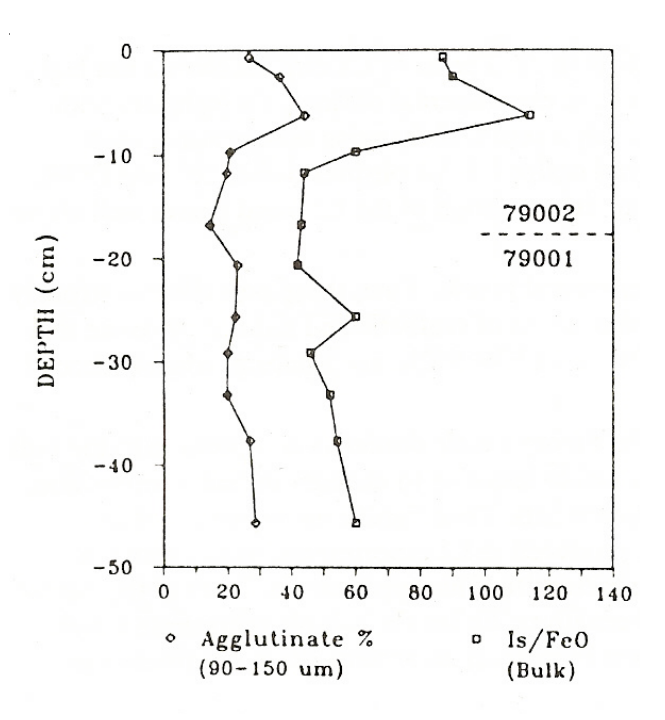
Figure 5: Agglutinate content of 79002/1 double drive tube (McKay et al. 1989).
study has not been performed on this core, presumably because the trench samples nearly were more interesting. Particles seen in figure 8 and those extracted during dissection have not been studied.
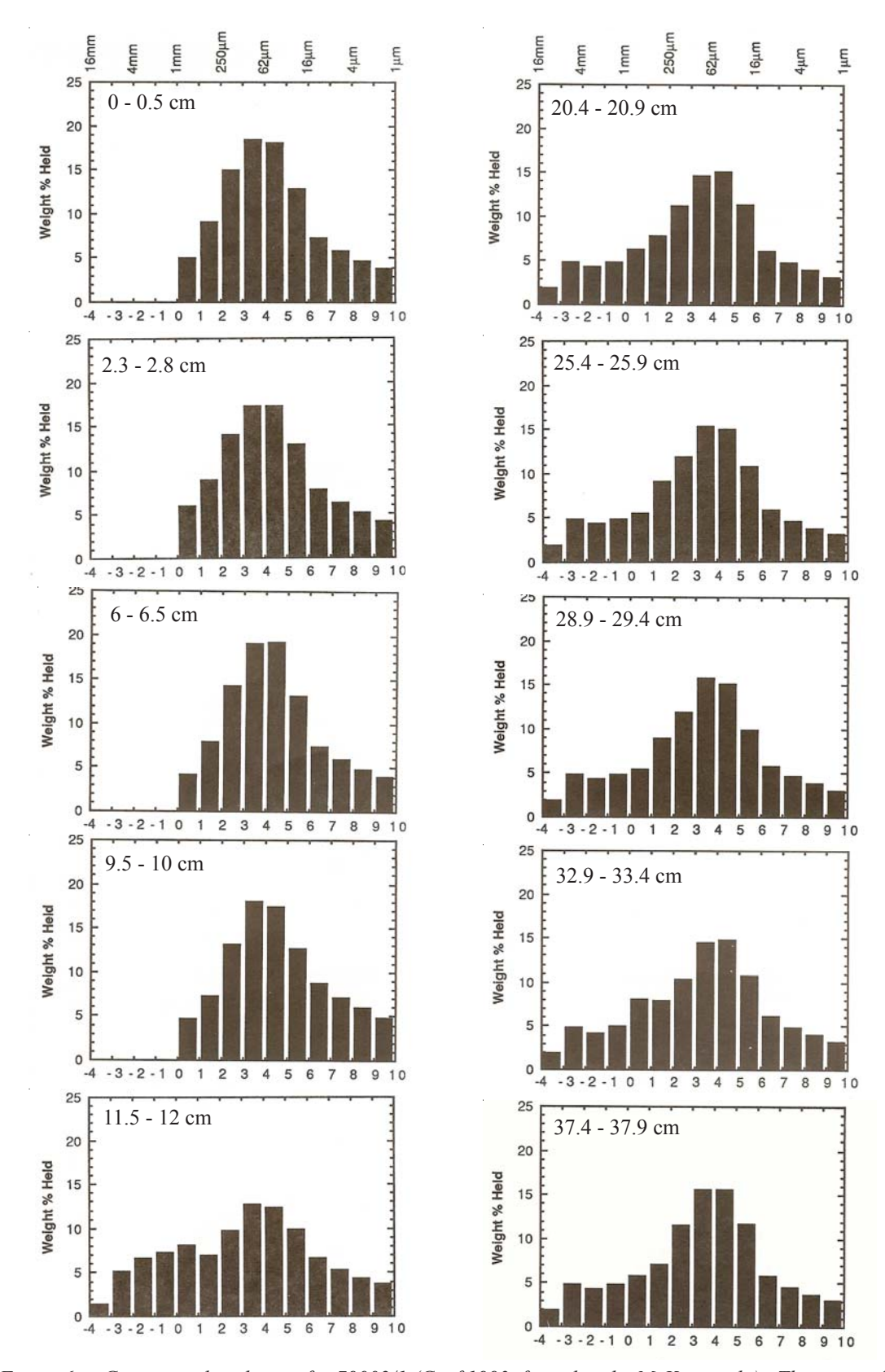
Figure 6a: Grain size distribution for 79002/1 (Graf 1993, from data by McKay et al. ). The coarse fines were handpicked because they were friable, thus causing an artificial “discontinuity” in the histogram.
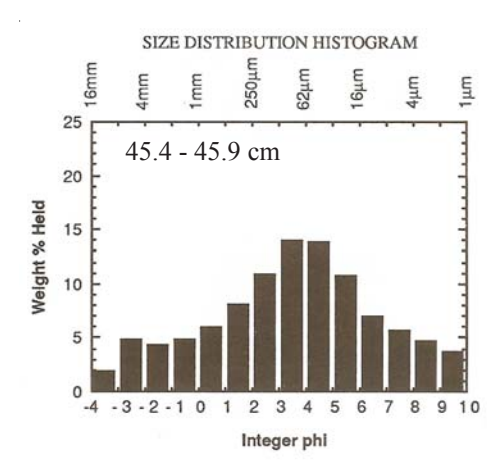
Figure 6b: Grain size distribution 79002/1 (cont.)
LSPET (1973c) Preliminary examination of lunar samples. Apollo 17 Preliminary Science Report. NASA SP-330, 7- 1—7-46.
McKay D.S., Wentworth S.J. and Basu A. (1988) Core 79001/2: An example of extreme mixing in the lunar regolith (abs). Lunar Planet. Sci. XIX, 758-759.
Mitchell J.K., Carrier W.D., Costes N.C., Houston W.N., Scott R.F. and Hovland H.J. (1973) 8. Soil-Mechanics. In Apollo 17 Preliminary Science Rpt. NASA SP-330. pages 8-1-22.
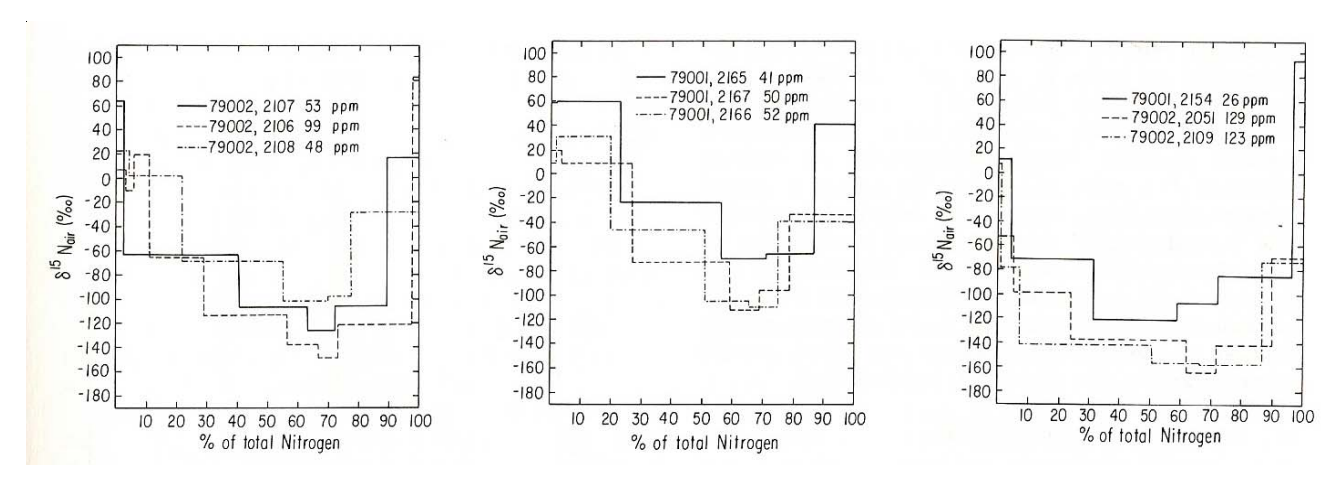
Figure 7: Nitrogen isotopes as function of release temperature for different subsamples of double drive tube 79002/1 (Stone and Clayton 1988).
References for 79001-2 core
Section titled “References for 79001-2 core”Butler P. (1973) Lunar Sample Information Catalog Apollo 17. Lunar Receiving Laboratory. MSC 03211 Curator’s Catalog. pp. 447.
Duke M.B. and Nagle J.S. (1976) Lunar Core Catalog. JSC09252 rev. Curators’ Office
Fryxell R. and Heiken G. (1974) Preservation of lunar core samples: Preparation and interpretation of three-dimensional stratigraphic sections. Proc. 5th Lunar Sci. Conf. 935-966. .Graf J.C. (1993) Lunar Soils Grain Size Catalog. NASA Reference Pub. 1265, March 1993
Korotev R.L. and Kremser D. (1992) Compositional variations in Apollo 17 soils and their relationships to the geology of the Taurus-Littrow site. Proc. 22nd Lunar Planet. Sci. Conf. 275-301.
LSPET (1973a) Apollo 17 lunar samples : Chemical and petrographic description. Science 182, 659-690.
Morris R.V., Korotev R.L. and Lauer H.V. (1989) Maturity and geochemistry of the van Serg core (79001/2) with implications for micrometeorite compositions. Proc. 19th Lunar Planet. Sci. Conf. 269-284.
Stone J. and Clayton R.N. (1989) Nitrogen isotopes in drive tube 79002/79001: Regolith history and nitrogen isotopic evolution in the solar wind. Proc. 19th Lunar Planet. Sci. Conf. 285-295.
Wolfe E.W., Bailey N.G., Lucchitta B.K., Muehlberger W.R., Scott D.H., Sutton R.L and Wilshire H.G. (1981) The geologic investigation of the Taurus-Littrow Valley: Apollo 17 Landing Site. US Geol. Survey Prof. Paper, 1080, pp. 280.
Table 1. Chemical composition of 79001.
| reference weight SiO2 % TiO2 | Morris89 average top | ave 18 mature | bottom ave 10 high La | |
|---|---|---|---|---|
| Al2O3 FeO MnO MgO | 15.6 | 15.6 | 14.9 | (a) |
| CaO Na2O K2O P2O5 S % sum | 0.4 | 0.406 | 0.41 | (a) |
| Sc ppm | 50.3 | 49.6 | 45.3 | (a) |
| V Cr Co Ni Cu Zn Ga Ge ppb As Se Rb Sr Y Zr Nb Mo Ru Rh Pd ppb Ag ppb Cd ppb In ppb Sn ppb Sb ppb Te ppb Cs ppm | 2924 36.1 186 | 2895 38.6 255 | 2783 38.1 218 | (a) (a) (a) |
| Ba La Ce Pr | 102 8.56 25.3 | 103 8.72 24.8 | 117 10.43 30 | (a) (a) (a) |
| Nd Sm Eu | 7.32 1.51 | 7.22 1.52 | 7.68 1.46 | (a) (a) |
| Gd Tb Dy Ho Er | 1.68 | 1.73 | 1.68 | (a) |
| Tm Yb Lu Hf Ta W ppb Re ppb Os ppb | 6.09 0.86 6.39 1.07 | 6.02 0.86 6.27 1.09 | 6.19 0.86 6.55 1.01 | (a) (a) (a) (a) |
| Ir ppb Pt ppb Au ppb | 6 | 7.7 | 8.7 | (a) |
| Th ppm U ppm | 1.06 | 1.08 | 1.5 | (a) |
| technique (a) INAA |
Lunar Sample Compendium C Meyer 2011
Lunar Sample Compendium C Meyer 2011
,60010 PB
,6023 ts
,6024 ts
,6025 ts
~ 10.5 cm
Lunar Sample Compendium C Meyer 2011
,6011 PB
,6026 ts ,6027 ts ,6028 ts
~ 12.3 cm
,6012 PB
,6029 ts ,6030 ts ,6031 ts
Lunar Sample Compendium C Meyer 2011
Lunar Sample Compendium C Meyer 2011
E1
CAUTION: A large amount of material middle may be missing!

Lunar Sample Compendium C Meyer 2011
Lunar Sample Compendium C Meyer 2011
Lunar Sample Compendium C Meyer 2011
Lunar Sample Compendium C Meyer 2011
Lunar Sample Compendium C Meyer 2011
Lunar Sample Compendium C Meyer 2011
Lunar Sample Compendium C Meyer 2011
bottom